


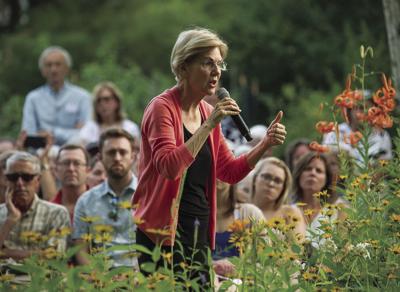
WOLFEBORO — Patricia Carney Dalton felt good Wednesday evening after listening to an Elizabeth Warren campaign speech that was part personal story and part specific policy prescriptions, including a new tax for the ultra wealthy.
Warren spoke to a crowd of about 400 in the backyard of a home owned by Rep. Edith DesMarais.
As Dalton walked back to her nearby summer home, she said she loved the speech.
“I know she has lots of plans but, as a teacher, you’ve got to plan,” Dalton said. “I like how she’s concise. She lays it out and she’s passionate.”
Those plans include one she rolled out a week ago for rural America, with elements that would benefit small-town New Hampshire, the Massachusetts U.S. senator said in an interview with The Laconia Daily Sun before her speech.
A primary tenet of the proposal is protecting access to health care in rural communities. That has been an issue in Laconia, where LRGHealthcare, faced with debt and struggling with the cost of providing uncompensated or undercompensated care, had to make cutbacks, including the elimination of labor and child delivery services. Hospital officials say they have been looking to merge with another health care organization.
“When hospitals close or when they shut down basic services like labor and delivery or emergency rooms, young families can’t move into an area and seniors often feel they have to leave in order to be closer to health care services,” Warren said.
“My plan starts with reversing the presumption on hospital consolidations from assuming they go through to assuming there are no consolidations unless the hospitals involved can demonstrate that access will be guaranteed into the future.”
She said her plan to provide Medicare for everybody would help rural hospitals.
“Small-town hospitals operate on very thin margins and that means they can’t absorb uncompensated care,” she said.
“Also, as a country, we need to be willing to make investments in rural hospitals and doctors and nurses to ensure there are enough available so that access is meaningful and easy for people in every corner of America.”
Her plan also calls for increasing the Medicare reimbursement rate for rural hospitals.
She wants to boost internet coverage in rural areas.
“It’s effectively impossible to participate in the 21st century economy without access to high-speed internet,” she said. “For years now, the federal government has been subsidizing giant telecom to get them to provide access in sparsely populated areas and they’ve pretty much failed to deliver. It’s time to take that money and invest it instead in local options.
"Municipalities and other community groups want to create public options for high-speed internet. Help them get that done. We need high-speed internet everywhere in America in the same way that a little less than 100 years ago we needed to make sure electricity was available everywhere in America.”
Her other plans include universal childcare, universal Pre-K, and canceling student loan debt — which Warren says would also inject money into the economy of small towns.
How to pay for all this? She has a plan for that, too: an annual tax on the richest 0.1 percent of Americans, which she said would generate $2.75 trillion in revenue over 10 years.
It would apply only to households with a net worth of $50 million or more. Households would pay an annual 2 percent tax on every dollar of net worth above $50 million and a 3 percent tax on every dollar of net worth above $1 billion.
During the speech, she revved up the crowd by touting her “ultra-millionaire tax,” at times holding two fingers in the air to emphasize how much could be done with a 2-pennies-per-dollar tax on the richest of the rich.
She held the crowd’s rapt attention with her personal story of growing up in difficult economic conditions as a child in Oklahoma but rising to become a teacher, a law professor and a U.S. senator.
When she was 12, her father, a building maintenance man, had a major heart attack and was out of work for a long time. Her mother had always stayed home to take care of Warren and her brothers.
“My mother used to tuck me into bed at night and I knew what would come next; she’d close the door, she’d lean back against it and she’d start to cry,” she said.
She recalls her mother getting out a dress and looking at her and saying, “We will not lose this house.”
Her mother put on the dress, walked to Sears and got a full-time minimum-wage job that kept the family solvent.
“For me, I thought, there it is, the story I learned from my mother, that no matter how hard it is, no matter how scared you are, when it comes down to it, you reach down deep and find what you have to find and pull it up and you take care of the people you love.”


(0) comments
Welcome to the discussion.
Log In
Keep it Clean. Please avoid obscene, vulgar, lewd, racist or sexually-oriented language.
PLEASE TURN OFF YOUR CAPS LOCK.
Don't Threaten. Threats of harming another person will not be tolerated.
Be Truthful. Don't knowingly lie about anyone or anything.
Be Nice. No racism, sexism or any sort of -ism that is degrading to another person.
Be Proactive. Use the 'Report' link on each comment to let us know of abusive posts.
Share with Us. We'd love to hear eyewitness accounts, the history behind an article.