


By ROGER AMSDEN, for THE LACONIA DAILY SUN
SANDWICH — More than 40 people showed up at Range View Farm here last Saturday and brought with them over 150 different types of apples as part of the Sandwich Apple Project, which has a goal of finding and preserving lost heirloom apples.
Martha Carlson, who along with her husband, Rudy, hosted the gathering, said that Ben Watson of Francestown, author of Cider, Hard and Sweet, helped people identify the apples by shape, color, taste, texture and even fragrance. Watson also brought along samples of 10 different heirloom varieties.
One heirloom apple which was brought to Saturday's event by Eleanor Jenkins of Eaton was tentatively identified as Spitzenburg, which was Thomas Jefferson's favorite apple. An aromatic apple with a sweet, spicy taste, the Spitzenburg was the ancestor of the Jonathan, which is the ancestor of today's popular Idared variety.
Carlson said that another one of the apples which was brought in and sampled was identified by Watson as most likely being a Smokehouse, a variety first identified in Pennsylvania in 1837. The local Smokehouse apple came from a twisted old tree on Image Hill, a historic dance hall in the Lower Corners. The tree, which is giving away to heart rot, still produces crisp red and tasty apples each fall, which Carlson says make great pies.
The tree was first brought to the attention of the town by Maggie Constantine and is one of nine old, unidentified apple trees whose twigs were grafted onto rootstock trees earlier this year after Constantine invited the Sandwich Agricultural Commission to take cuttings from the Image Hill tree.
The grafting session was the first step in the Agricultural Commission 's Sandwich Apple Project, which seeks to identify and preserve heirloom varieties which at one time flourished on farms throughout the town.
Carlson said she and her husband were assisted by in organizing Saturday's event by John Pries, a former information technology professional and entrepreneur, who last year left behind his corporate life in Boston and moved into a hill-side home on a dirt road in town and discovered an ancient orchard full of several varieties of apples unlike anything seen in the supermarket.
"Some of them are spectacular," Pries said. He was inspired to learn more about them and joined the town's agricultural commission, where he and Carlson created the Sandwich Apple Project.
Carlson said another variety which was identified was a Snow Drift crabapple, a small yellow apple with a red blush. She said that crabapples were frequently planted in orchards featuring other varieties in order to attract bees and other pollinators.
She said another heirloom apple, a very large red sauce apple that grows in veterinarian Julie Dolan's North Sandwich orchard, is also one of great interest.
Apples that were brought to the workshop were passed around for sampling, and many were pressed into cider. Late in the coming winter, scions will be cut from the trees that produced the preferred apples, and in April they'll be grafted onto root stock.
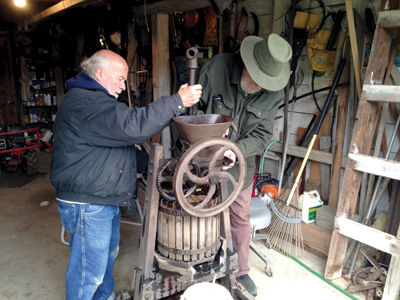
Jean Robichaud and Rudy Carlson make cider at Range View Farm in Sandwich. (Courtesy/Martha Carlson)
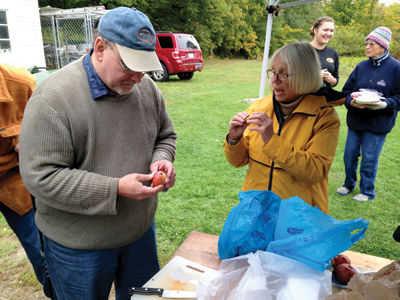
Ben Watson examines an apple found by Anne Hackl which she brought to the Sandwich Agricultural Committee's Apple Project Saturday at Range View Farm in Sandwich. (Courtesy/Martha Carlson)


(0) comments
Welcome to the discussion.
Log In
Keep it Clean. Please avoid obscene, vulgar, lewd, racist or sexually-oriented language.
PLEASE TURN OFF YOUR CAPS LOCK.
Don't Threaten. Threats of harming another person will not be tolerated.
Be Truthful. Don't knowingly lie about anyone or anything.
Be Nice. No racism, sexism or any sort of -ism that is degrading to another person.
Be Proactive. Use the 'Report' link on each comment to let us know of abusive posts.
Share with Us. We'd love to hear eyewitness accounts, the history behind an article.