


LACONIA — At 12:45 p.m. yesterday, a tornado tore through a neighborhood by Crystal Lake, flattening a crowded pavilion and felling trees across the roadway, blockading the victims from emergency responders.
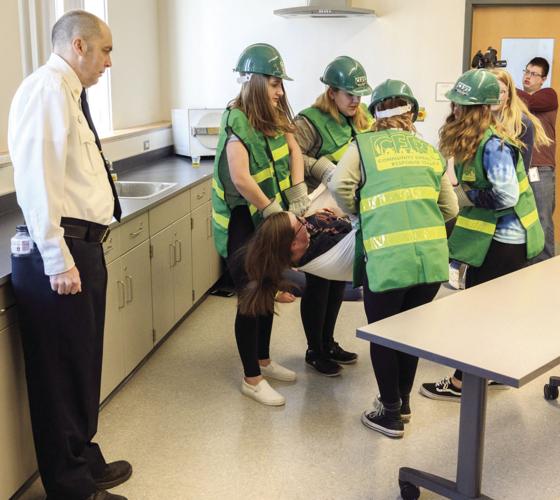
At least, that was the scenario that was put together in order to test the skills of students in the Law Enforcement and Health Science classes at the Huot Technical Center, who for the last month have been the first group in the state to take a community emergency response curriculum specifically designed for teenagers.
Students played the role of residents of that neighborhood, who split up into teams to tackle various aspects of a complicated emergency. One team had to extinguish a fire at a utility box so another crew could cut power to a line that had fallen amid the debris, which was burying victims with varying degrees of injury. Meanwhile two women ran around the scene, one looking frantically for her young son, another overcome by the news that her parent was one of those deceased.
The event was the culmination of a new collaboration between the Huot Center and the Partnership for Public Health. The class was sparked about a year ago by a conversation between Gina McGuire, health science teacher at the Huot, and John Beland, emergency preparedness and response director for PPH.
During March, McGuire’s health science class joined with the law enforcement class, taught by Bill Clary, for two or three sessions per week. The curriculum included topics such as disaster preparedness, fire and utility control, disaster psychology and search and rescue.
Observing the students respond to the disaster were Jay Ellingson and Kirk Beattie, assistant chief and chief at the Laconia Fire Department. The scenario was spread out over two connecting classrooms. A large storage room represented the collapsed pavilion. It was dark, the door was blocked by an obstacle and the room was filled with debris and victims.
While watching students take control of the situation, Ellingson said they were navigating challenges that are common in disaster situations.
“They’re learning how to move in the dark, with limited access,” he said. Meanwhile, another student, playing the role of a distressed mother, was yelling at them. “She’s missing a child, she’s upset, grabbing rescuers, distracting their focus.”
It’s a chaotic scene with many different tasks demanding immediate attention. When such a mass casualty incident occurs, having a team of trained civilians – such as the Lakes Region Community Emergency Response Team – can be a life-saving advantage for first responders, Beattie said.
“The CERT Team that we have help us out in a lot of ways that free us up to do other specific tasks,” Beattie said. CERT members can help direct traffic, help with evaluations of patients, and staff a rehab center for first responders. “They’ve been invaluable to us.”
For many of the students involved in the program, the simulation gave them a taste of what their career choice might entail. Aiden Dube, an 11th grader from Inter-Lakes High School, was on the emergency medical service team during the simulation. He said the sense of urgency during the simulation underscored his desire to become a trauma surgeon.
“I knew I wanted to become a doctor, I knew I wanted to do something in emergency (medicine), the more real stuff, being the second person to see them after the first responders,” Dube said. “This whole thing was a lot of fun.”
Caitlin Beattie, a Laconia student and daughter to the fire chief, said she wasn’t sure if she wanted to follow in her father’s footsteps or pursue a career in nursing. Her experience in the simulation resonated with something in her genes.
“I was kind of on the fence between being an ER nurse or a paramedic, this gave me the feel of being on the scene,” she said.
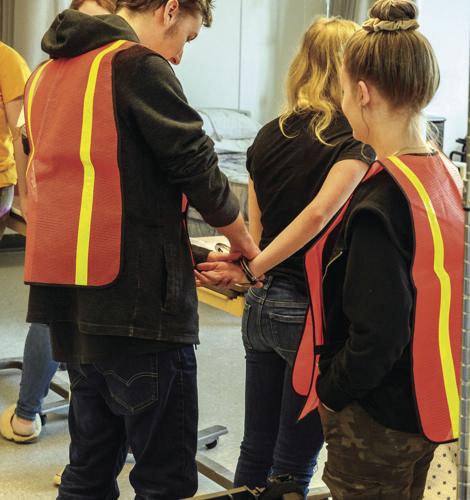
Maeghan Ash, also of Laconia, played the frantic mother, who became so disruptive that she was placed in handcuffs. She said the event made her feel assured in her aspiration to become an emergency room nurse. “I always wanted to be a nurse because I want to help people. To help save that person, I think is so cool.”
Following the conclusion of the class, Beland said he plans to spend the summer tweaking the lesson planning and bring it back for another group of students next year.
“My goal with this program is not necessarily to have these people join our CERT team – although I would love it if they did – I’m just trying to make our population in general better prepared for emergencies.”


(0) comments
Welcome to the discussion.
Log In
Keep it Clean. Please avoid obscene, vulgar, lewd, racist or sexually-oriented language.
PLEASE TURN OFF YOUR CAPS LOCK.
Don't Threaten. Threats of harming another person will not be tolerated.
Be Truthful. Don't knowingly lie about anyone or anything.
Be Nice. No racism, sexism or any sort of -ism that is degrading to another person.
Be Proactive. Use the 'Report' link on each comment to let us know of abusive posts.
Share with Us. We'd love to hear eyewitness accounts, the history behind an article.