


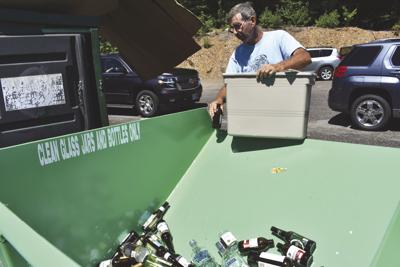
Pauline Doucette of Laconia speaks for a lot of people when she says she’s disappointed with the city’s decision to have residents throw their bottles away, rather than recycling them.
Laconia isn’t alone in making that decision, though. Faced with budget-busting increases in the cost of recycling, communities across the state have been debating whether it makes more sense to abandon their recycling efforts and simply toss everything into the solid waste bin.
Gilford no longer allows glass in its single-stream recycling program, but rather than having residents throw it in with other solid waste, the town is stockpiling the glass in preparation for eventually crushing it and using it as aggregate for road and sidewalk construction.
Michael Durfor, executive director of the Northeast Resource Recovery Association, which monitors solid waste and recycling trends, said communities can save $100 per ton by removing glass from the recycling stream.
Durfor emphasized that recycling remains profitable for those who are able to separate items, and he advocates “source separation” — keeping plastics, cardboard, glass, and aluminum in separate recycle streams. Doing so requires a lot of space, though, and he said some communities do not have enough available land to successfully operate such a program.
That does not mean they should abandon recycling, he said.
“The cheapest way to get rid of used oil is to dump it on the ground, if you’re just going to count beans,” he said. “It’s not the right thing to do, and those things have a cost.”
Single-stream recycling is a popular method for handling recyclables, because it is easy for residents and does not take up a lot of space. The recyclables go to a distribution center where workers do the separation.
Because recycling involves hauling costs that are charged by the ton, removing the glass makes sense. What to do with that glass becomes the question.
The town of New London has a successful glass-crushing operation and, by accepting glass from other towns, New London no longer has a need to purchase gravel for its roads. Processed glass is created from silica sand, and crushing it produces particles the size of silica sand which can be used as a base for paving projects or mixed into concrete. There also is an interest in using it for fiberglass insulation.
Officials from the town of Bristol visited New London to see how it handled the glass as selectmen ponder the best course of action. Town Administrator Nik Coates has estimated that Bristol will exceed its solid waste budget by $25,000 if it continues its single-stream recycling, even after separating out the glass. There is a separate bin to handle the glass, and it took only a little more than a month to fill the first container.
It costs half as much to dispose of solid waste, but selectmen have been reluctant to give up recycling for fear that residents would not resume recycling if the market returns. They have discussed holding a public hearing to hear what residents want to do.
Laconia's solution
Jennifer Anderson of Laconia said she doesn’t feel right about throwing bottles in the trash.
“Just because there’s no market for it doesn’t mean it’s not the way to go forward,” she said. “For the most part, glass is 100 percent recyclable, so going into a landfill, that means filling up more space, and that has its own consequences.”
Durfor said that, with New England landfills closing or reaching capacity, there is a possibility that, within the next eight to 10 years, there will be 5 million tons of solid waste with nowhere to put it.
“If you know you’re going to have a shortfall in space to get rid of trash, you want to preserve that as much as possible,” he said.
Durfor predicts that the shortfall will mean higher prices for solid waste down the line, so simply putting recyclables in with regular trash will hasten that day and wipe out any short-term savings realized from not recycling.
Anderson says that tossing out glass might impact the environment in ways we don’t realize, by encouraging other forms of containers that would be harmful if burned.
“This is not just a local problem here,” she said. “We should find what other inventive ways we might use glass.”
She praised it for being the most versatile container for storing things because it can be cleaned and refilled.
“It seems the perfect solution for everyday life,” she said. “We don’t want to be encouraging people to be making plastic; we need to be really imaginative about what we can do with glass.”
Laconia City Manager Scott Myers said he initially heard from people upset at the idea of throwing away glass, but that seems to have died down.
“We understand the value of recycling,” he said, “but right now, the logistics of the whole single-stream recycling is a money-loser, even after removing the glass.”
During the last fiscal year, the city faced more than a $50,000 impact from rising recycling costs, Myers said, but by underspending in some other areas of the budget, Laconia ended up with a $20,000 shortfall which the City Council made up for by transferring money at the end of the year.
With the glass being the heaviest item, removing it from the single-stream will reduce some tonnage, he said, but the costs also have increased beyond what the city anticipated when preparing the new budget last April and May.
“We’re just now tracking to see the impact of the remote recycling locations that are not operating,” Myers said. “We’ll see how much of that might be ending up in curbside pickup and how much more weight we’ll see in solid waste.
Myers said smaller towns are better able to have people go to a facility and sort the recyclables. Because Laconia offers curbside pickup, it faces a significant challenge in trying to encourage more sorting. Putting out separate bins for residents would require an additional truck and more staff, and not everyone would have the space to store the extra containers, he said.
“It would require a significant buy-in from the community,” Myers said, “and I’m not sure it would be more cost-effective.”
Myers said that, if another community was able to offer a space for residents to voluntarily drop off the glass, “we’d love to hear from them.”
Another thing that might help, he said, is for the New Hampshire Department of Transportation, which establishes the specifications for asphalt, to include glass in the mix.
“That would create a demand for glass to be crushed,” he said. “That would involve much more than just Laconia, and they also would need a place to source the material, but such a solution could have some merit."





(0) comments
Welcome to the discussion.
Log In
Keep it Clean. Please avoid obscene, vulgar, lewd, racist or sexually-oriented language.
PLEASE TURN OFF YOUR CAPS LOCK.
Don't Threaten. Threats of harming another person will not be tolerated.
Be Truthful. Don't knowingly lie about anyone or anything.
Be Nice. No racism, sexism or any sort of -ism that is degrading to another person.
Be Proactive. Use the 'Report' link on each comment to let us know of abusive posts.
Share with Us. We'd love to hear eyewitness accounts, the history behind an article.