


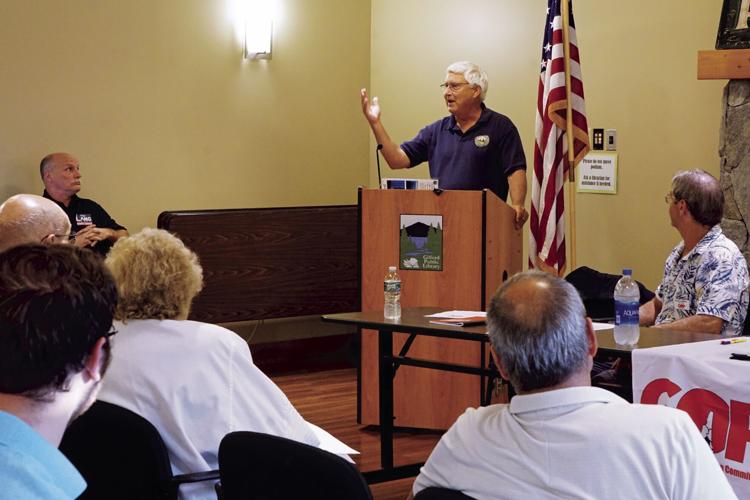
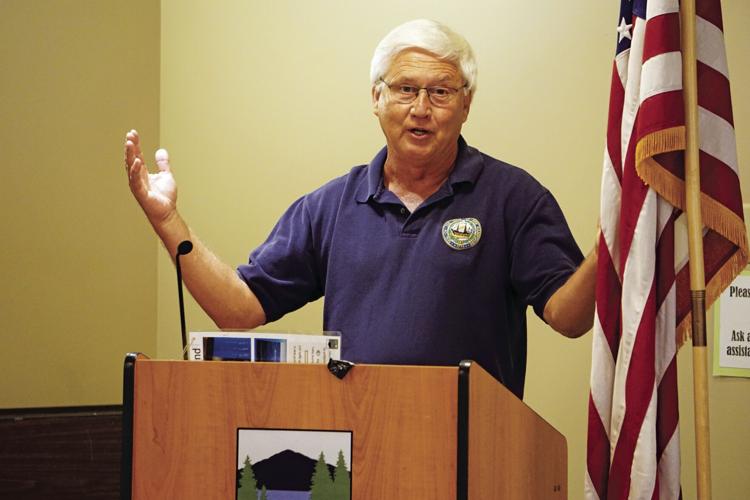
GILFORD — To accomplish their policy goals, Republicans in Concord need one thing: unity. That was the pitch Republican gubernatorial candidate and former Senate President Chuck Morse made to a small crowd of party members and elected officials at the Belknap County Republican Committee’s meeting Wednesday night.
“The House was so close this year that, at times, the Democrats ran the House,” Morse said when describing his candidacy’s purpose. Despite party support for a parental rights bill, he continued, it failed. “We couldn't get it passed. We couldn't get it passed because we didn't have enough Republicans, never mind conservative, like-minded people.
“I asked you to come along with me in this journey to be the governor of the state of New Hampshire, because I think I've proven as a state rep., as a senator and Senate president, that I can get the job done,” Morse said. “I can get those votes across the line. And I can get us thinking together and working together and solving problems.”
Morse, who noticed his candidacy for the Republican gubernatorial nomination mere hours after Gov. Chris Sununu announced he wouldn’t seek a fifth term, was a longtime member of the state Legislature. He served as a state representative from 1998 to 2002 and as a state senator from 2002 to 2006, and again from 2010 to 2022, serving two stints as Senate president along the way. Morse narrowly lost the Republican senate primary to Don Bolduc last year.
In his presentation on Wednesday, Morse made it clear he’s running on his track record as both a legislator and a leader: he highlighted his contributions to budget development and his list of policy accomplishments while in the Senate.
Morse told a story of Republican momentum during his tenure: from his return to the Senate in 2011 — when “we had to cut that budget by $800 million because the Democrats had drove the state in a hole so deep we couldn't get out of it” — to his departure in 2022, the state had become “the envy of the Northeast and probably the nation” because of its lowered business taxes, low unemployment rate and balanced budget.
“This was no accident,” he said.
In response to an audience questions, Morse touched on hot-button issues this year that he would revive or continue to support as governor: he pledged to continue providing financial support to the state’s northern border, advocated making education freedom accounts accessible to all students regardless of income and said he would sign a parental rights bill “tomorrow” if he could.
In typical form for New Hampshire voters, attendees across the board said it was too early to have a favorite in the so-far two-candidate gubernatorial primary, though they all singled out Manchester Mayor Joyce Craig as the Democratic candidate they opposed most strongly.
Former U.S. Senator and NH Attorney General Kelly Ayotte is the only other Republican to have announced in the race for governor, though other candidates who have hinted at a potential run include Education Secretary Frank Edelblut.
Some attendees favored Morse because of his extensive state — rather than federal — experience, while others admired Ayotte’s lofty resume.
Former Gilford School Board Member Kyle Sanborn said he, though undecided, favored Morse because he had not been tarnished by time in federal government and seemed “genuine.”
“I like him a little bit better, because he hasn't been to Washington,” Sanborn said. “[Ayotte] went down to Washington, and she didn't vote all the time the way that I thought she would.
“He's a New Hampshire guy through and through.”
Paul Lange, BCRC treasurer, said he admired Ayotte’s tough-on-crime stances as state attorney general. Lisa Freeman, a former state representative and school committee member in Manchester now living in the Lakes Region, pointed to Ayotte’s Senate service as a positive accomplishment.
“We just need to stop the shenanigans,” Freeman said. While Sununu took a more collaborative approach, she said, “I want to see a governor who will lay down a harder line.”
Attendees described the prospect of a competitive and open primary in the race to succeed four-term incumbent Sununu with earnest excitement, speaking highly of both candidates. They emphasized accessibility and a solid disposition to withstand scrutiny as nonpolicy priorities. Debate performance, they agreed, will be telling.
“This will be a close one for all of us,” Freeman said.


(0) comments
Welcome to the discussion.
Log In
Keep it Clean. Please avoid obscene, vulgar, lewd, racist or sexually-oriented language.
PLEASE TURN OFF YOUR CAPS LOCK.
Don't Threaten. Threats of harming another person will not be tolerated.
Be Truthful. Don't knowingly lie about anyone or anything.
Be Nice. No racism, sexism or any sort of -ism that is degrading to another person.
Be Proactive. Use the 'Report' link on each comment to let us know of abusive posts.
Share with Us. We'd love to hear eyewitness accounts, the history behind an article.