


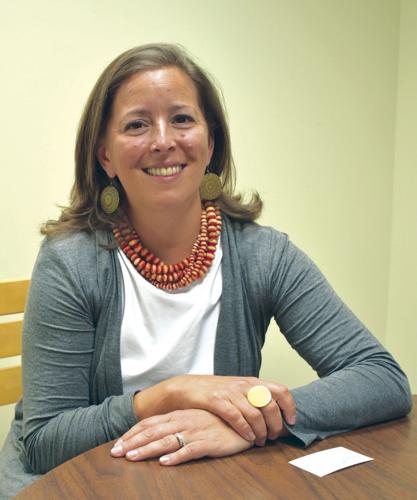
PLYMOUTH — Helping students find their own passions while encouraging them to embrace others’ cultural traditions is among the attractions for Alexa Schmid in her career as an international educator.
“I love middle school kids,” she said during an interview at Plymouth State University, where she is working on her doctorate in education. “They’re awkward and moody and have their ups and downs, but they are finding their passions and we focus on ‘what do you love?’”
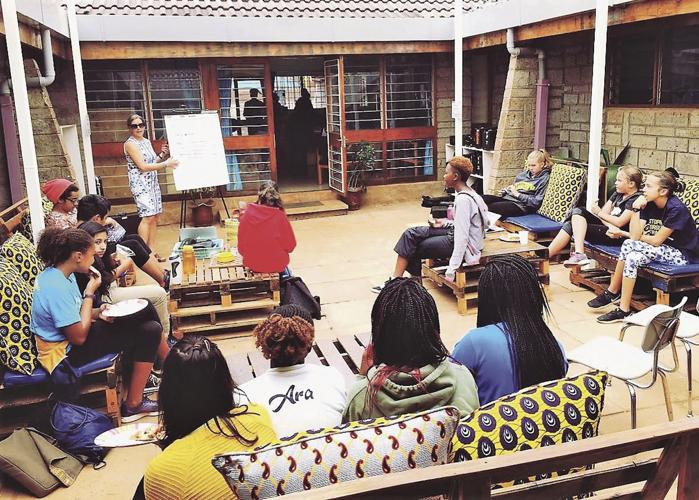
Schmid has carried her own love – teaching – overseas, where she serves as principal of the International School of Kenya and where her creative approach to education has led the U.S. Department of State to name her its first International Principal of the Year — an award she shares with another principal in Chennai, India.
She will be traveling to Washington, D.C., in September to participate in the National Association of Secondary School Principals’ National Principal of the Year program, networking with her peers and participating in professional development.
In nominating her for the honor, the school’s director, David Henry, cited her ability to find creative solutions to engage her students, who come from some 65 nations. Most are the children of diplomats, and the diverse population presents challenges and opportunities.
“I try to focus on both diversity and convergence,” Schmid said of the school, which brings together different cultures, religions and holidays.
In working to provide opportunities for global citizenship, Schmid assisted students in planning and leading a “plastic protest” on Earth Day, and in presenting a single-use, plastic-free proposal to the school’s director. She leads a diversity working group to improve cultural competency, global citizenship and diversity in staffing to support the students.
An environmental class designed a video game, and a design triathlon aimed to help students solve problems.
“It does take a unique teacher to connect with this age group,” Schmid said, but, growing up as the daughter of a middle school teacher, she had a head start.
Finding her path
Schmid said she took a varied path to where she is now, first by attending Duke University after graduation from Plymouth Regional High School. She changed her major, giving up the opportunity to study abroad at that time, but after graduating she went into the Peace Corps, living in a small village with no electricity in Zambia, in Southern Africa. She learned the language and helped subsistence farmers with fish farming, agroforestry, animal husbandry, and agricultural practices.
She had been exposed to travel earlier, with her mother’s sister living in Italy and making a trip to Greece, “so I grew up appreciating travel,” she said. However, it was her time in the Peace Corps that convinced her to seek work overseas.
She went to Cairo, Egypt, as a middle school mathematics teacher while working on a master’s degree in education at Plymouth State University, taking online courses and attending in person during summer breaks. During her six years in Egypt, she met her future husband, another international teacher, from Montana.
She went on from Egypt to the American Embassy School in New Delhi, India, where she spent eight years and became interested in administration. She earned a certificate of advanced graduate studies from PSU, taking on the role of assistant principal.
“It was a great first step,” she said, before going on to seek her doctorate and become principal of the International School of Kenya, a private school established jointly by the U.S. Embassy and the Canadian High Commission.
“It’s a nice post,” Schmid said. “There’s a neat spirit in the community to make Kenya a better place.”
Challenges
The biggest challenge of being in an international school is the transience of both students and teachers. Students may attend for one, two, or three years, and teachers may be there only twice as long.
“How do you build a community and make it stable?” Schmid asked.
The political situation in Kenya also changes. There have been violent and peaceful elections, and Schmid said that disrupted the school during her first semester, including frequent closures.
“But the school takes care of the community, with lots of security,” she said. “They’re friendly people, and the day-to-day interactions are positive.”
The school offers intercultural trips and camping adventures to complement the classroom experience, and teachers are able to integrate the latest research into their curriculum.
As a private school, it is “accountable, but not reliant on U.S. testing,” Schmid said. “We follow all the research by choice, and are rich in resources. … We’re able to make choices with fewer strings.”
She said she has a lot of appreciation for the teachers in international schools.
There are perks, as well. There are opportunities for travel during vacations and there are frequent three- and four-day breaks that have allowed Schmid and her family to make excursions and do things like shark cage diving.
“What has kept us overseas, 19 years in all, are the opportunities for travel and expanding our world view and raising our kids there,” Schmid said.
Her twin daughters will be going into seventh grade at the International School, she said.
Professor Marcel Lebrun, who directs the Doctor of Education in Learning, Leadership and Community Program at Plymouth State University where Schmid is pursuing her doctorate, said the institution “is proud to play a supporting role in her story, ensuring that she has the training and resources to be successful in Kenya, and wherever life — and her career as an educator — may take her next.”
PSU recognizes that the world for today’s students is much smaller, said Peter Lee Miller, the school's communications manager, and it is trying to become more of an international institution, attracting students from all over. The online and in-person opportunities that Schmid has utilized help to make that possible.
“As an institution, we stress cultural competence and diversity tolerance,” Miller noted, and Schmid said there are several international doctoral students in her program.
As for being named International Principal of the Year, Schmid said, “It is an honor to be recognized with this award. I’ve been fortunate to have some amazing mentors who have helped at every step of my career.
“I am also fortunate to have found a program — right in my own childhood backyard of Plymouth — that gives me the flexibility to live my dream of teaching abroad, working with students from different backgrounds, and making a global impact, while continuing my education.”
“I encourage people to try to travel as much as possible,” she said. “And I encourage students to study abroad.
“Education is our future,” she said, “and the kids of diplomats are already making a difference. I talk to the kids and say, ‘You’re an ambassador for your country.'"


(0) comments
Welcome to the discussion.
Log In
Keep it Clean. Please avoid obscene, vulgar, lewd, racist or sexually-oriented language.
PLEASE TURN OFF YOUR CAPS LOCK.
Don't Threaten. Threats of harming another person will not be tolerated.
Be Truthful. Don't knowingly lie about anyone or anything.
Be Nice. No racism, sexism or any sort of -ism that is degrading to another person.
Be Proactive. Use the 'Report' link on each comment to let us know of abusive posts.
Share with Us. We'd love to hear eyewitness accounts, the history behind an article.