


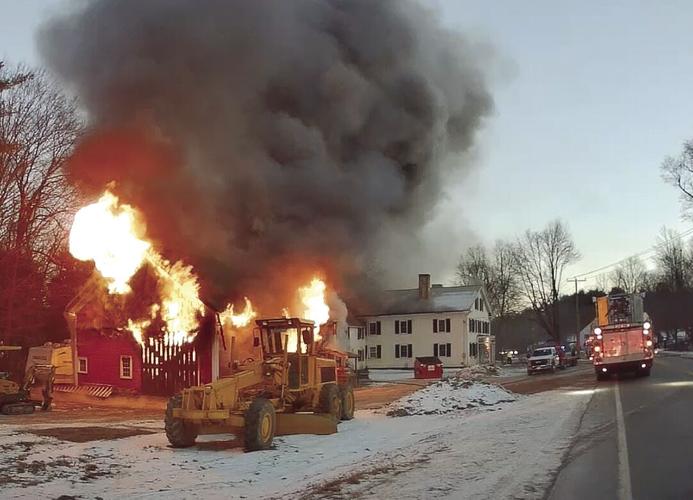
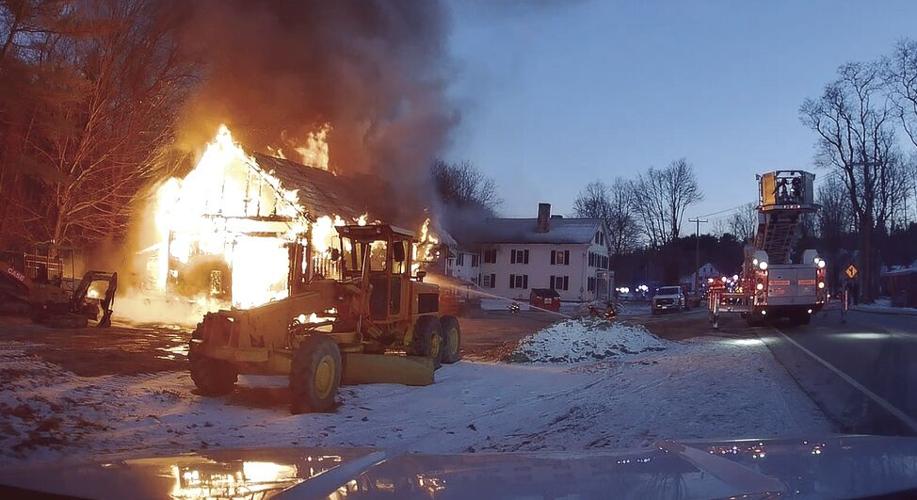
FRANKLIN — There were no injuries following a barn fire on South Main Street on Wednesday, which took two hours to contain.
The fire department was dispatched to the fire, in a barn attached to a house at 4:30 p.m. on Jan. 15, at 916 S. Main St. The first engine arrived on scene in about 5 minutes, with heavy fire on display, and firefighters requested additional assistance. Two hose lines were deployed. The fire was put out roughly two hours later.
“We arrived with heavy fire and went right work,” Fire Captain Dan Chapman wrote in a press release.
“The department is lucky to have a great turnout from our off-duty and part-time staff members.”
No occupants, firefighters or pets were injured. The cause of the fire is under investigation, but it appears to be accidental.
“The amount of fire was overwhelming for the amount of staff we had, and we were also trying to keep the fire from spreading from a barn to go in inside the house. And to do that, that's labor,” said Fire Chief Mike Foss.
“It's manpower intensive, so we had to throw a lot of manpower in between.”
Franklin was assisted on scene by the Bristol, Tilton-Northfield, Sanbornton, Belmont, Hill Boscawen, New Hampton, Laconia, Gilford and Concord fire departments, and Lakes Regional Mutual Fire Aid. Three additional calls were received and handled by the Andover and Laconia departments and Penacook Rescue Squad. Chief Deborah Black of Belmont and Chief Scott Cathy of New Hampton also assisted with the additional calls.
The home was spared from the fire, but there was significant smoke damage. Foss estimated the large flames were in part due to the typical old frame construction of barns, with timbers that are dry and a large open space.
“And traditionally, everything's open, so it allows for fire spread to go pretty quickly through all those timbers. Because it gets so much oxygen and wind and everything else to kind of fuel it, between that and the dry timbers,” he said.
Captain Tom Hegener is the fire inspector for the Franklin Fire Department. He explained an investigation is a long, lengthy process. Hegener gets to the scene as early as possible to witness the fire and its behavior, which allows him to correspond with the patterns later observed during the investigative process.
He eventually speaks with bystanders, the property owner, witnesses and the 911 caller, and obtains witness statements. He will also make diagrams or sketches of the scene based on notes, then will do a safety inspection on the building before entering for the investigation. Hegener will then identify the area of origin, then start the investigation from the furthest point, working his way back to the origin point to cover the entire area. He can then attempt to determine the cause of the fire.
“We use a very indepth methodology to review everything, so that's why it takes so long,” Hegener said. “There's a lot of data to go through, and it's a matter of trying to disprove various hypotheses along the way. It's just time consuming.”
With an increase in fires in Franklin keeping the fire department busy, Foss offered advice on fire safety. He suggests people use mechanical system heating in their homes, rather than portable space heaters, especially ones that are not UL listed, which is a safety certification mark that indicates the product passed certain safety tests. He also emphasized the importance of working smoke and carbon monoxide detectors in the house.
“The biggest message, and I know it sounds simple, is really just working smoke detectors in a home really do save lives.”




(0) comments
Welcome to the discussion.
Log In
Keep it Clean. Please avoid obscene, vulgar, lewd, racist or sexually-oriented language.
PLEASE TURN OFF YOUR CAPS LOCK.
Don't Threaten. Threats of harming another person will not be tolerated.
Be Truthful. Don't knowingly lie about anyone or anything.
Be Nice. No racism, sexism or any sort of -ism that is degrading to another person.
Be Proactive. Use the 'Report' link on each comment to let us know of abusive posts.
Share with Us. We'd love to hear eyewitness accounts, the history behind an article.