


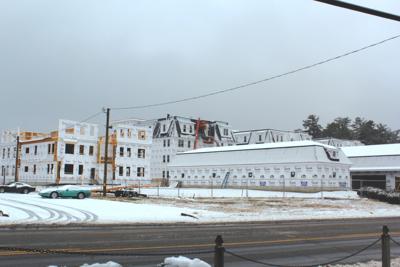
LACONIA — Thanks to a group of conflicting market segments and pandemic pressures, affordable rentals and homes are almost nowhere to be found within the Lakes Region, let alone Laconia. It's a big problem, and there isn't a clear solution.
“We have not created any significant new units of housing in the city over the past several years, particularly in the mid-price point situation,” said Dean Trefethen, Laconia’s Planning Director. Instead, developers had focused on luxury condos, lakeside homes for retirees and high-priced homes for the wealthy.
“So traditionally, the Lakes Region has been a hub for retirement,” explained Chris Roche, associate broker at Roche Realty Group in Laconia. “That is a segment of people that have saved their whole lives, they have lots of cash. They want first floor master bedrooms, maybe beach access to go along with it for their grandkids to come up and use the property. That’s one market segment. The other market is the second home segment, which is looking for a similar product, but not necessarily all the retirement requirements.”
What these two segments have in common is wealth, which not only increases prices, but also eats up a majority of available construction labor.
“Most of the construction here in New Hampshire, unfortunately, especially in the last five years has been mostly limited to the upper middle and high end market,” said Frank Roche, Chris's father and owner of Roche Realty Group. “There’s a lot of wealth demanding construction, and those contractors are tied up. Some of them are two to two and half years out to start a house. The smaller guys that used to do affordable housing, they’re all wrestling with the same problem, which is increased building supplies, increased cost of subcontractors, limited amount of inventory, high cost of land, so they’re in a dilemma where they can’t build affordable housing.”
According to the Roches, there are economic benefits from wealthier parties moving into the area, such as increased spending at local businesses, charitable giving, employment generation and a higher tax base.
“The increased tax base and opportunities are all true to a point,” said Trefethen, “but the opposite side of that is when people come up here and buy a very expensive home, they are not really contributing to the economy of the city on a large basis. Yes, they may go out to restaurants and those kinds of things, but those are exactly the kinds of jobs we have the hardest time filling, and the employees are the ones having the hardest time finding a place they can afford.”
“That’s been a dilemma in all these areas. They can’t locate employees within close proximity and give them adequate housing,” Frank Roche acknowledged. Another factor cited by the father-son team was rigid regulations, and a lack of infrastructure like sewer lines and road access to encourage building outside the city center. This forces developers to take on the cost of putting in sewer or septic systems and other infrastructure, thus increasing their risk factor and hesitancy to invest.
All of these issues are putting an extra squeeze on what the Roches call the primary market, which covers ordinary working residents and locals.
“That market is changing as well,” Chris Roche said. “We’re starting to see a lot of those people come from other areas, out of state specifically to escape COVID. What’s happening in the last 10 years or so, those markets are starting to butt heads a little bit, and that’s put a lot of upward pressure on sales.”
Laconia’s situation is far from unique regarding COVID migration. According to the Pew Research Center, roughly one in five Americans has relocated due to the pandemic, or know somebody who has. The prospect of new blood in the community only piled on to the already competing retirement and second home markets.
“It started out first with the second home market being the strongest in the area,” Roche said. “Then the retirement market started increasing, and those two markets started competing for the same properties.”
There is another, more controversial factor placing a tight squeeze on the housing market: temporary rentals, like Airbnb and VRBO, or contractor rentals are sucking up available inventory and jacking up prices.
“That’s one of the biggest trends we’re seeing, the Airbnb phenomenon, where people take a basic house or condo or apartment in a house, and they convert it to weekly rentals,” said Frank Roche. “It’s caused a huge displacement of existing inventory that normally would have gone on the market as for sale as a single family home but now that consumer can rent the house and generate a substantial cash flow to run it like a mini motel. It’s become a very popular investment vehicle. It’s also a controversial investment vehicle.”
When asked exactly how much inventory has been eliminated due to vacation rentals, Roche answered, “Nobody’s capsulized it, but just go on Airbnb or VRBO and check the listings. You’ll be amazed.”
As of December 2, 2021, a generic Airbnb search for Laconia turns up over 300 results.
In addition to big name temporary rental companies like VRBO and Airbnb, many local landlords have converted ordinary housing units into furnished, high-priced temporary rentals meant for high-paid temporary workers like travel nurses and contractors.
“The hospital is the largest employer in the Lakes Region,” said Chris Roche. “The thing they struggle with is maintaining employees and not wanting to hire full-time employees, what they’ve resorted to is a lot of travel nurses.”
Although travel nurses are temporary employees that don’t require their hospitals to pay benefits, they have salaries that can be double or even triple what a long-term full-time nurse makes. Hospitals around the country are suffering from a nursing shortage, and have been willing to pay the higher price for traveling professionals.
“What it does to the local markets is you have a person coming here making six figures as a nurse and that person can afford a significantly higher cost rental,” Chris Roche said. “It creates a very healthy market as a landlord to rent specifically to that type of person, but it does create a lot of competition for locals.”
As for controlling or curbing these short term rentals, the city is virtually powerless.
“In the case of folks that are renting to contract workers that are here for a month or two, they really do not come under our regulations, they’re just a rental unit at that point in time,” said Trefethen. “Our short term lodging ordinance covers only 15 days or less. It was designed primarily to combat the weekly vacation/weekend situation, the thought at the time was, ‘if you're renting for more than 15 days, it's probably not a vacation rental, it's probably something else.’”
According to both Trefethen and the Roches, the obvious solution is more housing, but so far there doesn’t seem to be a concrete solution.
"A healthy rental market would be a 4-5% vacancy rate.” Trefethen stated. “We have not seen that in the city for years now. Laconia is not unique; this is a problem throughout the state.
In the long run it’s not sustainable. It’s a problem that needs to be addressed. But we don’t have the solution for it yet.”


(1) comment
There is a simple solution. Penalize people for selling out their fellow citizens. Add a crippling tax to renting to Massholes and the like, short term or long. Do the same for housing sales and all of a sudden there are plenty of places to rent and buy for people from the granite state.
Welcome to the discussion.
Log In
Keep it Clean. Please avoid obscene, vulgar, lewd, racist or sexually-oriented language.
PLEASE TURN OFF YOUR CAPS LOCK.
Don't Threaten. Threats of harming another person will not be tolerated.
Be Truthful. Don't knowingly lie about anyone or anything.
Be Nice. No racism, sexism or any sort of -ism that is degrading to another person.
Be Proactive. Use the 'Report' link on each comment to let us know of abusive posts.
Share with Us. We'd love to hear eyewitness accounts, the history behind an article.