


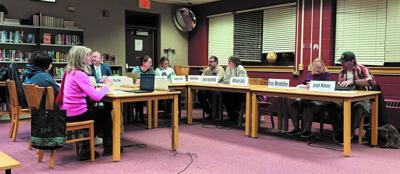
BRISTOL — As the Newfound Area School Board prepared to sign a five-year extension of the district’s transportation contract with First Student, Inc., on Feb. 10, Superintendent Paul Hoiriis pointed out it represented a savings of $86,587 from what was originally proposed.
“So they’re showing that they are working with us,” he said.
During the district’s deliberative session on Feb. 1, Hoiriis cited a 35% increase in transportations costs, due to the terms of the latest Teamsters collective bargaining agreement and the need for First Student to replace aging buses. He said was hoping to achieve some savings in further discussions with bus contractor.
The new agreement, which will be effective from July 1, 2025, to June 30, 2030, now represents a 28% increase from the prior contract in costs per run. It begins with a daily rate of $390.80 for regular routes, increasing to $551.64 in the final year of the contract. The rates are slightly less for special education transports and offer a minimum rate of $139.52 for athletic and extra-curricular trips. The shuttle to career and technical education is $227.64.
Hoiriis said the district now owns two vans that will be able to do some of the extra-curricular transports to save even more.
First Student also agreed to conduct an annual route efficiency study, which Hoiriis said is especially important with the changes in the makeup of the school district. Bridgewater, Groton and Hebron are leaving the Newfound Area School District to operate a new Pasquaney School District.
Hoiriis said First Student will continue transporting Alexandria students currently enrolled at the Bridgewater-Hebron Village School to that facility as part of the new bus contract at no extra cost. Newfound and Pasquaney have agreed to allow students currently enrolled in district schools to continue attending those schools after the split in a “tailoring out” memorandum of understanding.
The school board unanimously approved the contract extension.
Also related to the split, the Newfound board signed a separate memorandum of understanding that allows Bridgewater-Hebron Village School students to take part in Newfound athletics and extra curricular activities at a cost of $200 per pupil per season for each activity.
School funding petition
Responding to a request for support, the school board voted to allow members to sign an online petition urging Gov. Kelly Ayotte and the New Hampshire General Court to follow the recommendations of an education task force in an effort to relieve the school funding burden that falls on local property taxpayers.
The State of New Hampshire pays the lowest portion of education funding in the country, leaving the burden of supporting public education on those who pay property taxes. In 2019, the New Hampshire Legislature established an independent Commission to Study School Funding to review the state’s existing school funding formula and make recommendations “to ensure a uniform and equitable design for financing the cost of an adequate education.” After meeting for eight months, the commission concluded the current public school funding system should be reformed.
Among the findings was that there should be increased state funding to communities with the greatest student needs, “which will also result in greater taxpayer equity by reducing disproportionate burdens on poorer towns”. It also recommended eliminating the “excess-SWEPT” grant and reapplying the excess funds from the statewide education property tax to communities most in need, as envisioned when the tax was implemented. “There should be no blanket rebates, abatements, refunds, or grants,” the commission wrote, adding, “The state should enhance taxpayer equity through property tax relief targeted to homeowners and renters and introduce a property tax deferral program.”
The letter urging school board members to join the online petition continued, “During the Legislature’s work in 2024, there were several bills aimed at reducing that burden and sending aid to districts and students that needed it the most. Despite strong bipartisan support in the House, these bills were killed by the Senate and failed to become law. Meanwhile, all of us at the local level have continued working hard for our schools and communities to try and balance the needs of our students and the economic realities faced by our taxpayers. Inflation, energy costs, and unpredictable special education expenditures have put strains on our budgets, and the state has provided no relief.”
Actual costs of public education averaged $21,545 per pupil during the 2023-24 school year, while the average state aid to local schools was only $5,148 per pupil.
“Our local property taxes cover 70% of all school revenues in the state, the highest share in the country,” the letter went on to say before concluding, “The future of our state and our communities depends on the state contributing to a well-funded public education system.”
Not only school board members from around the state had signed the letter; some selectboard members, mayors and city councilors also signed it.
In discussing the request, Francine Wendelboe of New Hampton pointed out the funding issue is now before the New Hampshire Supreme Court, which is expected to issue an order soon.
Speaking as a former legislator who had grappled with education funding in the past, Wendelboe said, “I served 13 years on the Finance Committee during the Claremont [state funding] decision and the various 28 different funding suggestions, and I have to tell you, it’s always easy to say the state should give us more money. Well, where’s the state going to get it from?
“There’s three ways to get more money. One is to enact a sales tax; one is to enact an income tax; and the other is to cut services from other people. So do we not want the state to take care of roads or welfare or Medicaid or prisons, or any number of things? And, as they stated, there’s two court decisions pending. I think the Legislature’s hand will be forced once those court decisions come down.
“And I really think it’s just grandstanding and potentially putting our citizens in a position of a whole new tax. And, if you read this carefully, in the statements, you’re saying more money; you’re also saying we’re going to cut taxes. ... If we cut taxes to offset that, that would be one thing, but we’re just looking to balance it. We’ll spend more money and we’ll give you a little reduction, and I don’t think it is appropriate for us to get involved at this level, and I will vote against it, and I certainly wouldn’t want my name anywhere near this.”
Joe Maloney of Bristol suggested eliminating Education Freedom Accounts would help solve the problem. The EFA program uses state education funding to assist families in sending their students to private schools or homeschooling them.
“If I were to propose a road plowing voucher where I only got to put my tax money towards the roads that I drive on, I don’t think, you know, people wouldn’t think that’s very fair,” he said.


(0) comments
Welcome to the discussion.
Log In
Keep it Clean. Please avoid obscene, vulgar, lewd, racist or sexually-oriented language.
PLEASE TURN OFF YOUR CAPS LOCK.
Don't Threaten. Threats of harming another person will not be tolerated.
Be Truthful. Don't knowingly lie about anyone or anything.
Be Nice. No racism, sexism or any sort of -ism that is degrading to another person.
Be Proactive. Use the 'Report' link on each comment to let us know of abusive posts.
Share with Us. We'd love to hear eyewitness accounts, the history behind an article.