


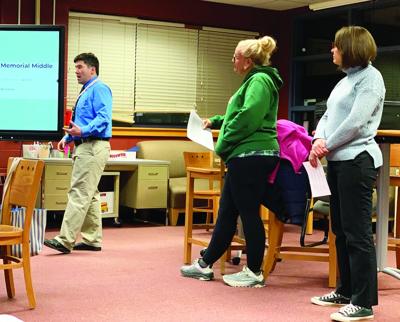
BRISTOL — Newfound Memorial Middle School’s youth risk behavior survey shows 24% of students are experiencing anxiety, and one in four have seriously considered attempting to die by suicide in the last 12 months.
Principal Chris Ulrich told members of the Newfound Area School Board on Dec. 8, he attributed much of the problem to students not getting enough sleep.
“Our kids are spending a lot of time in front of devices,” he said. “Our kids have a lot of access to devices at night.”
Many also are not eating breakfast, despite the district providing food for those who did not eat at home.
More disturbing, he said, is the increase in the number of students with serious mental health problems.
“Paul [Hoiriis] and I got to work together at the high school for seven years, and in those seven years, we had two students with significant enough mental health plans that we had to have a very rigorous safety plan to make sure that that kid had enough safeguards in place that we could educate them safely.
"Right now, as of today, we have four current students who currently have that same safety plan.
"I think it’s important to have a very honest conversation with the board about the degree to which we’re having some of these struggles, and to also honestly address what is in our control, and what’s outside of our control.”
Hoiriis serves as superintendent of Newfound schools.
In many ways, the survey offered good news. “Academically we are doing well,” Ulrich said. “We are doing excellent behavior-wise. Behaviors are down. Grades are up.”
The U.S. News & World Report ranking of middle schools showed Newfound middle rising from 28th in the state last year, to 24th, which Ulrich said puts it within the top 10% of Granite State middle schools.
“We’ve worked really hard to continually raise the academic bar, so, when we pass kids off to the high school, [they have] the literacy and math skills to be able to be successful,” Ulrich said. “And the other thing I do want to point out is that one of the things they highlighted is how well we do, especially when you look at our socio-economically disadvantaged population.”
Jennifer MacDonald, the Newfound Coalition For Youth coordinator, said the survey showed the majority of students are not using alcohol and other drugs.
“There is a strong protective factor against future substance misuse,” she said. “They’re reporting that mom and dad feel that substance use is not good. That’s a protective factor that their family is communicating.”
Ulrich said, “There’s a lot of research out there that the best way you can increase mental health, increase academic performance, increase overall outcomes and school safety, is by having at least one adult that you can connect with an adult.”
Physical Education Instructor Kammi Williams said, “We started the Life of a Bear pilot program at the middle school last year.
"We chose 11 student-athletes that we considered the rock stars of our community, brought them in, along with Mr. [Pete] Cofran, and we worked with them on leadership skills.” That included healthy decision-making skills, the importance of sleep, proper nutrition, and drug and alcohol prevention.
“Then we talked about team culture, and hoping that we can help rebuild and carry through a team culture, from, like, middle school all the way up to the high school.”
Cofran is a retired high school athletic director.
It is part of a broader approach, Williams said.
“Our goal is to help students identify and build meaningful, healthy, and bounded relationships with trusted adults in our school, their families, as well as the wider community. The research is undeniable. Young people who can name a trusted adult at home and at school are less likely to bully, be bullied, drop out, experience depression or suicidal thoughts, act violently, or abuse substances. They’re also more likely to complete tasks. They remain calm in the face of challenges, volunteer in their communities, and experience overall stronger physical and emotional wellness. So that’s the things that we’re trying at middle school."
Ulrich said the district can work on things like bullying prevention, limiting access to electronic devices, and providing access to healthy breakfasts and lunches. It is not as easy to provide the necessary mental health support.
“There’s a lot of transient mental health counselors in a location for a few months, maybe a year, and then they move on to somewhere else that has better pay,” he said, “if you’re someone who needs something intensive that’s not really available here, the only available option is online, right? And sitting online in front of a screen for three hours, trying to get the mental health help you need, isn’t going to work for every single kid.
“We also need assistance from families in limiting that screen time, getting them to sleep, getting them to eat breakfast. So there are things that are within our control, things I think our families can partner with us, and things that our community can help.”


(0) comments
Welcome to the discussion.
Log In
Keep it Clean. Please avoid obscene, vulgar, lewd, racist or sexually-oriented language.
PLEASE TURN OFF YOUR CAPS LOCK.
Don't Threaten. Threats of harming another person will not be tolerated.
Be Truthful. Don't knowingly lie about anyone or anything.
Be Nice. No racism, sexism or any sort of -ism that is degrading to another person.
Be Proactive. Use the 'Report' link on each comment to let us know of abusive posts.
Share with Us. We'd love to hear eyewitness accounts, the history behind an article.