


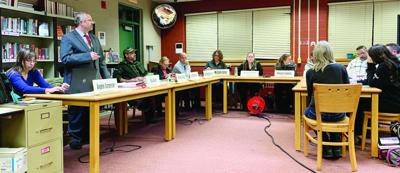
BRISTOL — Residents at the Newfound Area School District Budget Committee hearing on Jan. 12 expressed support for eliminating extracurricular activities, to meet conditions of the district’s 2% tax cap on assessments to member towns. To remain within the cap, the district must reduce its originally proposed budget by $2.3 million, which also means forgoing new positions, and no raises for administrators and support staff.
The original budget called for $29.3 million in spending, an increase of $3.3 million from the current budget. To remain within the tax cap, the budget had to be reduced to $27 million.
Superintendent Paul Hoiriis said, “When we presented this to both bodies — the budget committee and the [school] board, we asked for some guidance. They provided some guidance, but also asked us to go back to the administrative teams and talk about, where are we going to find these cuts?”
He said the first reduction was in new positions, including currently unfilled positions for a high school math teacher and special education case manager at the high school. They also cut five support staff positions for the middle and high school, of which 3.5 are currently unfilled.
Beyond those reductions, Hoiriis said they eliminated a math position at the middle school, a literacy position at the middle school, a replacement for a retiring French teacher at the high school, an English position at the high school, a part-time special education case manager at the middle school, and one of two positions serving as both a technology teacher and librarian at the three in-district elementary school, and the Bridgewater-Hebron Village School in the Pasquaney School District. Pasquaney reimburses Newfound toward the salary and benefits for that job.
The district serves the towns of Alexandria, Bristol, Danbury and New Hampton. The new Pasquaney School District serves Bridgewater, Hebron and Groton.
Stipends for those performing duties such as department head, as well as all administrative and program manager raises, also were eliminated.
The biggest impact is the total elimination of funding for extracurricular activities. That generated the most contentious discussion at the budget hearing.
Charles Lyle, of New Hampton, a member of Friends of Newfound Football, said eliminating sports is dangerous.
“I think it has negative impacts on the community. I think it increases crime, it increases drug use. You have a witching hour for kids from 3 to 7 after school. Their parents are still at work. They’re running around. A lot of these kids are in sports, or in music, or in whatever that keeps them out of trouble.
"I think the cost savings of that $634,000, after a period of time, you’re not going to save that; it’s going to be a lot more expensive.”
Lyle added eliminating sports is not equitable or fair.
“There are some kids that their parents say, ‘All right, well, I’m just going to put you in a private school, and you’re still going to do whatever you want to do.’ There’s a lot of children who do not have that option, and usually the children that don’t have that option are your highest-risk children. And I think that that’s a really, really slippery slope that we’re about to go down.”
Saying Friends of Newfound Football has done a lot to support the program, he suggested asking the community to co-sponsor some of extracurricular activities.
Others weighed in on the importance of sports, band and drama, saying it is what motivates many students to attend school. A woman who works in domestic violence and sexual assault support said failure to offer those activities will likely lead to “immense numbers of children with criminal records,” and will lead to costs for Youth Development Center detentions and services at Spaulding Academy & Family Services.
A physical science teacher said her class discussed the cuts when the budget information started coming out. “The second I said it is very highly possible we will not have sports next year, a third of my kids just stopped doing any work for me whatsoever,” she said. “We have a solid third to a half of our kids in this school that only show up for sports.”
Dana Torsey, of New Hampton, assured the crowd sports would be restored.
“This is almost a moot conversation,” he said. “I’ve been coming to these meetings for 60-65 years ... and this is not the first time sports have been cut. It’s been cut multiple times over the years, and what happens is, at the next deliberative session, now it’s SB 2, the taxpayers will come, and it’ll all be voted back in. We’ve never cut sports. We’re not going to cut sports. It’s too important. The school is going to [cut] it because they have to ... cut something to get to the budget, to make it legal, to make it work. But the taxpayers will put it back at the SB 2 meeting, guaranteed. I bet the farm on it.”
Francine Wendelboe, the school board member from New Hampton, concurred, saying, “Dana is right, and I’m going to give you a little lesson about politics — educational politics, school board politics, budget committee politics.
“I’m not a big fan of sports. I can take them or leave them, but I know it’s a huge incentive for kids. It bothers me to hear that half of the kids only come to school because they want to play sports, and they want to do band and music and that stuff. The primary role of school is to educate the children, so they can support themselves in the future. I don’t know how many kids from here go on to successful careers in sports or drama or music, OK, but the politics of it is, when you’re going to suggest the cut, there are certain holy grails: sports, Johnny’s little teacher. We can’t cut that position.”
Wendelboe said those who restore the money are “not the taxpayers” but “the employees and the parents.” Saying it costs $27,000 per child to educate them, she asked, “How many of you here that are going to be wanting to add all this money back in pay $27,000 in property taxes? No, no one.
"So you have two kids, you’re putting a $54,000 impact on the taxpayers, some of which cannot afford to keep tightening their belt and tightening their belt and doing without, maybe only taking their meds every other day, cutting back to mac-and-cheese, not being able to go visit their families, because they live on a certain budget, and they have to live within that budget.
"However, the reckoning comes in March, when the people go to vote, and that’s when your taxpayers will have a say.”
She noted she warned about “the reckoning” last year.
“If you went back to the audio, you will hear me say we are going to be faced next year with a $2- to $3-million shortfall, because when we calculated last year’s tax cap, it was based on the seven towns [three of which have withdrawn from the district]. The reality of this year is it’s based on the four towns. So the reckoning is here. We went along — fat, dumb, and happy — and we proposed new positions that didn’t end up getting filled. We kept spending just as much as we did before, and it’s the reckoning. We need to be adults. We need to step up and say, 'Enough is enough.' Our taxpayers cannot face it any more.
"So I urge you, you can waste your time and probably go to the deliberative session, but there’s enough employees and parents to just add the money back in, as Dana said, but you need to make sure, if you’re a taxpayer and you’re concerned about losing your home because you can’t afford $27,000 per kid in school, then turn out to vote and vote the budget down.”
The default budget, should the proposed draft be voted down, is calculated to be $27.1 million, or $128,234 more than the proposal.
The primary driver for the increases, Hoiriis said, are things beyond the district’s control: an 18.9% increase in health insurance, $257,000 in special education services, and $201,184 in transportation costs — a 12.36% increase negotiated last year to even out the impact of a higher contract rate with First Student.
The other factor is a new three-year teachers’ contract that adds $352,807 in salaries and benefits in the first year.
Warrant articles
The budget hearing also included information on school warrant articles.
In addition to the election of officers, the operating budget, and the teachers’ contract, there are warrant articles seeking to establish an expendable trust fund to cover unanticipated or excessive special education financial obligations, with the money — $300,000 — coming from any unexpended funds at the end of the fiscal year.
Another article seeks $300,000 from the unexpended fund balance for the existing trust fund for building maintenance.
The school board decided not to seek additional money for its expendable trust fund for technology.
Three articles would provide efficiency upgrades at the high school.
The first, deemed the most critical, is a long-term lease-purchase agreement for the installation of new propane boilers, and heating, ventilation and cooling controls and units at a cost of $6.2 million, with a first-year payment of $492,735. Offsetting that amount are a rebate of $75,000 and guaranteed energy savings of $72,259. That still leaves $345,476 for the district to pay. If the article passes, that money would require further cuts to the operating budget.
Facilities Manager Armand Girouard pointed out the HVAC system is 10 years beyond its expected useful life, and is requiring a great deal of maintenance. If it should fail, the district would be faced with high-cost emergency repairs.
The other two articles would pay for themselves, Hoiriis said.
Article 7 seeks a long-term lease-purchase agreement for LED lights, controls, and transformers at a cost of $6.2 million, with a first-year payment of $85,447. That would be more than offset by a first-year rebate of $85,000 and guaranteed energy savings of $56,000, so it would not affect the tax cap.
Article 8 seeks a long-term lease-purchase agreement for a roof-mounted solar energy system at the high school, at a total cost of $1.2 million, and a first-year payment of $94,824. The rebate for the first year is $299,000, with guaranteed energy savings of $65,000, also more than covering the cost of the lease payment and not affecting the tax cap. This is the last year that rebate would be available.
There is one more potential article which would seek voters’ approval to join the Lakes Region Special Education Charter School Consortium. Hoiriis expects to have more information soon on what the potential cost would be, but the effort is aimed at reducing the expense of out-of-district special education services.


(0) comments
Welcome to the discussion.
Log In
Keep it Clean. Please avoid obscene, vulgar, lewd, racist or sexually-oriented language.
PLEASE TURN OFF YOUR CAPS LOCK.
Don't Threaten. Threats of harming another person will not be tolerated.
Be Truthful. Don't knowingly lie about anyone or anything.
Be Nice. No racism, sexism or any sort of -ism that is degrading to another person.
Be Proactive. Use the 'Report' link on each comment to let us know of abusive posts.
Share with Us. We'd love to hear eyewitness accounts, the history behind an article.