


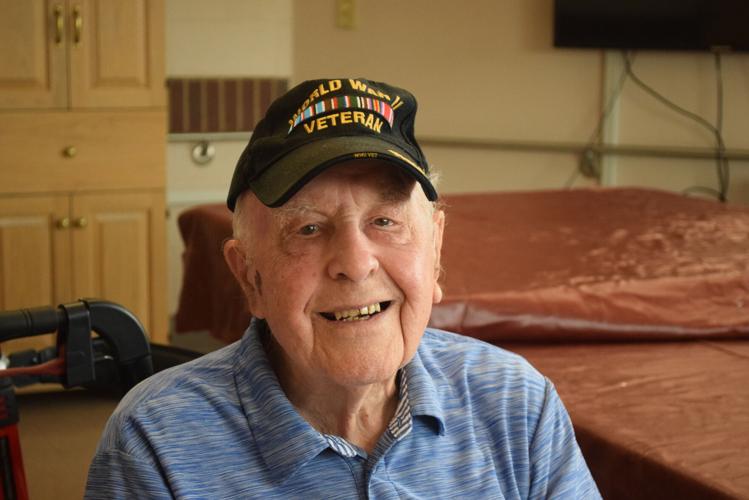
TILTON — Gerry Jutras is the last remaining veteran who served in World War II living at the New Hampshire Veterans Home, but when talking to the U.S. Navy seaman 1st class, you’d never know the man is approaching the century mark, until he talks about how much the world has changed around him.
Jutras walks around the Veterans Home sporting a smile, and a hat indicating him as a veteran from the Second World War, displaying his immense pride for his service. The 99-year-old is surrounded by veterans who have seen it all, and they can all understand each other, sharing common ground.
A long life
Jutras was born in Newburyport, Massachusetts, and after a brief stint in Amesbury, he moved to Lawrence, Massachusetts, where he grew up. He said Lawrence was great, as there were people of all walks of life, from all over.
“There were 17 different nationalities in Lawrence, and it was only eight-and-three-quarter square miles,” Jutras said. “So, everybody had a special neighborhood, and you could hear all the languages spoken all the time. We spoke French all the time at home.”
Jutras said his grandparents immigrated from Canada, and his parents ultimately moved to Massachusetts, from the Granite State. Growing up, he attended a Catholic school where they spoke both French and English. Jutras said his family lived in a “great French neighborhood,” and even attended a French church.
Whenever he was talking to his mom at home, it was strictly in French. That continued when he enlisted.
“I used to write my mother in French when I was in the Navy,” Jutras said. “My mother could speak English, but she was used to French, but my grandmother didn’t speak English.”
Jutras was just 14 years old when the Japanese attacked Pearl Harbor, essentially starting U.S. involvement in World War II.
His uncle, who served in the U.S. Army, was at his house when the Pearl Harbor attack happened, and “he got all upset,” because he had signed up for 2.5 years.
“He says, 'Now I’m in forever,'” Jutras said. “But he did stay in. He stayed in 20 years.”
Jutras said 1942 was a scary time. The world was in a “really tough spot,” and right in the thick of the war. It wasn’t just scary across the world, but right at home in Massachusetts, being relatively near the coast, and potential German attacks.
“We used to have street lights with things around them so they wouldn’t see them, so they weren’t visible at night,” Jutras said. “They used to put a cover around the street lights.”
He also said car headlights were painted on the top to dim them, and only be seen from the bottom. Jutras said there weren’t many cars then anyway, because rations only allowed for five gallons of gas at a time, and tires were hard to come by.
“It was different,” he said. “The women had ration stamps to go buy food and everything. Yeah, you went without a lot of things.”
He also said the draft was looming.
“At my high school, we had 10 people get killed in World War II, out of the four or five classes,” he said. “So, it was kind of a bad experience.”
Three years later, at the age of 17, Jutras enlisted in the Navy, in March 1945, after hearing about his uncle’s experience.
“He was in the Army in Italy, and North Africa, and he was sleeping on the ground,” Jutras said. “I said, 'No, forget it. I’m going to join the Navy.'
"So, me and my buddy joined the Navy, but we missed our graduation by a month when we were in boot camp."
Jutras went to boot camp near Lake Seneca, New York, with his best friend and neighbor Robert Berube.
When he enlisted, Nazi Germany was on the verge of defeat, with Victory in Europe Day coming just months later, on May 8. Otherwise, Jutras would likely have been involved in the invasion of Japan.
“That’s where I was going to,” he said. “We were going to bring the amphibious forces to the shore, the soldiers, and the Marines. Then I got out of boot camp, and the war ended.”
It all changed in an instant, when the Enola Gay dropped the atomic bomb on the city of Hiroshima, on Aug. 6, 1945, and the Japanese surrendered on Sept. 2, ending the war and creating brief time of peace for American soldiers. Jutras knows this likely saved his life, as hundreds of thousands of U.S. troops died.
“We got out of boot camp Aug. the 2nd, and then they threw the bomb, Aug. the 6th,” Jutras said. “So, that changed the whole pattern of the whole thing.”
Rather than being sent to California, the Navy assigned Jutras to an aircraft carrier on the East Coast. He first attended navigation school in Newport, Rhode Island, and in November 1945, Jutras boarded the USS Princeton to serve as a quartermaster. He was responsible for steering the ship, taking readings, tracking sunsets, and navigating.
“They had us doing maneuvers all the time, because the war was over,” Jutras said. “We went to the Caribbean, the south Atlantic, and everything. The other ships were doing good will tours, but we were working all the time.”
Jutras was on the ship for about a year, and discharged at age 19.
One uncle was a Coast Guard member, another was a supply officer in the Army, and a third was a combat engineer in Italy, and North Africa.
“They used to go looking for landmines and stuff like that,” he said of the uncle serving in the Mediterranean. “My other uncle in the Coast Guard was going up and down from Bangor, Maine, to Norfolk, Virginia, looking for German [submarines]. Right along the coast area, too, protecting us. And they found a lot of German subs, and they sank some of them, too.”
Jutras said he was “glad the war had come to an end before he could be deployed.
“I probably would have got killed going to land in Japan, because it would have been worse than D-Day, because they were going to have women and children fighting against us.”
Life after wartime
The war had ended, and Jutras received the Atlantic Theater Medal, as well as the World War II Victory Medal.
It was a hopeful time, following the Great Depression and a war that devastated much of the world. The economy started to get better, and he said, “everybody got a job.” For him, it was working in a foundry, which he didn’t enjoy, which led him attend Merrimack College. Afterward, he got a sales job at Prince Macaroni, where he worked for 33 years, and loved.
Neighborhoods were built, and people were starting families. Jutras was no exception, and married his longtime sweetheart, Helen, who he'd known since they were children. Helen, who died 19 years ago, was the cousin of his best friend, Robert.
“I lived next to him, so I grew up with him and I grew up with my wife,” Jutras said. “I knew her since she was 5 years old.”
Jutras and Helen got married after he finished college, and they had 8 children, who they raised in Pelham, over the next 50 years.
None went to the military, but Jutras feared his oldest son, now approaching 70, might get drafted during the Vietnam era. The conflict ended just before his time would have come.
“He’s like me,” Jutras said. “I got in just before the deadline. He just missed it a little bit.”
Outlook on today’s nation
At 99 years old, the veteran has seen so much of what this country has endured, living during 40% of America’s existence. He knows he was fortunate to have survived a war where more than 400,000 service members were killed, and he doesn’t take that for granted.
He’s also not afraid to criticize the country.
“Things are getting worse than they were before,” Jutras said. “It was much better. I guess they’re doing the wrong thing right now. They’re making all the wrong decisions, and no matter which party you got in there, they don’t do very well. We never had such bad presidents.”
Jutras is calling for the youth to step up, much like he did when he was 17 years old.
“We need younger people; that’s what we need,” Jutras said. “We need term limits to get those politicians out of there, because my grandchildren say, 'How come everybody in Congress is 80 or older?' And that’s true because these people that are there forever, never had another job. Most of them never know anything about common people. We need somebody that’s 40, 50, 60, or less.”
Best-kept secret
Jutras knows he represents what is often referred to as the Greatest Generation, saying he is one of only about 40 World War II veterans left in the Granite State, and among the youngest.
“In fact, there were seven guys that used to hang around together,” he said. “When we come out, we were all World War II veterans, most of them were four or five years older than me, and they’re all gone. I’m the last one left.”
He said he’s glad he went into the service, as it helped shape his life, and likely led him to attending college. Jutras said joining the Navy had him “grow up in a hurry.”
When he enlisted, he didn’t know quite where his life would take him, and didn’t know if he’d survive much longer, let alone eight decades later.
“I didn’t think it would be that long,” he said. “But, my sister lived to be 96. She died two, three years ago. My mother was 91. My grandmother was 90. My grandmother was 86. We’re all old.”
Gerry will turn 100 on May 5. While he never played organized sports, he loved to ice skate, sled and swim. They would walk for miles, and was always active and in good shape.
The real secret? “Good, healthy eating.”
“My grandmother, my wife, my mother, were all real good cooks,” he said. “We ate a lot of good food.”


(0) comments
Welcome to the discussion.
Log In
Keep it Clean. Please avoid obscene, vulgar, lewd, racist or sexually-oriented language.
PLEASE TURN OFF YOUR CAPS LOCK.
Don't Threaten. Threats of harming another person will not be tolerated.
Be Truthful. Don't knowingly lie about anyone or anything.
Be Nice. No racism, sexism or any sort of -ism that is degrading to another person.
Be Proactive. Use the 'Report' link on each comment to let us know of abusive posts.
Share with Us. We'd love to hear eyewitness accounts, the history behind an article.