


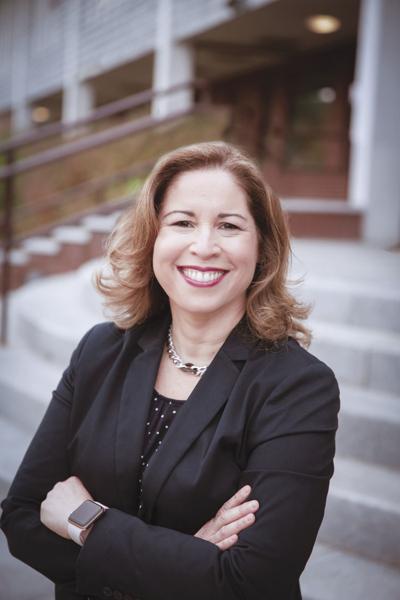
LACONIA — Students and faculty at Lakes Region Community College have adjusted fairly well to the switch to remote learning, but the college’s president said there have been “some bumps along the way.”
“Some students have no internet access at home, some are struggling financially, and there have been some mental health concerns,” said Larissa Baia, the college’s president. “But overall the bumps have been small.”
The college shifted to remote learning for most of its classes one month ago, to conform with social distancing guidelines from state and federal authorities due to the coronavirus pandemic. Lab sessions have continued on campus — but with fewer students at any one time — in programs like electrical systems, nursing and automotive technology.
The current semester is scheduled to end on May 8. In some courses, final exams will not be that much different than if the students were attending class on campus.
“For some, a paper will still be their final. For those classes where students give presentations, these presentations will be submitted on video instead of in front of the class,” Baia explained. But in many academic courses, students will take proctored online exams.
Faculty, she said, had two weeks to shift to computer-based learning, and figure out how they would prioritize their students' needs while working remotely.
In the culinary arts program, for example, instructors assembled baskets with a recipe and all the ingredients needed to prepare the dish, Baia said. Times were then arranged when students could come to the school to pick up their basket. They prepared the dish at home, used online technology to show the instructor how it turned out so the instructor could then grade the assignment. Though the instructor couldn't smell or taste the final result, the dish was large enough to feed four to six people — members of the student’s family.
“That’s creativity at its best,” said Baia. “I’ve never been prouder of the faculty.”
For Derek Daubenspeck of Meredith, shifting from in-class instruction to online has been smooth.
Daubenspeck, 18, is currently taking classes in Spanish and creative writing.
“It’s been a pretty good experience,” said Daubenspeck who started taking classes at LRCC last fall after completing nine years of home-schooling. “The teachers really try to help all the students.”
However, arranging time to talk to an instructor to get help is not as easy because it often involves back-and-forth emails and phone calls in order to arrange a mutual time.
Daubenspeck said being in a classroom with a teacher at the front of the room helps him pay better attention to what the instructor is saying. He credited his years of home-schooling with making the adjustment to remote learning easier.
“I’m used to learning and doing work without a lot of teacher guidance,” he said.
Though he prefers learning in a traditional classroom setting, Daubenspeck, who will start attending Pensacola Christian College in Florida in the fall, said both classroom and online learning “are great.”
But overall there have been challenges for some students during the pandemic.
Baia said since the COVID-19 crisis began to impact the Lakes Region, a number of students who work in essential businesses have been asked by their employers to work more hours.
“They have worked these additional hours because they need the money, and they are concerned that in a few weeks or months they might lose their jobs in a recession,” Baia explained.
The college will be receiving $439,512 in federal money from the CARES Act — the $2 trillion bill passed late last month to address the economic fallout of the pandemic.
The first portion of the money earmarked for LRCC — $219,000 — will be for emergency financial aid grants to students, Baia said.
She said the college’s administration is currently discussing how that money should be allocated. It could be disbursed equally among all the college’s students enrolled in for-credit classes. Or it could be distributed using a formula based on how many credits a student is carrying. A third option would be to disburse the money on the basis of each student’s financial need, Baia explained.
About two-thirds of LRCC students currently get some form of financial aid, she said.
The balance of the funds will be used for the college to recoup some of the costs associated with the pandemic, such as purchasing additional technology for some instructors to use for remote learning, refunds for residential students who had to vacate their dorm rooms early, and replacement of personal protective equipment which the college donated to area health-care facilities.
The college's summer semester is still scheduled to begin on May 12. Most of the courses for that term will also be online, Baia said. Enrollment is traditionally much smaller than during the rest of the year — between 100 and 150 students as compared to more than 800 who attend during the fall and spring semesters.
The college also had to cancel its commencement ceremony, which was scheduled for May 15, Baia said. The administration has been surveying students about whether they would prefer a traditional commencement at a later date once social distancing restrictions are lifted, or hold a virtual ceremony online.


(0) comments
Welcome to the discussion.
Log In
Keep it Clean. Please avoid obscene, vulgar, lewd, racist or sexually-oriented language.
PLEASE TURN OFF YOUR CAPS LOCK.
Don't Threaten. Threats of harming another person will not be tolerated.
Be Truthful. Don't knowingly lie about anyone or anything.
Be Nice. No racism, sexism or any sort of -ism that is degrading to another person.
Be Proactive. Use the 'Report' link on each comment to let us know of abusive posts.
Share with Us. We'd love to hear eyewitness accounts, the history behind an article.