


If it’s news to you, then consider yourself lucky: This year is a particularly bad one for ticks – or a good one if you are a tick. They’ve appeared earlier than in recent years, and in greater numbers, portending a bumper crop this year.
Kaitlyn Morse, founder of the citizen science-driven organization BeBop Labs, said her mailbox is already teeming with ticks.
“They came out as early as early April, we usually don’t see them until later in May,” Morse said.
Morse created BeBop Labs in 2018 as a way to get a handle on where in New Hampshire ticks were most prevalent, and if those ticks were carrying diseases known to affect humans. BeBop Labs – named after Morse’s dog – relies on the general public’s participation in the research by mailing in the ticks they find on themselves or their pets, as well as some basic information about when, where and on whom the ticks were found.
Morse said she didn’t have a firm answer as to why 2021 is seeing such a robust tick population. Yes, it was a fairly mild winter, but she hasn’t seen “compelling evidence” that there’s a direct correlation between climate and tick population. There might be an indirect link, though, as local rodent populations might have thrived over the winter, and squirrels, chipmunks and mice are known hosts to ticks that also feed on humans.
At any rate, there is some good news amid the influx of ticks. Morse said that the increased rate of ticks they’re seeing is exclusive to dog ticks. While they’re unpleasant and squirm-inducing, the testing that her organization has done has concluded that New Hampshire’s dog ticks almost never carry pathogens that are bad news for people. Of the thousands of dog ticks that BeBop has tested, only two have tested positive for pathogens.
It’s relieving, then, that blacklegged ticks – formerly known as deer ticks – aren’t booming in the same way that dog ticks are. Blacklegged ticks are much smaller than dog ticks. Results published by BeBop Labs, which combines its own findings with that of Ticknology and UMass Amherst’s Lab of Medical Zoology, show that 36% of blacklegged ticks in New Hampshire are infected with Lyme disease, which can result in chronic illness in humans. Blacklegged ticks in New Hampshire can also carry anaplasmosis, babesiosi and b. miyamotoi, though in occurrences of 5% or less.
BeBop’s 2021 newsletter includes a map of Lyme-carrying blacklegged ticks by town, which shows that the prevalence of the bacteria that causes the disease is as prevalent in the Lakes Region as it is in more southern parts of the state. There seems to be less Lyme in the White Mountains and North Country, though there is also less data to draw from in those regions.
What can be done to combat Lyme disease? For one, send any ticks that are found to be tested. For information on how to do that, visit BebopLabs.org.
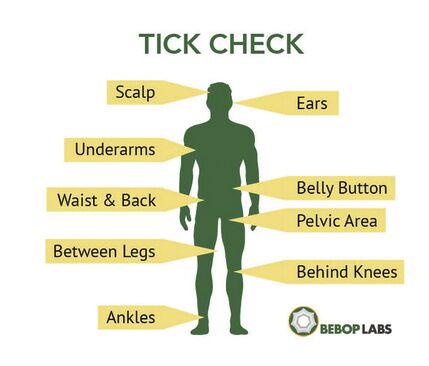
Morse said that it’s a good practice to make “tick checks” a part of the daily routine. Most tick-borne diseases require the parasite to be biting for more than 24 hours in order to infect the host, so if it can be safely removed shortly after it attaches itself, there’s minimal risk for disease. Ticks tend to seek a warm body part, often in the presence of hair, to attach themselves.
Speaking of removal, some old-fashioned ways, such as burning it with a hot match head or suffocating it with petroleum jelly, aren’t good ideas. It’s best to keep the tick alive while removing it. Use fingers or tweezers – BeBop sells specialized removal tools on their website – and use care to ensure that all of the tick, including its head, is removed.
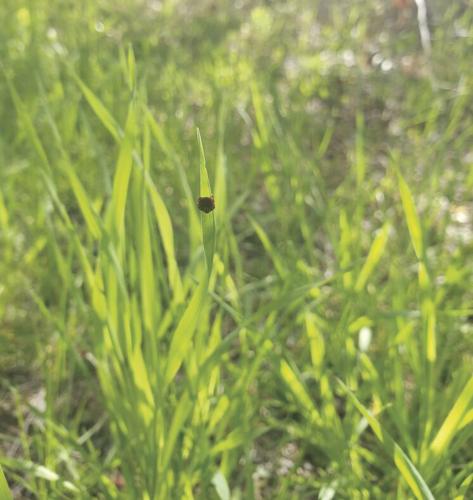
Ticks tend to climb tall grass to wait for a host to walk by, so keeping a trimmed lawn will reduce a property’s friendliness to ticks. Ticks like to lay their eggs in leaf piles, so keep those away from places where people are spending their time outdoors.
Morse is also a proponent of “tick tubes,” a device that leverages the local rodents to help control ticks. Rodents are an important food source in the tick life cycle, and ticks often lay their eggs in rodent nests. A tick tube is a cardboard tube, such as one used to carry toilet paper or paper towels, which is stuffed with dryer lint or cotton balls that have been treated with a permethrin solution. Permethrin is a pesticide that can harm cats or aquatic animals, so don’t place the tubes in areas where cats frequent or near a body of water. However, if they are placed where rodents can find them, they will take the lint or cotton to line their nests, and break the chain of events that leads ticks to bite nearby humans.
There are sprays that can be used to kill ticks on the landscape, but those same chemicals also kill pollinators. That’s why Morse prefers tick tubes, and noted that there’s a good tutorial on the website for the Pemi-Baker Beekeepers Association, under the “Resources” tab.


(0) comments
Welcome to the discussion.
Log In
Keep it Clean. Please avoid obscene, vulgar, lewd, racist or sexually-oriented language.
PLEASE TURN OFF YOUR CAPS LOCK.
Don't Threaten. Threats of harming another person will not be tolerated.
Be Truthful. Don't knowingly lie about anyone or anything.
Be Nice. No racism, sexism or any sort of -ism that is degrading to another person.
Be Proactive. Use the 'Report' link on each comment to let us know of abusive posts.
Share with Us. We'd love to hear eyewitness accounts, the history behind an article.