


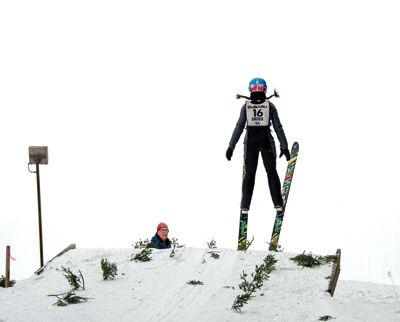

Ayla Weale from the Lebanon Outing Club hitting the K20 jump at Gunstock. (Karen Bobotas/for the Laconia Daily Sun)
By RICK GREEN, LACONIA DAILY SUN
PLYMOUTH — Most people have seen Olympic ski jumping, where an athlete flies off a towering ramp, soars through the air for a few seconds and covers a distance of more than two football fields before gracefully returning to Earth.
Ever wonder how athletes learn such an extreme sport?
A good place to start is at Plymouth Regional High School, where coach Morgan Stepp presides over a team of 18 ski jumpers, half boys and half girls.
Like anything else, you have to start slow, Stepp said.
“We start on a 10-meter hill,” Stepp said. “Anybody who is a remotely competent skier can go down a 10-meter hill. It is so small, there are no consequences if you don't jump. It's like a small knoll at a ski area.”
The skier learns the proper technique.
“We train them to get as low as possible with the back flat and the shins at a certain angle,” he said. “This allows you to get in the right position to make the right move, to jump up and out.”
On bigger hills and longer jumps, aerodynamics come into play. The skis and the skier turn into wings, or lifting surfaces, that allow for longer distances. The jumps are judged on distance and style. A stylish and safe conclusion to the jump comes with a Telemark-type landing with one foot in front of the other for stability.
Injuries infrequent
New Hampshire is the only state in the country with competitive ski jumping for high school students, and the question of safety always comes up.
The sport may seem extreme, but injuries are infrequent, Stepp said.
“Despite what it looks like when you see people flying through the air, the rate of injury is very low relative to other sports,” he said.
Crashes sometimes occur at the end of the jump when the skier is trying to stop. In six years of coaching, Stepp said he has seen a broken collar bone and a couple of concussions, one of which occurred recently.
Long skis
Most of the high school ski jumpers are alpine skiers, and they must adjust to a much longer ski.
“The reaction I get is, 'Oh my God the skis are big,” he said. “Most kids are curious about how they will handle bigger skis, 215 centimeters and up. There are no edges on them.”
The skis are long for stability and aerodynamics. Metal edges would add unnecessary weight and are not needed.
Balance is a key to the sport.
“If you're on a smaller hill, you can get away with mistakes, you are up and down so quickly,” he said. “But on a bigger hill, if your weight is too far back, you can get pushed back in the air and you could land on your back.”
The opposite problem could occur if a skier's weight was too far forward.
Olympic ski jumper
On the other far end of the sport, is the Olympic ski jumper.
Walter Malmquist skied for the Holderness School and later for Dartmouth. He competed in the 1976 and 1980 Winter Olympics. In 1980, he finished 12th in the Nordic Combined, which includes ski jumping and cross-country skiing.
Malmquist, who lives in West Fairlee, Vermont, said he never suffered broken bones or other severe injuries during competition, although as distances have increased at the elite level, there have been more injuries in recent years.
He started competing in the mid-1960s at the junior level at the Gunstock Mountain Resort.
The feel of soaring over the snow is amazing, he said.
“It is the biggest thrill you'll ever have in your life,” he said. “As you go over knoll, the height you gain, the feeling of flying and weightlessness, and then the controlled, Telemark landing, that is a huge accomplishment every time you do it. You don't need to win a gold medal to be awarded with the feeling.”
The takeoff speed for the jump may be 55 mph. Even though the jump itself may last only about 3 seconds, time seems to expand “so that a jump feels like a weekend experience,” Malmquist said.
He could spend five minutes talking about every aspect of the brief jump.
In addition to the exhilaration of the jump itself, the feeling of camaraderie within the tight-knit ski jumping community leaves a lasting impression.
“There is a real kindred spirit among all the participants,” he said. “That's what I remember. I really do remember feeling comfortable in very anxious situations.”
Nathaniel Weimer makes way to the top of the K20 jump at Gunstock. (Karen Bobotas/for the Laconia Daily Sun)





(0) comments
Welcome to the discussion.
Log In
Keep it Clean. Please avoid obscene, vulgar, lewd, racist or sexually-oriented language.
PLEASE TURN OFF YOUR CAPS LOCK.
Don't Threaten. Threats of harming another person will not be tolerated.
Be Truthful. Don't knowingly lie about anyone or anything.
Be Nice. No racism, sexism or any sort of -ism that is degrading to another person.
Be Proactive. Use the 'Report' link on each comment to let us know of abusive posts.
Share with Us. We'd love to hear eyewitness accounts, the history behind an article.