


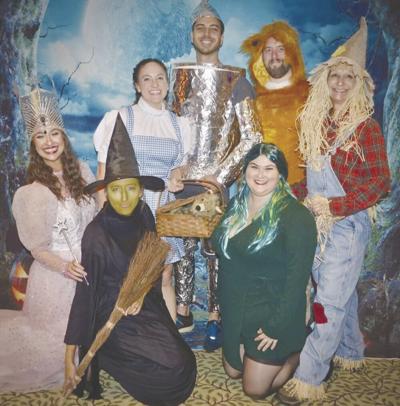
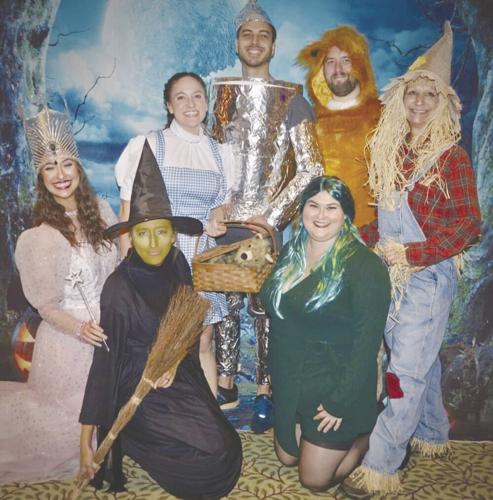
LACONIA — Witches, warlocks, vampires and teams dressed as Rugrats, the Addams Family and characters from "The Wizard of Oz" gathered at the Margate Resort last October to raise money for Brigid’s House of Hope, the state’s first supportive housing for victims of human trafficking.
This year, the 2nd Annual Lakes Region Costume Festival returns to the Margate at 7 p.m. on Saturday, Oct. 29, to muster support for this unique program with a steady demand.
“We know the need is here,” said Executive Director Bethany Cottrell, who founded Brigid’s House in 2018. The nonprofit raised money through grants and corporate and individual donations to open its first house this summer, serving as many as 14 adult victims throughout New Hampshire and New England, including from small towns.
“We think of Manchester, Nashua and Salem,” Cottrell said, “but it’s hitting a lot of smaller, rural areas as well.”
In a rural, family-oriented state, it's a seldom-recognized vice affecting a population that is typically invisible. Human trafficking is the exploitation of a person through labor, services or a commercial sex act by threat, fraud, coercion or physical force, according to the New Hampshire Human Trafficking Collaborative Task Force. Victims include those who work as escorts, adults and children recruited for pornography, and anyone unwillingly engaged to provide sexual services, including in massage parlors or private homes.
“Trafficking and exploitation is a community problem,” Cottrell said. “These victims and survivors are our community members, our neighbors, our friends — those we interact with every day who have suffered extreme trauma that leads to their victimization.”
Trafficking grew silently during the pandemic, shifting online then taking off, according to the Polaris Project, a Washington, D.C.-based nonprofit that helps survivors nationwide and runs a national hotline. Most victims are women ages 18 to 35, but include males and members of the LGBTQ community.
In what amounts to human slavery, involuntary services are sold to others — frequently by family members and intimate partners, according to Polaris. From 2019 to 2020, recruitment by a family member or caregiver increased by 47%, rising from 21% to 31% of trafficking cases. In that time frame, trafficking by intimate partners jumped from 22% to 27%.
People who fall prey are often in desperate situations where they feel they have no choice. They're compelled by captors, employers or controllers who threaten to withhold food, money, critical medication, passports, transportation, recreational drugs or communication with friends or family members. Unless they perform on demand, harm may befall their loved ones. Their entrapment resembles an amalgam of abuse, neglect, domestic violence and incarceration, Cottrell said.
When the pandemic shut down in-person venues such as bars, hotels and nightclubs, human trafficking soared online, increasing by 22% between 2019 and 2020, according to the U.S. National Human Trafficking Hotline. The hotline counted 10,583 human trafficking situations involving 16,658 victims in 2020 alone. The actual number is higher because many incidents go unreported by victims who are afraid to come forward. Recruitment for sex via Facebook and Instagram more than doubled between 2019 and 2020.
Social media continues to provide conduits and anonymous contacts for trafficking, especially of young women with substance-use disorders, a history of trauma or sexual assault and no safe or steady place to live or sleep. Particularly at risk also are refugees and people who have recently relocated, and young people with mental health challenges, according to Polaris.
"They prey on victims who are not well connected, people who may not be missed right away, who might be easy to manipulate because of fear," said Kate Bruchacova, a health educator for the Partnership for Public Health in Laconia and UNH Cooperative Extension in Belknap County, who works with new Americans. Bruchacova said she has counseled 10 women in the Lakes Region who arrived as "mail order brides," who came expecting love and a better life and instead found themselves trapped, enslaved and abused. One online predator arranged for a woman to come to be his wife so he could have sexual access to her children.
Many immigrants who don't speak English or are refugees are wary of government authorities based on past experience and are unwilling to report to police, for fear of being deported. Some women were not treated equally in the countries they left, and accept their situation here as life as usual, no matter how painful or exploitative. Some feel ashamed for what they perceive as their own failure. Most can't return to their home countries because they lack money and access to their passports.
"It almost makes me think how many could be here and we don't even know about it," Bruchacova said.
The trafficking trade is not just international, as many people believe. Based on current data, it simmers beneath the surface of many communities, said Bruchacova, and can become an active problem during Motorcycle Week and big events that draw outsiders.
Laconia police officers have been trained to spot it and intervene, said Chief Matt Canfield, who said he cannot recall any human trafficking arrests in the city in the last five years.
"The problem with human trafficking is a very high percentage is never reported," Canfield said. "I'm not saying it's not occurring in Laconia and in New Hampshire," but it's difficult to pin down real numbers. "People trafficked across the Mexican border to gain citizenship are not reporting. People trafficked for sex to satisfy a drug addiction are not going to report. Someone running an operation with underage kids has power over them. Around the country, most of it is unreported."
Shocking statistics in New Hampshire
Two years ago, community trainings on human trafficking increased across the state. The NH Human Trafficking Collaborative Task Force transitioned to the state police with the Merrimack County Sheriff’s Office as a law enforcement partner. The number of new human trafficking investigations jumped from 23 in 2020 to 104 in 2021, according to the task force’s 2021 annual report.
Considering the problem's scope and presence, “We need to continue with our aggressive efforts to combat human trafficking,” said Task Force Officer David McCormack of the State Police Special Investigations Unit.
Data from the New Hampshire Coalition Against Sexual and Domestic Violence shows that 105 human trafficking victims were aided by social service agencies last year, and 91.4% were female. Roughly half were from under-served populations, including people with disabilities or limited English proficiency and people experiencing homelessness or living in rural areas.
Last year, just under 12% were known to be 17 or younger, according to NHCASDV.
During 2021, 84 children were referred to the state’s Division of Children, Youth and Families for human trafficking allegations. Eighty-three were for sex trafficking and one was for labor. The victims ranged in age from zero to 17, and 75% were female, according to the Division for Children, Youth and Families.
Last year, hospitals across the state treated 15 victims of human trafficking, according to reports from the NH Department of Health and Human Services.
The need for community support
In the three months since its transitional housing opened off Route 101 between Manchester and the Seacoast, Brigid’s House of Hope has received 17 referrals from social service agencies, law enforcement, hospitals and victims seeking respite and assistance for themselves, Cottrell said.
Two calls recently came regarding victims in Grafton County. In addition, Brigid's House was contacted by the U.S. Attorney’s Office seeking placement for three girls, ages 15 and 16.
“How do you house underage youth when it may be a parent who’s trafficking them?" Cottrell said. "There’s really a stabilizing need to make a safe place, a place to sleep.” She said the challenge now is to expand the Brigid's House program and hire more case managers and round-the-clock staff — who are not funded by grants.
This year’s $287,000 operating budget will jump to $584,000 next year, she said, with the addition of rental assistance and case management for up to five units of housing in the community.
In May, an interfaith breakfast in Laconia raised $1,900 for Brigid’s House. Starting Nov. 1, a grant of around $200,000 from the Bureau of Housing Supports at NH DHHS will enable Brigid's House to offer rental supports to victims who cannot relocate to southern New Hampshire, or who are not candidates for group living. Last year’s costume festival raised $4,000 from approximately 100 people. Cottrell hopes at least 150 revelers will attend Saturday.
The goal is to reach people who are still in trafficking situations and let them know that an army of others supports them and wants to help them to safety, Cottrell said. Brigid’s House provides a haven that enables them to exit dangerous situations and start the road to recovery.
“This can’t happen if we just ignore it. We are always looking for community support," Cottrell said. That includes volunteers, financial gifts and in-kind donations.
In 2020, friends and family members were the access point for help for 40% of known survivors, according to Polaris.
For more information on how to recognize human trafficking in the community and how to help, visit polarisproject.org/recognizing-human-trafficking and polarisproject.org/training. Victims in need of immediate assistance should call 911. To report suspected incidents or find assistance for trafficking victims, call the U.S. National Human Trafficking Hotline at 888-373-7888 or text “Be Free” to 233733.
Tickets to the 2nd Annual Lakes Region Costume Festival are available by visiting tinyurl.com/3hz5dv3p. All proceeds go to Brigid’s House. The event, sponsored by Friends of the Paradise Beach Club, features a costume contest, prizes, a raffle, live music by the Jodie Cunningham Band, light food and a cash bar.


(0) comments
Welcome to the discussion.
Log In
Keep it Clean. Please avoid obscene, vulgar, lewd, racist or sexually-oriented language.
PLEASE TURN OFF YOUR CAPS LOCK.
Don't Threaten. Threats of harming another person will not be tolerated.
Be Truthful. Don't knowingly lie about anyone or anything.
Be Nice. No racism, sexism or any sort of -ism that is degrading to another person.
Be Proactive. Use the 'Report' link on each comment to let us know of abusive posts.
Share with Us. We'd love to hear eyewitness accounts, the history behind an article.