


LACONIA — Laconia Police Chief Matthew Canfield has school safety on his mind every single day.
After the shooting in Uvalde, Texas, Canfield spoke with The Daily Sun to emphasize that Laconia school and law enforcement officials are doing all within their power to ensure that local schools are secure.
“We are currently doing everything that we can do,” Canfield said. “Schools are safe in Laconia.”
Chief Canfield served on Gov. Chris Sununu’s 2018 School Safety Preparedness Task Force, which joined educators and safety officials to develop 59 recommendations – spanning the areas of legislation, mental health, planning, training and exercises – to maximize New Hampshire Schools’ ability to prevent school violence. Its recommendations were not only adopted at the state level, with the adoption of new social-emotional learning programs and incorporating anti-shooter drills into the list of required safety drills in 2018, but brought into Laconia schools.
The task force was formed in response to the school shooting in Parkland, Florida. Canfield noted that few states had task forces addressing school safety and said that he considered New Hampshire very “forward thinking” on the issue.
“We’re on the cutting edge in New Hampshire,” Canfield said. “Not just from a law enforcement perspective but also with school personnel and mental health professionals.”
Read the full findings and recommendations of the task force at governor.nh.gov/sites/g/files/ehbemt336/files/documents/20180705-school-safety-report.pdf.
ALICE – Alert, Lockdown, Inform, Counter, Evacuate – training is completed annually by the Laconia and Gilford police departments. According to its website, ALICE is an active shooter response training program that helps organizations “prevent, mitigate, respond to and recover from” incidents of violence. ALICE training helps create communication and security procedures to help catch potential incidents early and helps empower potential victims and safety officials during an incident.
Read more about ALICE training at alicetraining.com/our-program/alice-training.
The Laconia Police Department also, every few years and twice in the last five years, completes a full-scale, on-the-ground active shooter drill in Laconia schools. These trainings are done on a weekend and with actors.
Canfield stressed that these trainings are massive and thorough: covering everything from ensuring that medical personnel can treat victims while remaining safe themselves to an effective and clear communication procedure with parents, to prevent behaviors that might interfere with police and medical response to a scene.
The New Hampshire Department of Homeland Security completes a risk assessment in each school every three years, identifying potential safety vulnerabilities both before and during a violent attack.
Canfield stressed that every point identified in Laconia’s most recent risk assessment has been addressed.
Laconia also has an emergency preparedness group, with the superintendent, principals and police officers, that meets monthly to ensure that Laconia schools are meeting safety standards.
“Even something as small as a side door that is being left unlocked would be brought up and addressed” by the group, Canfield said. The shooter in Uvalde gained access to the building through an unlocked side door.
There are student resource officers in the middle and high schools that, on top of providing some physical safety, work to form bonds with students and lead mentoring programs.
“We will continue to work hard, to train hard and to work with law enforcement, with emergency services, and with school systems to make our schools as safe as they can possibly be,” Canfield said.
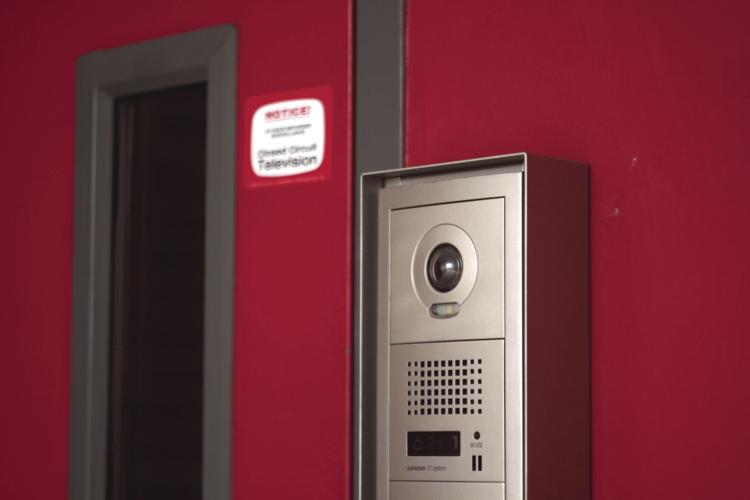
LPD is in the process of connecting school camera feeds to the dispatch center – those feeds would only be utilized during school emergencies where it would benefit law enforcement to have interior school visuals.
“It’s a matter of reducing response time… as well as minimizing access to potential victims,” Canfield said. Most active shooter situations resolve in five minutes, according to the findings of the Governor’s task force. Helping law enforcement to address the situation as soon as possible and preventing or at least delaying an active shooter from getting access to students and teachers are what saves lives, Canfield said.
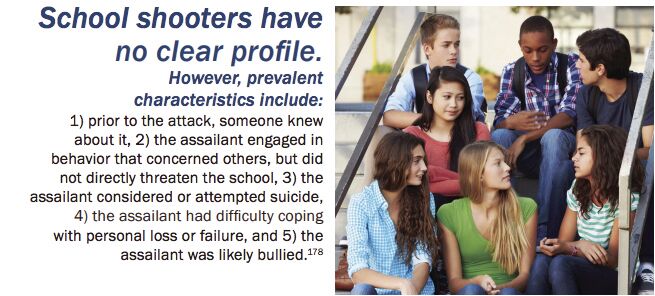
It isn't possible to pinpoint the causes of such tragedies, Canfield said. Still, it is important to maximize schools’ ability to mitigate and respond to potential events in a way that ensures the safety of students and teachers.
Gilford Police Chief Kris Kelley also emphasized that on top of hardening schools – making it more difficult for unwanted visitors to enter school buildings – prevention of school violence through community building is essential to overall safety.
Mitigation and prevention through the creation of a healthy social environment are key, Kelley said.
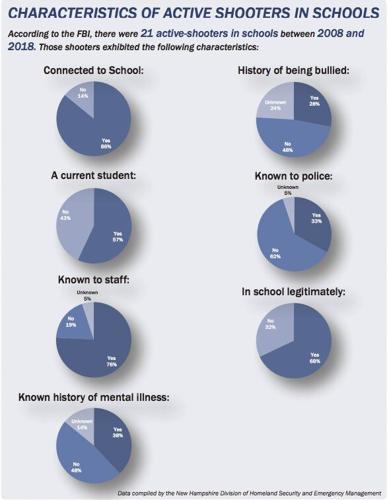
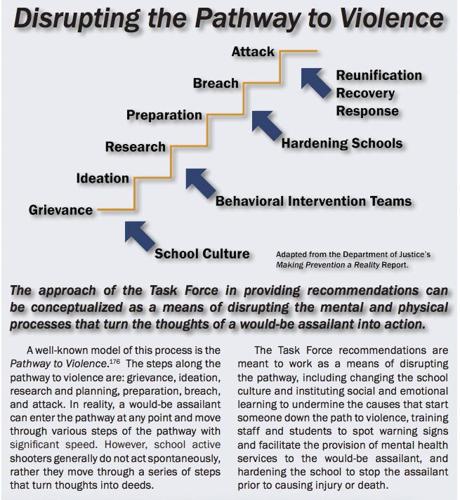
The findings of the task force support his emphasis: its recommendations aim to disrupt the pathway to violence for potential shooters. According to findings of the FBI cited by the task force, more than half of school shooters are current students. More than two-thirds of shooters are in schools for legitimate reasons and more than 85% are connected to the school.
The Jesse Lewis Choose Love Program was founded in 2013 by Scarlett Lewis after the loss of her son Jesse in the Sandy Hook School shooting. Its curriculum uses Character Social Emotional Development programs to create supportive, thoughtful, happy and safe communities. Choose Love began as an initiative for schools but now offers programs for people in all stages of life in the home, at work and in communities.
The state of New Hampshire adopted the Choose Love Curriculum in 2018 as a result of the recommendations of the school safety task force, which underline the importance of SEL to positive mental health outcomes, and overall safety, in schools. SEL, by equipping students to manage their emotions and relationships, not only decreases levels of bullying and improves overall student behavior, it also can lead to improved academic performance and motivation, according to the task force's report.
Inter-Lakes Schools are described on Choose Love’s website as particularly enthusiastic about the program, and Lewis presented virtually to students in Inter-Lakes schools in 2020. The Inter-Lakes Superintendent’s office did not respond to requests for comment on school safety and their engagement with the Chose Love Program.
“From gratitude, kindness, compassion, forgiveness, and courage” – Choose Love’s curriculum formula – “to additional topics such as mental health awareness, suicide prevention, and healthy relationships, students receive a comprehensive social/emotional foundation,” said Holly Vieten, Inter-Lakes guidance director in an email.
No one topic of recommendation made by the task force and adopted by the education systems in the Lakes Region – not just laws, not just school hardening, not just mental health and social culture, not just training – on its own will prevent school violence. School security will not address bullying cultures that might drive students to violence, and proactive mental health infrastructure in schools will not minimize the casualties of shootings once they begin.
As Lakes Region schools have demonstrated in their safety measures, an extensive, proactive and rounded approach is imperative.
Canfield, discussing how the effort originally formed in response to the Parkland shooting, said that the events in Uvalde might prompt a revisit by the task force to its findings to look for additional opportunities to improve safety.


(0) comments
Welcome to the discussion.
Log In
Keep it Clean. Please avoid obscene, vulgar, lewd, racist or sexually-oriented language.
PLEASE TURN OFF YOUR CAPS LOCK.
Don't Threaten. Threats of harming another person will not be tolerated.
Be Truthful. Don't knowingly lie about anyone or anything.
Be Nice. No racism, sexism or any sort of -ism that is degrading to another person.
Be Proactive. Use the 'Report' link on each comment to let us know of abusive posts.
Share with Us. We'd love to hear eyewitness accounts, the history behind an article.