


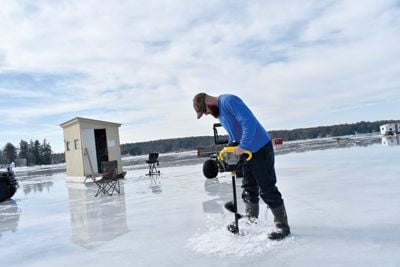
Devin Barlow uses an auger to cut a hole in the ice of Lake Winnipesaukee, just off of Gilford Town Beach. He found 18 inches of ice yesterday, despite high temperatures near 70 degrees. (Adam Drapcho/Laconia Daily Sun)
By ADAM DRAPCHO, LACONIA DAILY SUN
GILFORD — Devin Barlow and Bob Rafferty checked the thickness of the ice off the Gilford town beach yesterday and found that, despite the 65-degree temperature of the day, there was about 18 inches of ice. They dragged their bobhouse onto the ice and spent the day fishing for cusks and lake trout in weather warm enough for short sleeves.
“This is the thickest we’ve seen it, which I don’t really understand,” said Rafferty.
At the end of the day, though, the two men, both from Laconia, planned to drag the bobhouse back to shore, because they knew that lake ice comes with no guarantees.
“You’ve got to be smart,” said Barlow.
Even in the deepest cold of winter, experts warn that thick ice on one part of the lake doesn’t mean that the ice is safe everywhere. After a few days of warm weather, that’s even more true.
Lt. Heidi Murphy, who works with the New Hampshire Fish and Game Department’s Law Enforcement Division, said weather like Wednesday’s makes her nervous.
“Because water is variable. Springs that you don’t know about are more apt to start opening things up. Because things are melting and streams are going to flow a lot faster, which is going to melt things faster.
“That’s why we always say, check before you go, check before you go, check before you go.”
There have already been at least two vehicles falling through the ice this winter — a Jeep in Meredith and a pickup truck in Gilford.
There’s still plenty of ice coverage to be found, said Gilford Fire Chief Stephen Carrier, but people could find weak spots, too.
“Obviously, we’re losing a lot of ice,” Carrier said. “If there’s underwater structures, such as rocks, they’ll heat up more rapidly and cause the ice [above] to melt more rapidly,” he said. Once the shoreline starts to warm, it will also melt ice along the edges of lakes and ponds, he noted.
Even a bobhouse left on the lake could weaken the ice it’s sitting on. On a sunny day, the structure would absorb heat from the sun and radiate it into the ice. Even if it rains, water running off the roof could cause a weak spot.
“As for the most part, people are still pretty cautious and when the weather gets this warm, they need to start paying more attention,” said Carrier. “Now is the time to start checking the ice.”
The U.S. Army Corps of Engineers’ Cold Regions Research and Engineering Laboratory recommends a minimum of 6 inches of ice for foot travel and 8 to 10 inches of hard ice for all-terrain vehicles or snow machines.
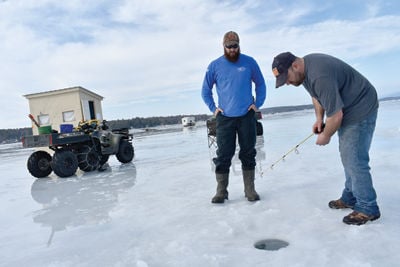
Bob Rafferty drops a jig down into the hole he cut in the ice above Lake Winnipesaukee, just off of Gilford Town Beach, as Devin Barlow watches. (Adam Drapcho/Laconia Daily Sun)


(0) comments
Welcome to the discussion.
Log In
Keep it Clean. Please avoid obscene, vulgar, lewd, racist or sexually-oriented language.
PLEASE TURN OFF YOUR CAPS LOCK.
Don't Threaten. Threats of harming another person will not be tolerated.
Be Truthful. Don't knowingly lie about anyone or anything.
Be Nice. No racism, sexism or any sort of -ism that is degrading to another person.
Be Proactive. Use the 'Report' link on each comment to let us know of abusive posts.
Share with Us. We'd love to hear eyewitness accounts, the history behind an article.