



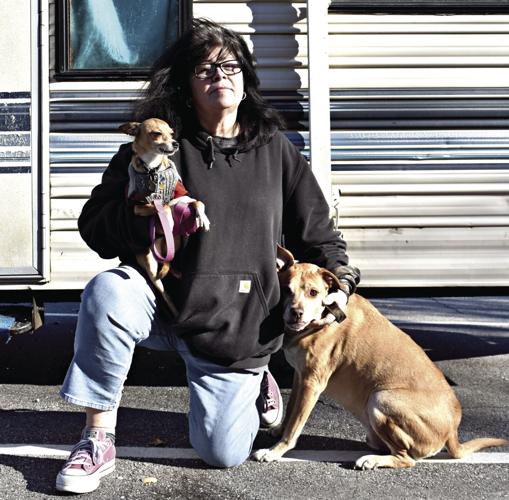


On the last day of June, the dovetailed problems of affordable housing and homelessness struck home for Melinda Lamos, age 50, and her two sons, ages 24 and 22 – as well as for their four cats, three dogs and two birds.
As animal lovers with pets - including two doctor-authorized emotional support dogs – their quest for a place to live has become more challenging than Lamos could have imagined.
The family has been looking for a place to live since the sons lost their jobs in June. Without those paychecks, the family lost the ability to pay rent for their apartment in Laconia, where they had lived since 2017.
"We went to a campground for two weeks. We've gone everywhere we possibly can," said Lamos, who has a support animal because of anxiety and PTSD. Even though emotional support dogs and service dogs are covered by laws that protect housing for people with disabilities, "That doesn't stop landlords from finding an excuse to overlook us," she said.
Their predicament is not unusual in a world where affordable housing is scarce, and competition for anything is steep.
For the past four months, Lamos, her sons and two dogs have been sleeping in a camper towed behind a truck that is frequently broken, parked outside shopping centers, Wal-Marts, and park and ride lots in scattered throughout the Lakes Region.
That means an itinerant life, with days and nights spent in an unheated camper without power or water, moving “wherever police give us the least amount of trouble,” Lamos said. She receives $794 a month in disability benefits and $1300-a-month housing voucher toward a two-bedroom apartment, but there are almost no two-bedroom apartments available for that price in the Lakes Region, and even fewer that take pets.
At the end of August, with the possibility of staying in a hotel in Franklin, Lamos surrendered her cats and one bird to her cousin to make it easier to find a home. At that point, her trained service dog had died, and one of the cats killed one of the birds. Lamos said she was surprised to see young mothers with children, laden with bags and backpacks, making their way through the woods behind their parked the camper. Sometimes there's a family pet.
"There are people sleeping in cars with blankets over the windows. It’s 1,000 times more difficult (to find an apartment) if you have animals,” said Lamos. By law, landlords cannot turn down a viable renter who has a service animal. One apartment management company told Lamos she couldn’t bring a service dog there unless the landlord agreed to accept it, she said.
It's almost impossible to estimate how many people are homeless now in Laconia or the Lakes Region. It's a shifting population, tallied mostly by social service agencies who work with people who have no permanent address. Some are not connected to service providers. Some are too new to know where to turn. That includes some renters who were evicted after the COVID moratoriums expired. Help through municipal welfare departments doesn't always materialize, Lamos said.
The next point-in-time count in January will give an estimate of how many Granite Staters are without homes, including in Belknap County. The shortage of affording housing and rising rents are ongoing, increasing factors, said Stephanie Savard, director of the New Hampshire Coalition to End Homelessness. “That has been an issue before the pandemic,” and has only accelerated post-pandemic. There isn’t enough affordable housing to provide a safety net for people who are evicted due to non-payment of rent, and cannot find another place.
Animal shelters around the state are strapped to find homes for an increasing number of pets who belonged to people who lost homes for a variety of reasons that festered during the pandemic.
The New Hampshire Humane Society in Laconia used to receive 10 requests on average each week from people seeking to surrender pets, said Executive Director Charles Stanton. Last month the count jumped to six to eight calls a day, many from “individuals surrendering animals because of economic strain or housing issues,” Stanton said. “We are doing everything we can to keep pets with their families while also realizing that some people are at the end of their rope,” Stanton told the Granite State News Collaborative last month.
“Absolutely,” pet surrender “can be a side effect of homelessness. It’s a difficult situation for someone to have to decide to move into an apartment that might not allow animals,” said Savard. “Often times, people may choose to remain homeless for the concern of not giving up their pet.”
As the situation wears on, many give in.
The Humane Society shelter currently has 18 dogs, 51 cats and one guinea pig, after a sharp uptick in surrenders in late September and early October. “I would say six or seven out of every 10 surrenders is related to infection or housing and security of some kind,” Stanton said.
Adoption numbers have remained fairly consistent, he said, and so have the woes expressed by owners who have no other option. “In nearly every instance, people have referenced the ‘astronomical’ housing costs, and that new developments are not affordable for the average household,” Stanton said.
Stanton said he has facilitated “numerous interviews with people who were living out of their cars” who contacted the shelter to make sure their pets have someplace to stay where they would be cared for.
Through its Safe Harbor program, the Humane Society can hold a pet for two weeks while an owner finds housing. But that time frame is unrealistically short, considering the dearth of options in their price range.
Stanton said the shelter relies on income from adoptions, and can only accommodate a limited number in temporary care. Most families “ultimately make a decision to surrender because they realize that leaving their pet in a shelter for lengthy periods of time is not a good situation for the animal.”
Stanton said the Humane Society has plenty of donated pet food and supplies to give to families experiencing hardship. At the shelter, the larger problem remains workforce.
“We are definitely understaffed. We've had job descriptions posted on social media and our website for months. Animal care at a shelter is difficult work. It is not lucrative but it is very rewarding,” Stanton said. He hopes area residents will answer the call. “We always need more kind and compassionate people who can commit to this kind of work," he said.
For more information, visit nhhumane.org.


(0) comments
Welcome to the discussion.
Log In
Keep it Clean. Please avoid obscene, vulgar, lewd, racist or sexually-oriented language.
PLEASE TURN OFF YOUR CAPS LOCK.
Don't Threaten. Threats of harming another person will not be tolerated.
Be Truthful. Don't knowingly lie about anyone or anything.
Be Nice. No racism, sexism or any sort of -ism that is degrading to another person.
Be Proactive. Use the 'Report' link on each comment to let us know of abusive posts.
Share with Us. We'd love to hear eyewitness accounts, the history behind an article.