


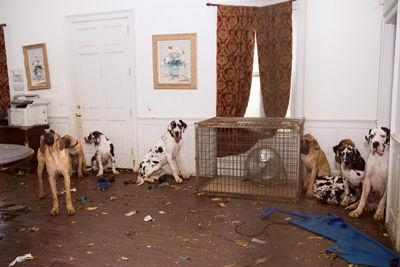
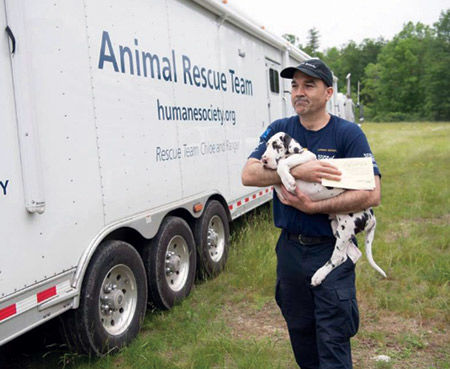
The highly publicized seizure last June of 84 Great Danes in Wolfeboro and Bartlett has brought the issue of animal neglect to the forefront of people’s consciousness, but the case has not explained why people collect more animals than they can reasonably care for.
The court has not yet rendered a final decision in the case of Christina Fay, 59, who stood trial for allegedly keeping her dogs in squalid conditions and denying them adequate food, water and veterinary care. But her case differs from similar claims of abuse in that she is wealthy, and her dogs were living in a mansion.
Typically, when authorities respond to reports of abuse, the animals are in poorly maintained homes, and the perpetrator is on the lower end of the economic spectrum. Some of those cases involve large numbers of animals. A report in Discover Magazine states that three-quarters of animal hoarders have low incomes, 88 percent are unmarried, and two-thirds are elderly.
Yet, like Fay, they maintain that they love their animals and they cannot imagine what life would be like without them. They deny there is a problem, even when animals in their care are suffering.
Veterinarian Donald Lester of Northern Lakes Veterinary Hospital in Ashland said that, in his experience, most people who accumulate animals are kind-hearted and their intentions are good, but they find themselves in a predicament where they have too many animals.
“Their hearts are in the right place,” he said, “but they find themselves without the resources to properly care for their animals.”
That can occur with even a single pet. Lester cited a case from his Lincoln office where a man took in his late father’s dog. The man had a job at a restaurant where the dog could accompany him to work and eat food scraps. The man lost his restaurant job and his next one did not allow him to take the dog along. The dog lost a lot of weight from not being fed properly, and the animal was seized. Fortunately for the dog, it has regained its normal weight, but the man was devastated because the dog was his connection to his father.
“We’ve had two or three abuse cases where we’ve worked through it, and one where the police were involved,” Lester said.
In that case, it also was a human health issue because there were infants and children in the home.
“The person couldn’t keep up with taking care of them,” Lester said. “The Department of Health and Human Services got involved, and said, ‘We’re going to take your children, or someone is going to take the animals.’ Fortunately, they made the right decision and gave up the animals.”
The problem is not confined to dogs and cats.
“You see it also in horses,” Lester said, recounting a case in which the former state veterinarian, Dr. Cliff McGinnis, took a report of horses not being properly cared for. “He went out with a trailer full of hay and said all they were lacking is food. He told the owner that he would be back in a month with an empty trailer and, if the horses were not being fed, he would take them away. He came back again and there was no food, so he took the horses.”
Lester avoided characterizing abusers as hoarders or suggesting they have psychological problems, saying he is not qualified to offer such an opinion.
A September article in Smithsonian Magazine describes a new study, based on research by doctoral student Elisa Arrienti in Brazil, that describes animal hoarding as an independent disorder, unrelated to object-hoarding, that is more complex than a simple diagnosis as a mental health problem.
The article quotes Randall Lockwood, senior vice president of Forensic Sciences and Anti-Cruelty projects for the ASPCA, as saying, “In the past, it has been seen as an addictive behavior, and as a manifestation of OCD [obsessive compulsive disorder]. We’re also now seeing it as an attachment disorder, where people have an impaired ability to form relationships with other people, and animals fill that void.”
Many people say they started collecting animals after a trauma, such as the death of a loved one, and Lester attested to how animals can make up for human contact.
“I like to say, ‘Animals are good people, but people aren’t always good animals,’” he said. “People go through divorces or the loss of a loved one, and it’s easier to get a pet than to find another good human being.”
People who end up with too many pets often seem to be “nice and benevolent” in the beginning, Lester said. “Like many of us in the animal world, we have a hard time saying no to these animals. I think a lot of it comes from that.”
Lester, who provided care for one of Fay’s Great Danes, said, “Everybody’s got a kneejerk reaction, that this woman is probably a horrible person, and she’s not,” Lester said. “My original response was what everybody else’s was, and I was shocked when a client came in and said, ‘That poor woman.’ I don’t have mental health credentials, but I do think she needs some help.”
Veterinarians used to have the authority to take neglected animals but Lester said New Hampshire law now gives that authority to local police officers.
“They’ll either enlist myself to go with them or have the Humane Society come up to verify the animals’ conditions,” Lester said. “In most instances, they’re given chance after chance after chance. It’s kind of sad all the way around. Nobody wants to lose their animals.”
He said it is hard to write a law to protect animals because every situation is different.
“They don’t start out being bad people,” Lester said, “they just get into situations where bad things happen, and, fortunately, there are law in place to mitigate the suffering of the pets. Hopefully, there’s something in place to help the people, too.”


(0) comments
Welcome to the discussion.
Log In
Keep it Clean. Please avoid obscene, vulgar, lewd, racist or sexually-oriented language.
PLEASE TURN OFF YOUR CAPS LOCK.
Don't Threaten. Threats of harming another person will not be tolerated.
Be Truthful. Don't knowingly lie about anyone or anything.
Be Nice. No racism, sexism or any sort of -ism that is degrading to another person.
Be Proactive. Use the 'Report' link on each comment to let us know of abusive posts.
Share with Us. We'd love to hear eyewitness accounts, the history behind an article.