


LACONIA — The Prevention, Enforcement, and Treatment Program that the Laconia City Council set in motion through the police department in 2014 is set to go statewide, with the council’s acceptance this week of a $1.2 million grant from the New Hampshire Department of Justice. The total grant to participating communities is $4.6 million.
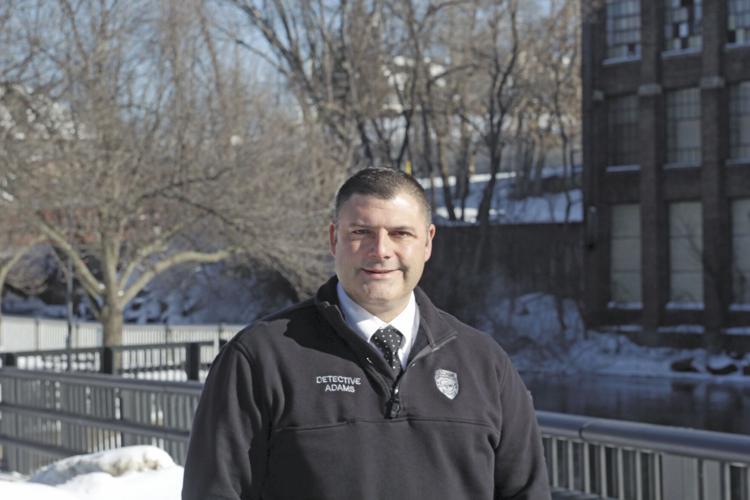
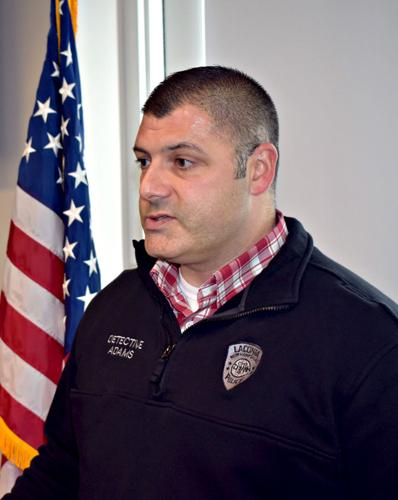
Through the grant, Laconia Police Officer Eric Adams, who has led Laconia’s PET Program since its inception, will become the training officer for seven municipalities initially, with others potentially joining later on.
The program is based on the belief that first responders trained in the relationship between adverse childhood experiences and substance use disorder will be able to deal with drug users in a more humane and effective manner. The program focuses on linking users with community resources that can help them overcome their problems and avoid recidivism.
The grant proposal states that “each community is very different but the elements of the program can be shaped so that it works in every location.” To that end, Adams will travel to each police department and assist in building the program. Together, they will identify community resources that are available to help those with addictions overcome their problems.
“It’s really about building community collaboration,” Adams said, “and humanizing some of the things we do on a daily basis.”
The grant will cover Adams’ salary, and the Laconia Police Department will hire someone to take over his role here. While Adams could have moved to an office in Concord, he said he wished to remain in Laconia.
The expanded program also will incorporate the experience of Manchester’s Adverse Childhood Experiences Response Team which includes a Manchester police officer for law enforcement, security, and safety, and a family advocate from Amoskeag Health to provide emotional and physical support.
The “pilot” phase of the program will focus on Laconia, Berlin, Belmont, Claremont, Merrimack, Londonderry, and Manchester, with the possible addition of a police department from Strafford County.
By dedicating a full-time police officer to respond to all overdose calls in the community, Laconia has shown how a collaboration with other resources can produce positive results for both the addicted and their families.
The plan calls for developing a system of referrals to integrate police work with community resources while building trust among those with addictions and establishing community support for the program. As the success of the program becomes apparent, Adams expects other communities to join in.
Beginnings
The Laconia City Council in 2014 asked the former police chief to try and address the wave of opioid drug overdoses leading to the deaths of even younger users. The “war on drugs” had some successes, but did not seem to be keeping up with the problem.
As originally outlined, there would be a new position in the police department to focus on making presentations to the community in order to build awareness of the problem.
“It was sold as, ‘You’re going to be doing a lot of presentations to the community about addiction,’” Adams recalled. “What person really enjoys going into public speaking?”
Adams’ background was as a corrections officer at the state prison, then as a Tilton police officer who joined the state Drug Task Force, doing narcotics investigations. He returned to patrolling in Tilton until he had an opportunity to join the Laconia Police Department as a patrol officer.
“I got hired here in 2012, and I loved it,” he said. “I just love the city, and I enjoy the people.”
When the new position opened up, he volunteered, figuring it was a way to use his prior experience in drug enforcement.
“I was like, okay, this is something I could do,” he said.
He now admits how little he knew at the time. They started by identifying 10 drug users who the department was dealing with on a regular basis, “and I was basically just kind of reaching out to them. I started going to the overdose calls and talked to them.”
Adams tried to find what resources were available to help them and that is when he began to learn the relationship between trauma and drug misuse.
“When I worked narcotics, I didn’t care whether you were buying drugs for your own personal use or for sale,” he said. “I just knew if you were involved in it, I was gonna arrest you.”
Once he found himself driving people to recovery centers and to counseling, he learned from them things like never saying, “I can understand what you’re going through,” because it is impossible to know all of the things others are experiencing.
He learned to build support by offering them structure, such as contacting him twice a day to ask how they are doing. He learned to recognize that people in recovery will have setbacks, and to just express that he’s glad they survived and are still alive.
“Nobody deserves to die,” he said. While it was their choice to take drugs, it often is because of some form of trauma in their lives that they are trying to mask.
The PET Program expands upon how he has learned to train officers to approach people and offer assistance, rather than simply to punish them. There are times when enforcement is appropriate, Adams said, but he worked with the court to establish a route where offenders go back and reconnect with Adams to oversee their recovery and reduce the number of times police have to respond to an overdose.
The New Hampshire Department of Justice recognized the success of Laconia’s PET Program, which led to the current grant.
“Training officers so they have an understanding of what the resources are that are out there, they know they can walk to the main entrance, go up to the information booth, and say, ‘Hey, I’ve got somebody here that really wishes they could talk to somebody,’" Adams said.


(0) comments
Welcome to the discussion.
Log In
Keep it Clean. Please avoid obscene, vulgar, lewd, racist or sexually-oriented language.
PLEASE TURN OFF YOUR CAPS LOCK.
Don't Threaten. Threats of harming another person will not be tolerated.
Be Truthful. Don't knowingly lie about anyone or anything.
Be Nice. No racism, sexism or any sort of -ism that is degrading to another person.
Be Proactive. Use the 'Report' link on each comment to let us know of abusive posts.
Share with Us. We'd love to hear eyewitness accounts, the history behind an article.