


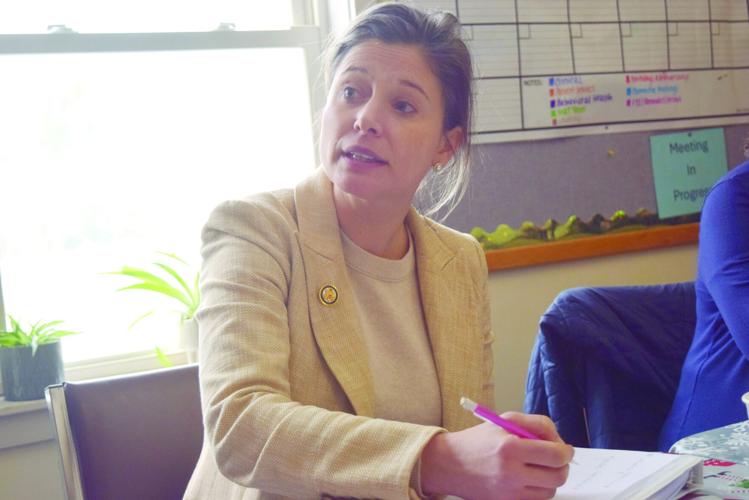
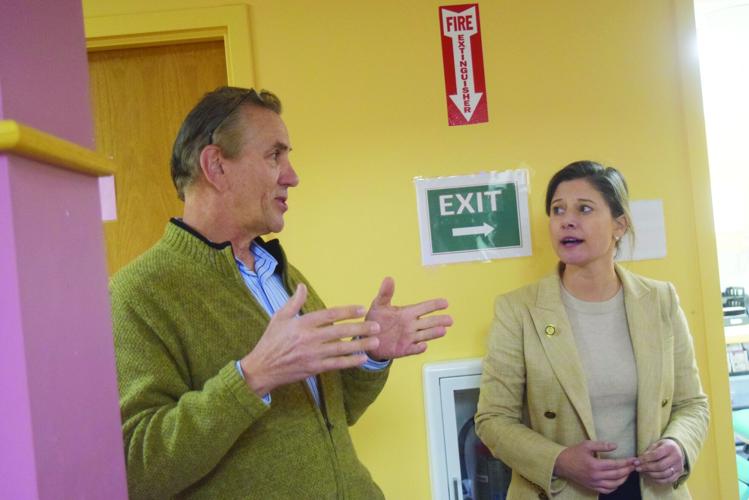
FRANKLIN — Rep. Maggie Goodlander (CD2), during a roundtable discussion at HealthFirst Family Care Center on Tuesday, spoke to health care leaders and local stakeholders about challenges she can impact with federal funding.
Goodlander recently secured $900,000 in federal funding to help expand the facility, including connecting two adjacent buildings to increase capacity for 641 new patients, and 1,671 annual visits, in the Three Rivers City.
The expansion is intended to create an “integrated health campus,” focusing on increasing access to essential services, like primary care and behavioral health, for underserved communities. It also supports both workforce retention and the local economy.
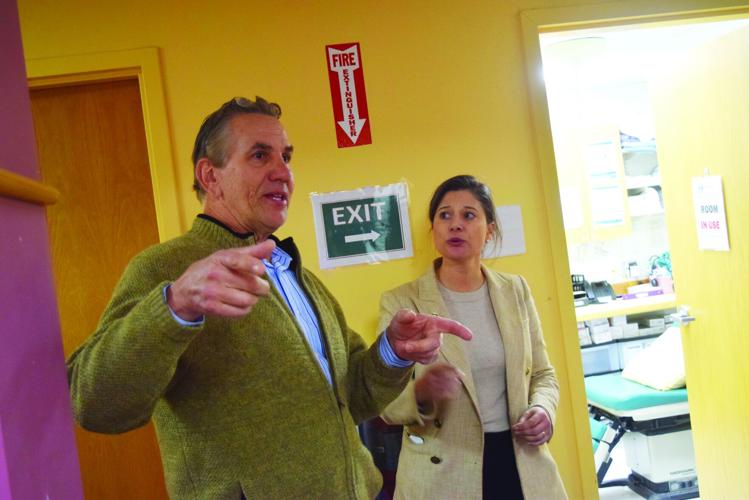
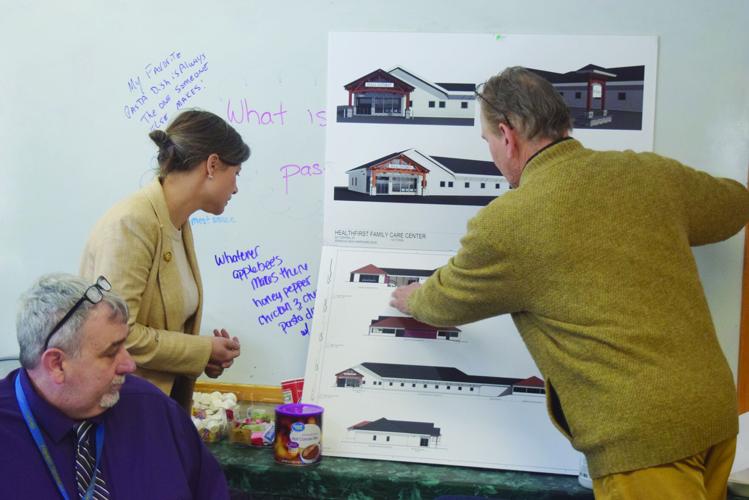
HealthFirst CEO Ted Bolognani showed artists' renderings of the project, which he said will start on May 4, and likely take a year to complete. Bolognani gave a facility tour, and Goodlander saw the functions of the facility, and met its workers.
“Every corner of this wonderful, but very aged building, is being used right now, and put to use,” Goodlander said. “Every time I’ve been here, our hope has been that we would be able to secure this funding. There’s never been a more uncertain time for federal funding, and it was really a year slog to try to advocate for this.”
Goodlander said it is a net positive, for both the state and country, noting the return on investment is massive.
“We’re down the street from the hospital, where the next line of defense are emergency rooms,” Goodlander said. "This comes at an extraordinary cost in dollars, and in people’s lives, when we don’t have the bandwidth in the places — and this is one of these places where we get the best care delivered to people when they need it, and where they need it.”
Goodlander believes in community health centers, and that it's one of the best ideas Congress has ever embraced. She said it is important to make sure they are properly funded.
“We spend more on health care than any country in the history of the world, and so much of that money goes to the biggest corporations in the world, who just don’t need it,” Goodlander said. “They are profiteering off of people's pain and health.”
Goodlander praised the work of community health care centers, saying the organizations have some of the hardest working, and best, providers in the state. Goodlander called HealthFirst an “incredible team” who rallies together to find creative solutions in a “very siloed industry.”
“Every time, though, we dive into the details of what their challenges are when it comes to some of the biggest corporations in the world,” Goodlander said, referring to difficulties health care providers often have with insurance agencies, while working to provide care to patients.
“It’s such a large list of tools that are being weaponized against them, and making it harder for them to do their essential job, and achieve their central mission, which is delivering the care that people in this state need.”
Representatives of other community health care providers, including Mid-State Health Center and Riverbend Community Mental Health, were also there to speak.
Goodlander said she wants to tackle issues, like denied claims from insurance companies.
“Their capacity for denying claims and extracting costs from people who just can’t afford it seems to be boundless,” Goodlander said.
Goodlander said the stories she hears blow her mind, happening due to what she described as “the biggest cuts in American history.” When she has spoken to representatives of HealthFirst and Mid-State, there are two words that always come up to describe the cuts: devastating and catastrophic.
“You heard those words here today, because that is the hand that these health care providers have been dealt,” Goodlander said. “It’s not a winnable game for them, and they are having to make — as their patients are having to make — the most painful choices imaginable.”
During the roundtable, organization representatives spoke about patients who have told them not to fill their prescriptions. HealthFirst Project Manager Stacey Benoit shared a story about was a patient who needed psychological medication, but simply couldn’t pay for it.
Wendy Williams, grants and programming director for Mid-State Health Center, also spoke about how formularies constantly change for prescription medications. With the list constantly shifting, their team needs to keep up with which medications are covered. It often requires doctor intervention, prescription services, meeting the patient, and time-consuming aspects that could be detrimental with some conditions.
“It’s just bad patient care,” Williams said. “If they are trying to manage, prevent, chronic disease, it is just crazy.”
Goodlander also said schools are “convening grounds” for some of the most important care delivered. The Franklin School District was represented at the meeting, with Superintendent Dan LeGallo and Coordinator of School Wellness Barbara Slayton joining the conversation.
Slayton oversees federal funding the district receives for mental health and school safety grants, as well as clinical supervision and oversight of counseling teams. The school district works with both HealthFirst and Riverbend for co-located services, where physicians are there at least one day a week.
“We have a provider room in each of our buildings, so we can take the barriers away. So that kids can get to therapy by walking down the hall, instead of getting to an office, which then provides parental time off, transportation, and those things,” Slayton said.
Franklin schools were a pilot program for HealthFirst, which has since expanded to work with six other school districts and 175 students. LeGallo stressed how important it is to have this type of collaboration.
During Goodlander’s visit to Franklin, she also saw the public library, and spoke with city and school leaders.
Those leaders spoke about rising utility costs, and the inability to afford owning a home, making it harder for economic development.
She also spoke with a group of Franklin High students, who she said are feeling more uncertainty than ever. The conversation ranged from the future of Social Security, to fears about Immigration and Customs Enforcement activity.
“The threats against fellow Americans have never been greater,” Goodlander said. “There’s a real focus here in Franklin, as I’ve heard in communities across the state, including the North Country, what it would mean in New Hampshire to have an industrial warehouse to detain human beings.”
Goodlander referred to a proposed ICE detention facility in Merrimack.
Goodlander has visited Franklin numerous times over the past year, and each time she learns about the community, as it rallies together to do more with less.
“Whether it is the biggest cuts to health care in American history; the senseless, chaotic and truly cruel cuts to education funding, Franklin has had to make some very painful choices on how to dedicate resources.”


(0) comments
Welcome to the discussion.
Log In
Keep it Clean. Please avoid obscene, vulgar, lewd, racist or sexually-oriented language.
PLEASE TURN OFF YOUR CAPS LOCK.
Don't Threaten. Threats of harming another person will not be tolerated.
Be Truthful. Don't knowingly lie about anyone or anything.
Be Nice. No racism, sexism or any sort of -ism that is degrading to another person.
Be Proactive. Use the 'Report' link on each comment to let us know of abusive posts.
Share with Us. We'd love to hear eyewitness accounts, the history behind an article.