


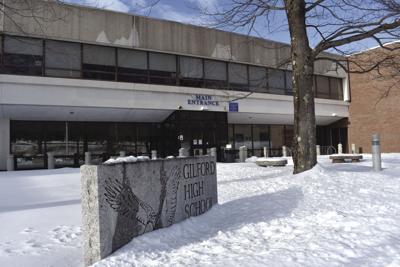
GILFORD — “You were in close contact with another student who tested positive for COVID-19,” Superintendent of Schools Kurt Beitler’s recorded voice said to Josh Dery, 16, a junior at Gilford High School. “You must now quarantine for 14 days. Stay home and stay healthy. Have a nice vacation.”
Dery received this call on Thursday, Nov. 12. He hung up the phone and dropped his shoes; he had been getting ready to leave the house when the call came in. He had an exciting Thursday night planned with his friends after a nice workout at the gym, but the call put an end to all of that.
Dery said he then walked to the kitchen and stood there, disappointed. He blankly surveyed his surroundings then became enraged with his new situation.
Dery’s mother, Andrea Preston, 45, had received the same recorded message about her son. She called him and told him he had to stay put for the week.
When his mother arrived home he met her in their kitchen, where she told him he needed to lay low for the next two weeks.
That was when he first realized he couldn’t go to work for two weeks and, he recalled, he became even more irate with his situation. “That was what really made me upset,” Dery recalled. “Remote learning was fine, not ideal but fine. My teachers know how to teach remotely well enough. But there isn’t exactly a remote way to bus tables.”
The moment in the kitchen was also what sent him up in arms. “I can remember going off on a tangent about how many of our rights are being violated as Americans. Something about how it should be other people’s choice whether they are in contact with me or not.”
He was still upset the next morning about having to quarantine.
“Some of my classes were really good about accommodating me on Friday, others weren’t really aware that I was going to be out, or that others were going to be out as well," he said. "So I missed some classes, which was ridiculously frustrating. The next Wednesday the whole school went remote so I didn’t miss anything after that, which was fine.”
Dery also recalled that he felt quarantining where it really hurt – in the wallet. “I was already in debt, I owed my mother some money and needed to fix my brakes on my car," he said. "I also needed snow tires.”
Dery said all he felt he could do was drive, sit around, do homework and play Xbox.
Dery drove to Plymouth to get a rapid test for COVID-19, which came back negative. “I felt a rush of relief, I could now see my friends and be around people.” he recalled. “I knew I wasn’t 100 percent cleared to be out in public so my family and I were still careful, but if my friends knew the risks they were getting into I’d still have them over. Because I wasn’t officially released from quarantine until the following Friday, I stayed pretty much to myself.”
When his 14-day quarantine was over, Dery said he went to work, earned some money to work off his debt, drove some of his friends to Concord and got some Taco Bell: “I felt so free, after 14 days of being stuck at home just because you might be sick, it felt so nice to leave and go out into the real world and interact with other people. People besides your own family that is.”
Some teachers also had to quarantine because of the outbreak at the school. One teacher who agreed to speak about her experience only under the condition of anonymity said she was notified of her exposure through a text message from Anthony Sperazzo, the Gilford High School principal. She said she wasn’t particularly surprised to receive the news because of the recent spikes in the Lakes Region.
She was out when she received the message, so she had to go home.
“This whole thing kind of ruined my weekend. I was supposed to meet my baby niece. So that was disappointing.”
She said the most stressful part of the whole thing was trying to remember where she was at what time that week. She also scheduled a COVID test for that Tuesday, then went through contact tracing with the administration, “I strongly advocated that everyone in the class with my positive student be quarantined,” she said.
She said the administration is handling the COVID issue well given all of the things on their plate, but believes the school should have gone remote sooner.
She used Google Meets to teach her in-person students from home for two days in November, and said it seemed to work well for the circumstances.
That same week the school went full remote for all classes, which has its own set of challenges. “Remote learning is a lot more clerical work than I’m used to. Toggling between screens, setting up one-on-one Google Meets, writing comments on documents. That’s all stuff that when we’re in person just requires me to walk over to my students.”
She said the district did a nice job of preparing teachers and students for the possibility of going remote, and at creating a structure for kids who were learning remotely schooling. She said students log in to every class and teachers either do lessons or give students work to do independently. At the end of the session, students check in again before they leave their meeting.
“It feels like a lot of screen time," she said. "I’m on my computer from 6:30 a.m. until 3:30 p.m."


(0) comments
Welcome to the discussion.
Log In
Keep it Clean. Please avoid obscene, vulgar, lewd, racist or sexually-oriented language.
PLEASE TURN OFF YOUR CAPS LOCK.
Don't Threaten. Threats of harming another person will not be tolerated.
Be Truthful. Don't knowingly lie about anyone or anything.
Be Nice. No racism, sexism or any sort of -ism that is degrading to another person.
Be Proactive. Use the 'Report' link on each comment to let us know of abusive posts.
Share with Us. We'd love to hear eyewitness accounts, the history behind an article.