


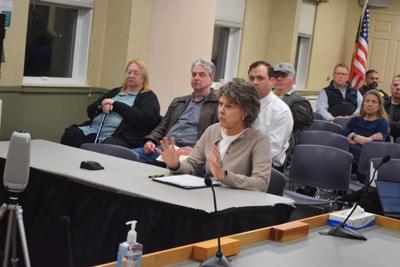
GILFORD — The newly created energy committee has been researching solar power options, and provided an estimate for a discounted array at the new public works building at the tune of $240,000.
Committee Chair Lena Nirk told the selectboard, on Oct. 28, that Revision Energy came to town for a site visit, free of charge, and recommended 339 clip-on solar panels at a cost of $400,000. With a potential 40% discount through an investment tax credit, the total would be $240,000.
“I do want to stress this informal site visit, this is not a bid,” Nirk told the selectboard. “This is sort of a general, ballpark estimate.”
The committee has had four meetings since it was voted into existence at Town Meeting. At the second meeting, the committee heard a presentation from Clean Energy New Hampshire, a nonprofit company that supports energy efficiency and renewable energy sources. Nirk said the organization provided resources the town could access, and they track available federal and state grants.
“One of the federal rebates, or programs, that’s still around is a 40% federal investment tax credit for solar on municipal buildings,” Nirk told the board. “This is around until the end of December 2027. There are some requirements in that the project has to be completed by the end of December, and hooked up to the grid.”
Nirk said the credit is 30%, but with the required amount of “domestic content,” another 10% will be taken off the cost of the project.
The domestic content bonus credit is available to taxpayers certifying their energy project was built with certain percentages of steel, iron or manufactured products mined, produced or manufactured in the United States, according to the IRS website.
This caught the committee’s attention, as a stipulation in the warrant article leading to its creation was to look at solar for the new public works building. An informal site visit was done, which provided a ballpark cost and the amount of panels needed.
At the beginning of October, Revision Energy requested the energy bills for three town buildings — public works, fire department, and town hall — so they could understand the towns' capacity. The company knows the building is new, and is assumed to be more efficient, even being much larger.
Nirk said the town’s grid is ready to accept the project, which would be a small, customer generator causing no hold ups. Revision Energy examined the buildings, and the most cost effective location is the public works building.
The town hall’s roof configuration made this a less desirable option, and Nirk added the fire department could be a spot to consider in the future, when its roof is replaced.
Revision Energy provided a cash flow analysis showing the simple payback would be eight years, and without the tax credit, it would be about 13 years.
Nirk said the panels are guaranteed for 25 years, but they would likely last much longer, and Revision Energy provided information going out 40 years to show the savings.
“In these numbers, they assume that in the summer, these panels would cover completely the cost of the public works building, and we would be able to sell back to the grid during the summer period,” Nirk said.
Nirk said Revision didn’t expect the array to cover all winter needs, but it depends on the load.
She said there were questions about how the panels degrade over time, and said they are a “solid state type of device,” and the life depends on the manufacturing. Nirk said 95% of the materials can be recycled, and they are mostly made up of glass, aluminum, plastic, copper, silver and “some other metals.”
“There has been, in the past, some misunderstanding of are these panels a hazardous substance; do they need to be treated that way?” Nirk said. “Less than 1% of what’s in a panel might be hazardous.”
She said the price of recycling a panel is currently $28, and in 40 years, that price will change, but it may actually decrease, because of values fluctuating.
“It’s a pretty good market, even now, where some of the early panels coming out of use are now being recycled,” Nirk said.
There are only a few maintenance costs, and one is the inverters, which will need to be replaced after 20 years.
The $11.2 million building is mostly finished, with Public Works Director Meghan Theriault saying there are just a few odds and ends to wrap up. Employees are now working in the building.
Selectboard Clerk Richard Grenier wasn’t keen on bringing solar power to the building, as he was chair of the public works building committee for three years, and that group found solar power not to be feasible.
“We had a discussion about solar, and we unanimously voted to not do it,” Grenier said. “We had concerns about putting things on the roof. Is there any other way it can be done?”
Grenier asked if the ground were an option, and Nirk said it would likely be expensive. She added the roof was studied, and it is capable of handling the solar.
“It’s actually a good thing,” Nirk said. “That was sort of the issue with the fire station. Their roof is older.”
Vice Chair Gus Benavides said he’s always in favor of trying to find alternative fuel, and noted costs are high for utility rates across the board. He wants to save the taxpayers as much money as possible, and wants to consider any startup costs or money that might need to be spent down the line.
“We’re trying to think outside the box on what we do, but at the same time, I really want to point out the fact that you have addressed the issue that this board has been concerned over the years, is what is the cleanup cost, forgive me for that word, recycling cost,” Benavides said.
Benavides was concerned, because 20 years ago, the town was told geothermal energy was the “latest and greatest technology,” and an “end all, solve all.” Now, two decades later, they are wishing they hadn’t gone that route.
“We have to be faithful to the residents of the town,” Benavides said. “Are we passing on a debt or an expense 20 years from now, 25, 40 years from now? Our kids and grandkids are going to look back at us and go, ‘what were those guys thinking?’”
Benavides wants to make sure the research is thorough. He asked about the particulars of how it's paid for. Nirk said the project would be paid for up front, then reimbursed through federal funds, but she needed to find specifics.
Benavides said this is where homework needs to come in, and he used the police department as an example of looking into all avenues to get as much grant money as possible.
Grenier said the project is moving quickly, noting it took years for the public works and transfer station projects to be formulated before ever breaking ground.
The board recommends checking with other participating municipalities who have used such grants, make site visits, and reach out to multiple organizations to see how estimates compare. Ultimately, a project like this would come before the voters at Town Meeting.
“It would be interesting to see if, when and if, we do put this out for bid what those final numbers will be,” Benavides said. “I realize it’s more than one company, but it’s not like there’s going to be a ton of companies out there. But, I would have to assume that the solar companies would love to bid on a project like that, if we got to that point.”


(0) comments
Welcome to the discussion.
Log In
Keep it Clean. Please avoid obscene, vulgar, lewd, racist or sexually-oriented language.
PLEASE TURN OFF YOUR CAPS LOCK.
Don't Threaten. Threats of harming another person will not be tolerated.
Be Truthful. Don't knowingly lie about anyone or anything.
Be Nice. No racism, sexism or any sort of -ism that is degrading to another person.
Be Proactive. Use the 'Report' link on each comment to let us know of abusive posts.
Share with Us. We'd love to hear eyewitness accounts, the history behind an article.