


LACONIA — Efforts to help those struggling with substance misuse succeed due to a willingness to improvise and collaborate between many community agencies.
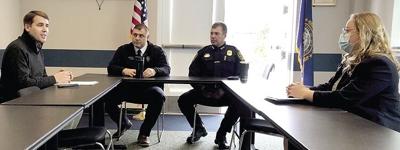
Members of law enforcement, and human service agencies stressed that point as they met Thursday with U.S. Rep. Chris Pappas in Laconia for a roundtable discussion on the expansion of the Prevention, Enforcement, and Treatment Program — or PET — and discussed federal grants recently awarded to the state to train local law enforcement in ways to better handle overdoses and other addiction-related crises and also build stronger community access and networks for first responders.
The $4.7 million grants will integrate the PET Program with the Adverse Childhood Experiences Response Team Technical Assistance Center, operated through the Manchester Police Department, which helps families and children impacted by overdoses or other trauma connect with services.
Pappas said the interdisciplinary approach provided by PET and ACERT should help first responders be more effective in dealing with drug users, many of whom have emotional troubles in addition to their addiction, as well as affected family members.
He said there were 100,000 overdose deaths around the U.S. last year. Locally, Laconia Police Chief Matt Canfield said his officers had been called to between 80 and 90 overdoses in the city last year, with 14 of them fatalities.
“It’s a struggle (for addicts) every day, but that struggle can be managed and they can get help,” Canfield said.
But a holistic approach to the issue is essential if those who are in addiction are going to get that help, he said.
The ACERT program in Manchester is made up of a police officer, a crisis services advocate, and a behavioral health professional. The team goes as soon as possible to the scene of an overdose or other traumatic event to determine what services the children who witnessed the event should receive, such as counseling, support groups, or education.
Participating in Thursday’s discussion was Laconia Police Officer Eric Adams who joined the Laconia Police Department in 2014 and has played a major role in building the PET program from the ground up.
Others taking part were Maggie Pritchard, chief executive officer of the Lakes Region Mental Health Center; Erin Pettengill, president of the Family Resource Center of Central New Hampshire; Katie Burns, ACERT supervisor for Amoskeag Health; and Siobhan Balazs, ACERT coordinator at Lakes Region Community Services.
Adams said six police departments around the state, including Belmont, are looking to start their own PET Program. Utilizing funds from the grant, Adams will become the training officer for other departments who wish to join the program. The Laconia Department will hire someone to take over Adams’ duties in Laconia.
For the program to be effective, police need to identify those in the community who are struggling with drug abuse and then build relationships with those individuals as well as their families. Adams said that establishing connections with those in the human service field is also essential to providing the kind of wraparound support services addicts or their families need.
PET is not a one-size-fits-all kind of program. Adams said the program will need to be tailored to each community in order for it to be effective. Small departments, with two or three officers, will not be able to just copy Laconia’s program. Rather, he said, they may find the best approach will be to look at working with similar-sized departments in their area and putting together a regional program.
Experimenting with a variety of ideas and approaches had been critical to the Laconia program’s success, he said, adding other departments should feel comfortable to improvise in order to make the program work for them.
“It will mean a diversity of approaches,” Pritchard said.
Partnerships with counseling centers, treatment facilities, and other human service agencies has been vital.
“We work collectively,” said Pettingill. “The level of collaboration in Laconia is fantastic.”
Pappas said he is co-sponsoring a bill in Congress to allow PET and ACERT to become a national program.


(0) comments
Welcome to the discussion.
Log In
Keep it Clean. Please avoid obscene, vulgar, lewd, racist or sexually-oriented language.
PLEASE TURN OFF YOUR CAPS LOCK.
Don't Threaten. Threats of harming another person will not be tolerated.
Be Truthful. Don't knowingly lie about anyone or anything.
Be Nice. No racism, sexism or any sort of -ism that is degrading to another person.
Be Proactive. Use the 'Report' link on each comment to let us know of abusive posts.
Share with Us. We'd love to hear eyewitness accounts, the history behind an article.