


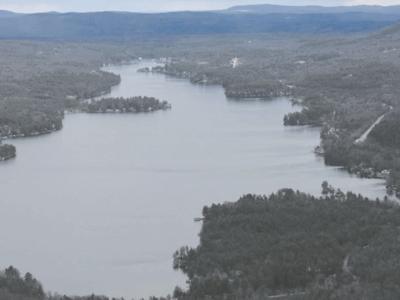
LAKE WINNIPESAUKEE — It might just be a record. Ice-out was declared Sunday, March 17, following a 4:37 p.m. flight by a pilot with Emerson Aviation.
Dave Emerson, speaking by phone, said he was out of town for the declaration, but one of his pilots, Matt Gianunzio, was able to take advantage of a break in the weather on Sunday afternoon for a tour of the lake.
“We were watching it all week long. When I left for a tradeshow last week, Meredith, Alton, Wolfeboro and Center Harbor still had ice,” Emerson said. Wolfeboro Bay cleared up on Tuesday, and then there were some days when fog and rain kept pilots on the ground.
Gianunzio took flight on Sunday morning, and saw there was still a span of ice between Echo and Sandy points, at the mouth of Alton Bay. But when he went back up in the late afternoon that ice had cleared.
With that bay fully liquidated, it meant the M/S Mount Washington could navigate to all of its ports of call around Lake Winnipesaukee. In other words: ice-out.
When ice-in was declared earlier this year, it was reported the earliest date on record for ice-out was March 16. However, Emerson said on Sunday that a double-check of historical data showed the previous record was actually March 18, meaning this year’s thaw could be the earliest in recorded history.
“Normal ice-out is the third week of April, that’s the norm,” Emerson said. “It’s been trending toward the beginning of April for the last couple of years.”
Also notable was the late ice-in this winer, which wasn’t declared until Feb. 9, the day before the Great Meredith Rotary Fishing Derby. Though ice-in and ice-out sound like opposites of each other, they are actually only loosely related. Ice-out signifies the navigability of Winnipesaukee, while ice-in is declared when all major sections of the lake — all the bays plus The Broads — are covered in ice.
“We only had one day of ice-in this year, which was incredible,” Emerson said. Ice-in lasted for about 24 hours, then a warm day followed by a windy day broke up much of the ice that had just formed.
“We never, never got any thickness of ice at all,” Emerson said. Temperatures stayed fairly mild for winter in the Lakes Region, with many daytime highs above freezing, and no real deep cold to speak of.
“A lot of wind, a lot of rain,” Emerson said. The rain in particular kept currents flowing through Winnipesaukee, which further inhibited ice formation.


(1) comment
I am curious how much all the ice-eaters affect the ice cover. There seem to be more of them than I remember. Furthermore, some of them are clearing much more ice than they need to.
While I expect they lead to an earlier ice-out, I hypothesize that the lack of an insulating ice cover leaves water exposed to colder temperatures on freezing nights. It might not be as straight forward as it would initially seem.
Welcome to the discussion.
Log In
Keep it Clean. Please avoid obscene, vulgar, lewd, racist or sexually-oriented language.
PLEASE TURN OFF YOUR CAPS LOCK.
Don't Threaten. Threats of harming another person will not be tolerated.
Be Truthful. Don't knowingly lie about anyone or anything.
Be Nice. No racism, sexism or any sort of -ism that is degrading to another person.
Be Proactive. Use the 'Report' link on each comment to let us know of abusive posts.
Share with Us. We'd love to hear eyewitness accounts, the history behind an article.