




BY DON CAMPBELL, LACONIA DAILY SUN
MOULTONBOROUGH —With about a month to go until its March 1 deadline, the Moultonborough Conservation Commission is just a little over $76,000 away from its goal of preserving the Moultonborough Falls Conservation Area, according to Commission Chair Marie Samaha. A New Hampshire Moose Plate grant of $24,000 and a generous gift from an anonymous Moultonborough resident helped them substantially, she said. The 37 acres of undeveloped forest, marsh and open water in the proposed Conservation Area are home to an abundance of wildlife. Preserving it will also protect a vital wildlife corridor between the Garland Pond Conservation Area and the wildlife habitat in the Lees Pond area, help protect the local water quality, and help mitigate the potential flooding caused by storms, Samaha said.
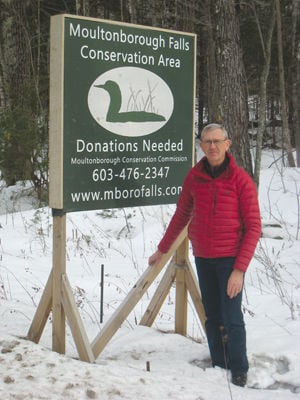
John Oliver
In 21st century America, it's pretty rare for people to stay put in their hometowns their entire lives. John Oliver is one of those rare individuals. His family has deep roots in Moultonborough, owning one of the original farms that Thomas Plant bought up in order to build his estate, Lucknow, which today is known as the Castle in the Clouds. Oliver's family then bought a farm on Sheridan Road in Moultonborough, which is where he grew up. Today, he lives in a house across the road from that farm. Apart from his time in the military, he has never lived anywhere but in his hometown. "Red Hill was my playground," he said with a smile. "I didn't go far."
Oliver earned a bachelor's degree in conservation from the North American School of Conservation and worked as a deputy warden for the New Hampshire Department of Fish and Game for over 20 years. During that time, he served as foreman of two of the department's fish hatcheries, in Ossipee and New Hampton. He is currently an advisor to the Lakes Region Conservation Trust and a member of its Lands Committee. He has donated many acres of land around Garland Pond to the Nature Conservancy, which now make up part of the Garland Pond Conservation area.
From childhood through adulthood, Oliver was well positioned to observe changes in the wildlife habitat as more and more houses and businesses were built in the Lakes Region. What he has seen over the years has led him to devote his life to preserving as much of the wildlife habitat in his region as possible.
"In my lifetime here, we have lost so much wildlife habitat," Oliver said. As an example, he points to a very active wildlife corridor that used to exist between the land behind Chickadee Station on the north side of Route 25 and Mud Pond and Green's Basin on Moultonborough Neck to the south. The wildlife now navigate around the additional businesses along Route 25 and the houses built on the land behind Chickadee Station. "A few white-tailed deer still cross there, but a lot fewer than before. Black bear have stopped using that corridor altogether," he said.
Oliver said that he and his father used to fish all over the area when he was growing up. "Shannon Brook, near Suissevale, used to be filled with smelt. Once Suissevale and Balmoral were built, the runoff changed the quality of the water in the brook. No more smelt," he said. "The same thing happened to the brook that runs out of Lake Kanasatka into Blackie's Cove on Winnipesaukee. it used to be filled with smelt." The smelt supported a healthy population of lake trout and shad in Lake Winnipesaukee; once the smelt declined, so did the lake trout and the shad. The Fish and Game Department now stocks the Lake with landlocked salmon for fishermen to catch, Oliver explained.
The land where the Moultonborough Airport is built is another example of the consequences of habitat loss, according to Oliver. When the airport was built, Weed Brook was relocated so that it flowed into a swamp on the north end of Berry Pond, instead of into the southern end, he said. In the process, it changed the circulation of water in the pond and eliminated the habitat that the woodcock used for its cover, which is an area where birds shelter during their migrations. "That used to be the best woodcock cover probably in the state," he said. “You used to see thousands of woodcock there. Now there are none," Oliver said.
A change in the way property is developed has also contributed to the loss of wildlife habit, according to Oliver. “You’ll notice that the older houses were built right on the roads,” he points out. “That didn’t take up so much wildlife habitat. These days, people are building in the middle of their properties, well away from the roads. That impacts a lot more wildlife habitat.”
Preserving wildlife corridors
Oliver said that one of the crucial goals must be to preserve the connections between surviving wildlife habitats in the Ossipee Mountains, Sandwich Mountains, the Red Hill watershed, Garland Pond, and the north end of Lake Winnipesaukee. “The animals need to be able to travel around their range,” Oliver explained. “They don’t simply stay in one place. They need to be able to move around. And generation after generation, wildlife use the same corridors.”
Emma Tutein, a wildlife biologist at the University of New Hampshire in Durham, helps conservation commissions around the state identify the areas of wildlife habitat, and the wildlife corridors, in their towns that are important to preserve. “Wildlife tend to follow natural features like rivers, brooks, ridgelines, and wetlands, depending upon the species,” she explained. “For example, river otters and mink would tend to follow rivers and brooks, whereas to white-tailed deer what might be more important is the absence of roads.”
The Moultonborough Falls wildlife corridor
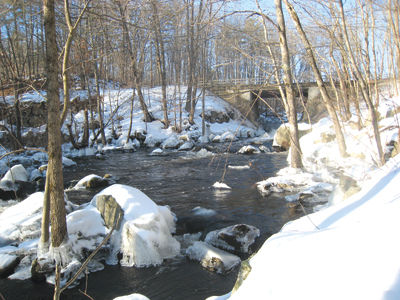
The Red Hill River flows from Red Hill Pond in Sandwich, down to Garland Pond, under Route 25 at Moultonborough Falls, and then into Lees Pond at the top of Lake Winnipesaukee. That connection between Garland Pond and Lees Pond is a vital wildlife corridor connecting the two areas of wildlife habitat, Tutein said. Preserving that corridor is one of the most important reasons that the Conservation Commission is working to preserve the Moultonborough Falls Conservation Area. “That river is going to become increasingly important, despite the human habitation around it,” Tutein said. Oliver agrees. “As far as water animals like otter and mink are concerned, that corridor is one of their last remaining wildlife corridors,” he said.
Oliver stressed that the goal is not to stop growth. "You're not going to stop development, but I just hope we can strike a better balance and preserve some of the remaining wildlife habitat," he said.
Area residents wishing to support the project can send checks made out to "MFCA" to the Moultonborough Conservation Commission, P.O. Box 139, Moultonborough NH 03254. For more information about the Moultonborough Falls Conservation Area visit www.mborofalls.com or its Facebook page at www.facebook.com/mborofalls.
John Oliver (Don Campbell/Laconia Daily Sun)
The Red Hill River flows under the Moultonborough Falls bridge over NH Route 25. This is a vital wildlife corridor between the Garland Pond Conservation Area and the Lees Pond wildlife habitat. (Don Campbell/Laconia Daily Sun)
Map of the 37-acre Moultonborough Falls Conservation Area (outlined in red). (Courtesy photo)
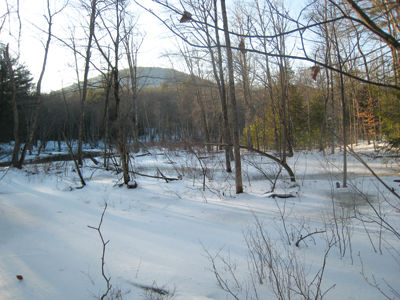
A view of Red Hill, at upper left, looking across the Red Hill River from below Moultonborough Falls. (Don Campbell/Laconia Daily Sun)
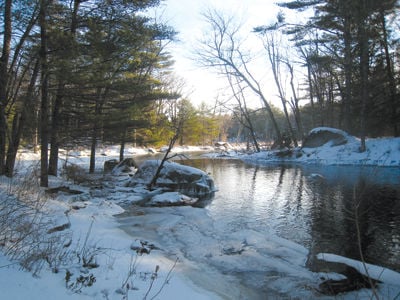
The Red Hill River flows towards Lees Pond. (Don Campbell/Laconia Daily Sun)
The Red Hill River flows over a second mini-falls, on its way to Lees Pond. (Don Campbell/Laconia Daily Sun)
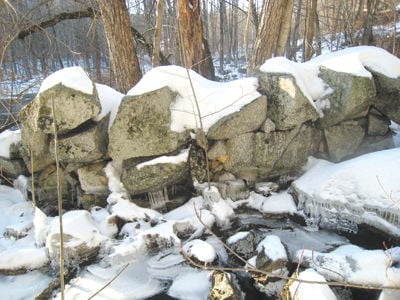
The Conservation Area also includes these remnants of the history of the village of Moultonborough Falls. These stones formed part of the foundation of the saw mill that used to operate on the Red Hill River just south of the present Moultonborough Falls bridge over Route 25. (Don Campbell/Laconia Daily Sun)


(0) comments
Welcome to the discussion.
Log In
Keep it Clean. Please avoid obscene, vulgar, lewd, racist or sexually-oriented language.
PLEASE TURN OFF YOUR CAPS LOCK.
Don't Threaten. Threats of harming another person will not be tolerated.
Be Truthful. Don't knowingly lie about anyone or anything.
Be Nice. No racism, sexism or any sort of -ism that is degrading to another person.
Be Proactive. Use the 'Report' link on each comment to let us know of abusive posts.
Share with Us. We'd love to hear eyewitness accounts, the history behind an article.