


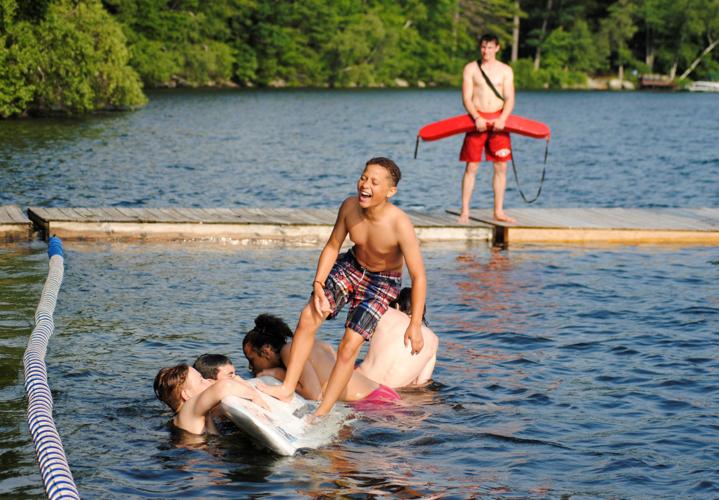
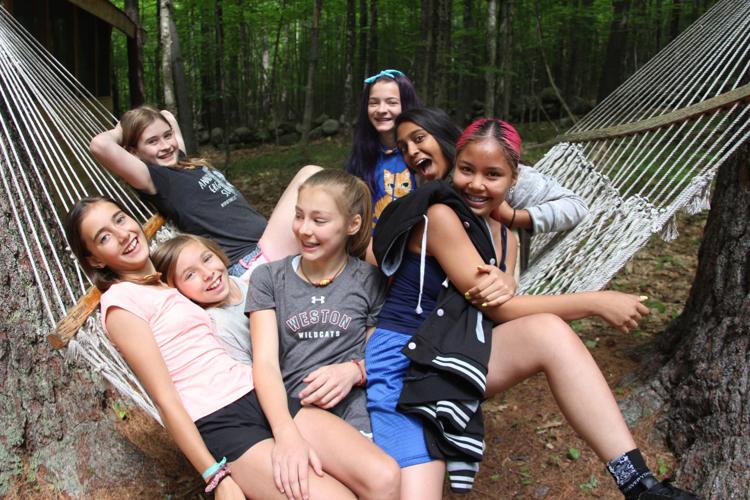
Think of summer camp, and some things leap to mind: learning to paddle a canoe, singing songs and hiking, pulling a bowstring against your cheek and letting loose an arrow. There are two camps in the region that do all of the traditional things, but with an unusual wrinkle – they are dedicated to giving these experiences to children that normally wouldn’t be found around a campfire.
Camp Hale, established in 1900, occupies the northern end of Squam Lake in Sandwich, and is operated by United South End Settlements, which provides services and programming for young people growing up in Boston’s South End. The children that it serves can spend anywhere from one week to a month each summer at Camp Hale, with fees on a sliding scale based on household size and income.
Camp Hawkeye is only about a century younger than Camp Hale. Located on Lake Kanasatka in Moultonborough, Hawkeye is in its 14th summer of bringing children of all backgrounds to camp. The goal is a diversity of campers – all religions, all ethnicities, all economic backgrounds – to learn and play together. Camp founders Garrett and Jess Colgan-Snyder raise money during the off-season so that they can provide scholarships to campers that wouldn’t otherwise be able to consider camp.
Hawkeye
Neil Preston grew up in Northampton, England, a city of more than 200,000 people about 60 miles from London. He was 13 when he first came to Camp Hawkeye, and it didn’t take long for the setting to make an impression on him.
He had a long day of traveling, including getting lost, so it was after sundown when Preston finally found Hawkeye. He had traveled in the U.S. previously, to play soccer in Arizona, but he had never been anywhere like the Lakes Region.
“It was a big shock. I remember the first time I arrived, it was at night. Garrett walked us across the grass field, then he had us stop and look up.” That was the first time that Preston had seen the Milky Way with his own eyes. “The mountains, the lakes, even the bugs, the mice in the cabins, it was a really different experience.”
Preston, now 27, came back every summer, then became a counselor-in-training, then junior counselor, counselor, junior counselor coordinator, even camp chef for one very hot summer. He now works full-time as head counselor, spending the off-season recruiting young people to spend their summers as counselors, and even younger people to become campers.
It was Preston’s history teacher back in Northampton, Phil Chapman, who had spent his previous summer as a counselor at Hawkeye, who suggested the camp.
“I really enjoyed being in America. Everything was bigger, the people were friendly,” Preston said. And, the camp experience changed him, especially learning new skills while shoulder-to-shoulder with someone completely different, yet, fundamentally similar.
“It’s a place where people are loved for who they really are. We have people from different race, religion, backgrounds, you can come here and be yourself and people will really respect that,” he said.
This year’s camp roll will include people from England, Canada, continental Europe, as well as all over the eastern United States. “Mainly, we try to get kids that we think would really benefit from this program,” Preston said. “People find our website online, they see the diversity, they ring us and want to be part of it, which I think is incredible.”
First-time campers often are drawn by the activities, but by the time they become adults, they’ll realize that it was the bonds they forged with fellow campers that were most valuable.
“Bringing these people together is a real opportunity to see what else is out there in the world, to gain more respect and to feed off each other. People understand that we’re all different, but we all need the same respect.”
Camp Hawkeye has been leasing its property in Moultonborough, and Preston said the operation has grown to the point where the Colgan-Snyders are looking for a property they can purchase and welcome more campers.
Hale
Camp Hale owes it name to Rev. Edward Everett Hale, who started a series of “settlement houses,” which sought to place college-educated people within impoverished communities to better connect the residents with resources that they might not know are available to them.
That effort evolved into the United South End Settlements, which offers early childhood, after school and summer programs for children, and coaching for their parents.
USES also operates Camp Hale, which operates four sessions each summer, with room for 60 children per session.
There are advantages to being a summer camp for more than a hundred years. One of those is that former campers have become parents, and they want their kids to have the Camp Hale experience. Another is that many former campers have found themselves in a position to become significant donors.
That’s a useful thing, because there are also drawbacks to being more than 100 years old. Julia Johannsen, USES board chair, said that when she first came to see Camp Hale in 2010, it was apparent that a capital campaign was necessary.
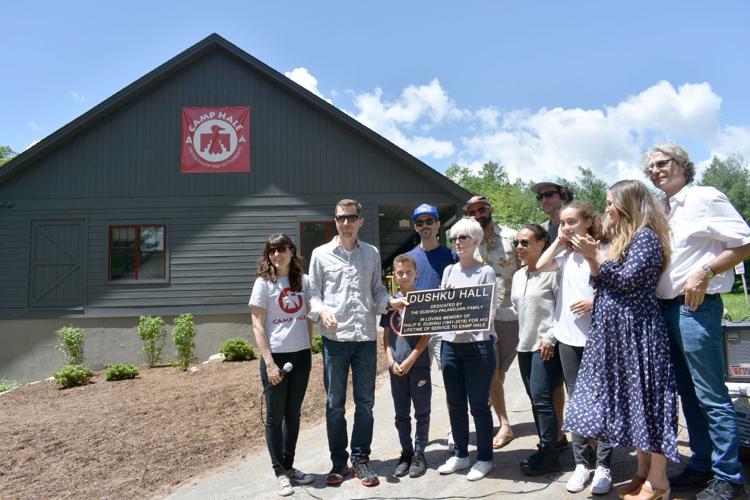
“It was in need of a little TLC,” she said. Some $3.4 million worth of tender loving care, to be precise. Camp Hale just celebrated the conclusion of the first phase of its campaign, which included a septic system, a new, much larger dining hall, new residence halls for counselors, and a revised road system that makes better use of the camp’s land. Next up is fundraising for a $1.1 million campaign to expand capacity of camper cabins and make other improvements.
Jerrell Cox, camp director, said he was glad to have “the site match the quality of programming for the kids of Camp Hale.”
Many former campers attended a ribbon-cutting celebration for the new dining hall. They said the weeks they spent at camp played an outsized role in forming them into the adults they are today.
Malik Morgan, 23, grew up in Roxbury, Massachusetts, one of eight children. At home, he was content to stay home, where he was safe and comfortable. But then his older brother came back from Camp Hale full of stories, and his mother said that he could go, too. And he found a completely different environment.
“I’d never been in the forest like this,” he said. He was six the first year he came to camp, and he returned every year, as a camper and then counselor, for 16 years.
“When I started coming here, I was complete opposite of what I am now. Every single time I came back it grew my confidence,” Morgan said. “It gave me the compassion to listen to people about their interests, and their problems, too.”
Tristan Coren, 18, started coming to Camp Hale in 2012, the first year the camp opened its programming to girls. She’s now a counselor.
“It taught me a lot of things about being a leader and presenting myself as a professional,” Coren said. “Camp was able to bring me completely out of my shell.”
Andrea Cox said she saw a similar transformation in her son, Jerrell, now the camp director. He first came to Camp Hale when he was 11, Andrea said. The experience changed “everything,” she said.
“His attitude changed. He learned to swim here, it was just amazing. It’s such a good outlet for him… It was the best thing for us. We didn’t want him in the city in the summer, doing nothing” Andrea said.


(0) comments
Welcome to the discussion.
Log In
Keep it Clean. Please avoid obscene, vulgar, lewd, racist or sexually-oriented language.
PLEASE TURN OFF YOUR CAPS LOCK.
Don't Threaten. Threats of harming another person will not be tolerated.
Be Truthful. Don't knowingly lie about anyone or anything.
Be Nice. No racism, sexism or any sort of -ism that is degrading to another person.
Be Proactive. Use the 'Report' link on each comment to let us know of abusive posts.
Share with Us. We'd love to hear eyewitness accounts, the history behind an article.