


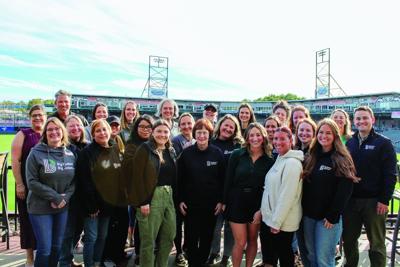
Several years ago, Big Brothers Big Sisters of New Hampshire reached out to their sister agency in Vermont like, well, a big sister.
The group in the Green Mountains had a small team, and it was struggling with resources and staff retention. NH Chief Executive Officer Stacy Kramer used what she knows about mentoring and leading to empower the Vermont group of four.
Lucky for them, she knows a lot.
Kramer has served the Granite State organization for 14 years, six as vice president of operations and development, and the last eight as CEO. In 2015, she was part of a merger of four BBBS agencies that existed in the state at that time; each organization and its governing board folded into one agency with a non-governing board.
“We learned a lot, and I think we have something to offer from what we learned in that process,” Kramer said, noting she used that knowledge to lead a recent merger between the Vermont and New Hampshire BBBS agencies.
Now, Kramer leads Big Brothers Big Sisters of New Hampshire and Vermont, and, all together, a team of 33 serves the twin states.
“How amazing that was as a mentoring organization, to be able to do and offer our expertise in what we learned before,” she said.
Sharing resources
Big Brothers Big Sisters is a local youth empowerment organization focused solely on mentorship. Through its chapters around the country, adult mentors, called Big Brothers or Big Sisters, are paired with children — Little Brothers and Sisters — in need.
The New Hampshire organization was founded in 1966, and Vermont’s in 1975.
Elliot Weiner, the communications and digital media manager for the combined chapter, started with the NH team three years ago, and he says the mentoring and merging of two state bodies began then.
In October, the national BBBS group affirmed the affiliation and the merger was official.
“We merged to better serve our youth and families and combine resources for both states,” Weiner said. “We get to combine our budgets.”
Weiner said that bigger budget, combined with the larger team, means the organization can serve more families, and create more new programs to empower children. The organization plans to innovate, streamline and reimagine how resources are invested — so more funds go directly into mentor programming for young people.
“We have the same mission. It only makes sense to share our resources so we can put more of our efforts, resources and donor money back into programming. In this day and age, when money and resources are being scrutinized, it’s the right thing to do, as resources are stretched past their limit for nonprofits,” Kramer said.
Currently, the merged organization can serve 500 pairs of bigs and littles, and month to month, those are roughly the numbers they are seeing. “For matches, there will be no immediate changes,” said Weiner.
In terms of online numbers, though, the growth has been massive. The New Hampshire agency had roughly 3,500 to 4,000 followers, and now, both states have a combined 8,000. “Immediately, our community grew immensely for everybody,” Weiner said.
Opportunity for new programs
Weiner said some basic program additions could look like more activities for the big-and-little pairs, such as movie nights.
Leaders are also looking to expand the Futures Ahead Program, through which students learn leadership and workforce development skills. Currently, it is offered only in a school classroom in Manchester, where young people learn how write a resume and prepare for a job interview. They also get matched to a community mentor.
Kramer says the agency is also rolling out a spring and summer program through which mentors help teenagers who don’t have a reliable person or vehicle to help them get in their on-road driving hours. Volunteers ride with them as they practice driving for 40 hours prior to their road exam.
“With a lot of our kids, either their parents or guardian doesn’t have a license, or they aren’t able to drive. This is a way to help them,” Kramer said. “They have someone to bounce ideas off of to learn what else it takes to take care of a car, register it.”
In the Lakes Region
A school-based Big Brothers Big Sisters program at Laconia Middle School is currently in the works, too. Big and little matches will be made over the winter, and once ready to launch, Kramer said adults will come for an after-school program, or perhaps there will be a peer-to-peer program with high schoolers. The exact shape of the program will depend on the young people who enroll, and what their needs are.
Thanks to a donation in Laconia, BBBS has also been able to increase enrollment by over 100 matches in the city over the last five years. While the organization is volunteer-based, Kramer said funds cover the costs of professional staff recruiting for both bigs and littles, interviews, assessments, training, and background and reference checks.
She points out the cost to support one match for one year is far less than the cost it takes to support treatment or incarceration for a child whose needs were not met. “Our hope is to raise the necessary funds to provide a mentor for every child in need.”
Service and coverage
Kramer now heads up a leadership team that includes Melissa Goerbig, chief program officer; Nicole McShane, chief philanthropy officer; and Kimberly Diamond, director of operations and special projects. Both Goerbig and McShane originally served the NH agency, and Diamond in Vermont.
The most served communities in New Hampshire are Dover, Exeter, Manchester, Nashua and Portsmouth; the Lakes Region also shows on the BBBS service map as being well-served. In Vermont, Bennington, Brattleboro, Burlington, Essex, Manchester and Waterbury are the communities where the agency is most active.
Fittingly, in NH, BBBS headquarters are in Stratham, with offices in other communities, including Laconia and Manchester. In Vermont, key offices are in Bennington, Brattleboro and Manchester.
Offices are used for interviews and meetings as needed, but mainly, team members work remotely. Weiner, for instance, lived in NH for the first three years he worked for the agency, but he now lives in Richmond, Virginia, where his wife grew up.
Now, Weiner — and others — meet virtually for interviews, as well as in parks, libraries and schools.
“Most of our work is done in the community,” Kramer said.
She noted service challenges include learning how to best serve rural communities, such as area of NH north of the White Mountains. “Mentees don’t want to travel an hour,” she said. “We’re trying to look at virtual models, and how we can build resources in those communities that are hard to reach because of transportation.”
For more information, visit bigsnhvt.org, or @bigsnhvt on social media.


(0) comments
Welcome to the discussion.
Log In
Keep it Clean. Please avoid obscene, vulgar, lewd, racist or sexually-oriented language.
PLEASE TURN OFF YOUR CAPS LOCK.
Don't Threaten. Threats of harming another person will not be tolerated.
Be Truthful. Don't knowingly lie about anyone or anything.
Be Nice. No racism, sexism or any sort of -ism that is degrading to another person.
Be Proactive. Use the 'Report' link on each comment to let us know of abusive posts.
Share with Us. We'd love to hear eyewitness accounts, the history behind an article.