


First of two parts
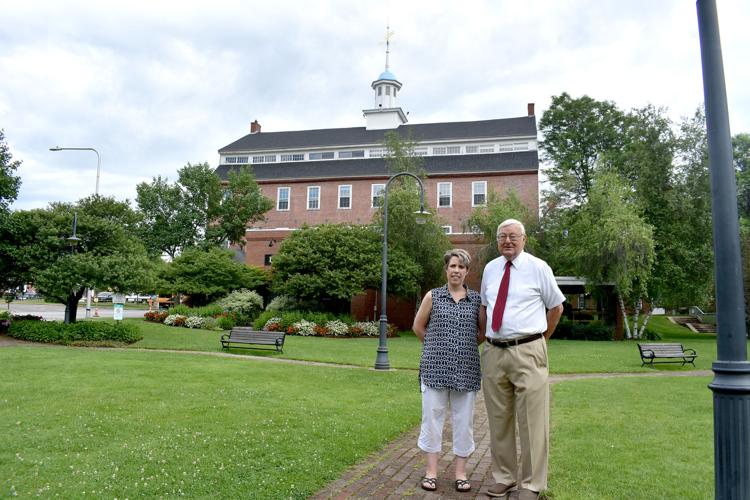
LACONIA — Two years ago, Karen Prior and Paul Falvey were new to the city. She, now the executive director of the Belknap Mill, was at the time working on a limited contract as a consultant for the mill association, and he had just recently assumed the role of President and CEO of Bank of New Hampshire.
Yet both were keenly aware of something – the organizations they represented are the oldest in the city, and the Mill had been able to rely upon the support of the bank for its continued existence. In fact, when Prior prepared to meet with Falvey a couple of years ago, the bank had just purchased $100,000 of the $350,000 in federal tax credits that the mill association had been awarded.
In light of that transaction, Prior knew she had to make a rather bold ask: The Mill was about to embark upon a $1.5 million capital campaign (now underway), and she asked Falvey if the Bank of New Hampshire would like to be part of it. She walked out of that meeting with a commitment from Falvey for the bank to be the lead donor for the campaign.
“These entities have been side-by-side in downtown Laconia for a couple hundred years,” Falvey said. The Mill, he said, “has evolved and survived through so many iterations, so many economies, so many cycles, it has done so because it is the base of Laconia.”
Prior said there was a lot riding on that ask. The Mill had been coming off a string of bad years, with operating losses in the tens of thousands. Meanwhile, maintenance had been deferred and the roof was deteriorating to the point where operations manager Tara Shore said it wasn’t unusual to find shingles in the grass after a windy night.
Having the bank’s contribution was not just a jump-start to a fund-raising drive, it was also symbolic of support for the institution, despite its shaky financials.
“It was really what saved the day,” Prior said.
The surviving mill
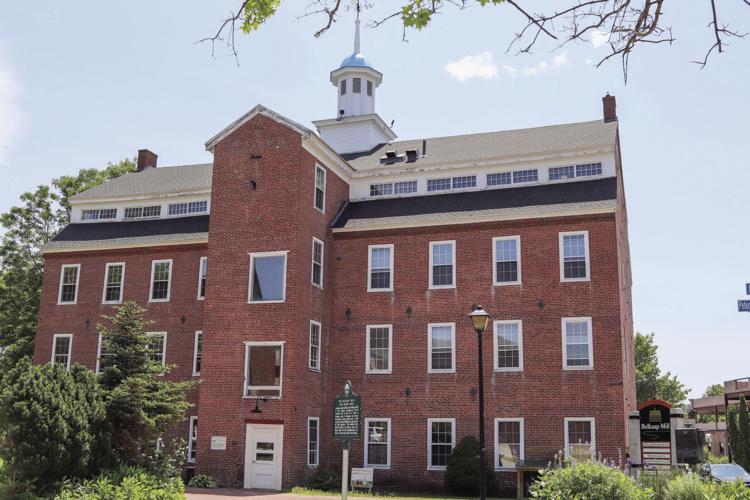
The Belknap Mill should have been torn down decades ago. At least, that’s what the city’s Urban Renewal plan, adopted in 1965, called for. At the time, the circa-1823 mill was dormant after more than a century of textile manufacturing, powered by water from the Winnipesaukee River. That plan destroyed many buildings of similar age in the city’s downtown, replacing them with Stewart Park, the parking garage, and modern storefronts.
But the Belknap Mill was spared, thanks to an effort from the group Save the Mill, which included several civic leaders and downtown businesspeople. They convinced first the city, then the county delegation, to sign on to their effort to save and preserve the mill building. The group also evolved into the Belknap Mill Association, a nonprofit organization that maintained the building and kept it open to the public for historical, cultural and educational programming, as well as a meeting space.
Rod Dyer, an attorney, has been part of the effort to save the mill for nearly 50 years. He was mayor of Laconia when Save the Mill was formed in 1970, and for him, the mill represents not just the history of Laconia, but his family’s story as well.
Dyer’s great-grandfather, Napoleon Dyer, was born in Canada. In 1878, Napoleon immigrated to Laconia to work at the Belknap Mill – thousands of French Canadians followed a similar migration in the late 19th century. Napoleon, Dyer said, was able to secure a foothold in his new country through mill work, then he worked for a time as a barber, and eventually became a self-trained lawyer.
“I consider Napoleon a metaphor for the French-Canadians who came down and how they evolved from second-class citizens to some of the most prominent citizens in Laconia,” Dyer said. “As a native of Laconia, it was part of my growing up that there were mills in downtown Laconia, so I know many, many people who worked in the mills.” They lived in or near downtown and walked to work, which, he said, contributed to the vitality of the city center.
In the case of the Belknap Mill, in particular, he was “amazed” by the quality of construction, and by the symbolism, of the structure. “I felt that the history, the contribution of the mills to our community, needed to be preserved.”
But it takes effort to sustain preservation, and by 2014, that effort was flagging. The board of directors at that time was marked by a lack of active interest, Dyer said, and, as a result, dues-paying membership had dropped. There had also been a revolving door, so to speak, on the executive director’s office, with the nameplate reading differently year after year.
“It seemed that the mill had more or less diminished in the community, it really was on the brink of going into bankruptcy or being sold,” Dyer said.
Five years ago, the association’s board of directors built a plan to offer sale of the building to the city, but the remaining members revolted, making it clear that they would never support such a move.
The mill had been on the brink, then saved, in 1970, by a group of dedicated citizens. It happened again some 45 years ago, this time featuring a new generation partnering with their forebears.
“A new group came in, sparked by Allison Ambrose, and she, and others, were able to turn the mill around,” Dyer said. The new energy led to new grants, which afforded a historic assessment of the building, which in turn opened the door to new funding opportunities. “They accomplished, in just a few years, a remarkable turnaround.
Prior, who agreed to convert from temporary consultant to permanent executive director, said she did so because of the energy of the new board, the dedication of the small staff and corps of volunteers, and for the “scrappy” resolve of the community to keep its mill.
“Because of where the mill was not too long ago, this board took a bold move,” Prior said. Since then, the roof has been addressed, the elevator has been repaired, and tasks that once seemed insurmountable are now manageable.
There’s still a few hundred thousand dollars left to get to that $1.5 million mark, but it now seems just a matter of time before they get there. Just last month, the mill association asked City Council to contribute $100,000, which would put the total over the million-dollar mark, and the request was unanimously approved.
Prior asked, “Who doesn’t want to get on that success train?”


(0) comments
Welcome to the discussion.
Log In
Keep it Clean. Please avoid obscene, vulgar, lewd, racist or sexually-oriented language.
PLEASE TURN OFF YOUR CAPS LOCK.
Don't Threaten. Threats of harming another person will not be tolerated.
Be Truthful. Don't knowingly lie about anyone or anything.
Be Nice. No racism, sexism or any sort of -ism that is degrading to another person.
Be Proactive. Use the 'Report' link on each comment to let us know of abusive posts.
Share with Us. We'd love to hear eyewitness accounts, the history behind an article.