


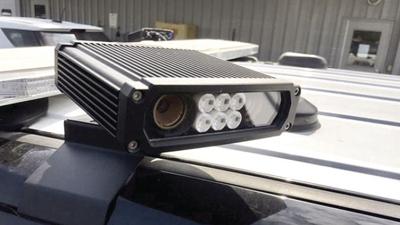
Automated license plate readers enable police to determine, in a matter of seconds, whether a vehicle is one that police are seeking. As useful as this technology could be for officers on patrol, area police department representatives say they are in no rush to get the state-of-the-art technology.
Last year New Hampshire became the last state in the nation to legalize these specialized cameras, which are connected to the cruiser’s on-board computer. The lightning-speed scanners, mounted on the cruiser’s roof, are capable of recording 1,500 license plates per minute. The plates can then be matched against a federal database and another one maintained by the New Hampshire Department of Safety. Those databases have information about stolen cars, criminal warrants, vehicles involved in major crimes or associated with missing children, or senior citizens with dementia.
But even with the advantages that cutting-edge technology affords, only a few police departments across the state have jumped on the bandwagon: Lincoln, Sunapee, and Londonderry. And Lakes Region departments do not see the scanners as a worthwhile investment — at least not yet. The big reason they cite is the cost; the units cost between $12,000 and $16,000 each.
“They’re very cost-prohibitive, which is a big drawback,” said Laconia Police Chief Matt Canfield. He said that his department has higher priorities in terms of new equipment. “I would rather get body cams (for officers) or dash cams (for cruisers),” the chief said.
Canfield said the readers make more sense for departments in areas where there are lots of stolen vehicles. But Laconia averages only about 10 to 12 stolen vehicles a year.
Belmont Police Capt. Rich Mann agreed, and said the license-plate readers would the give that department relatively little value in terms of fighting serious crime in return for the money spent.
“It’s really not worth it to spend that money just so we could catch more people wanted on bench warrants (for failing to appear in court), or driving on a suspended license,” he said.
Other area departments either would not comment about the potential of using readers or did not return calls seeking comment.
But supporters of the technology point out that the readers can also help police do other things besides catch criminals.
Chief Ted Smith, of the Lincoln Police Department, the only department that has an operating system at this time, said readers are a major advancement in law enforcement. “They help officers identify vehicles they can’t normally identify.”
Smith acknowledges that, like any other type of technology, there are bugs that remain to be worked out. He noted that since the readers were installed on a Lincoln cruiser early this month, the device has registered three “hits” of possible wanted vehicles. But the confirmation process showed the alerts were not valid.
Tuftonboro Police Chief Andrew Shagoury said the readers can help to police in situations like locating a missing child, an elderly motorist with dementia who has been reported missing, or even parking enforcement.
Shagoury, who is also president of the New Hampshire Association of Chiefs of Police, said the readers can allow officers to perform a number of functions more efficiently.
But it's the amount and type of information they collect — on everyone — that makes some people uneasy.
The New Hampshire law allowing the readers that went into effect last year has some of the toughest restrictions in the country. One restriction is the readers can retain the information about a particular plate for just three minutes. Another restriction is that all readers must be under the personal control of an officer; that means placing a fixed camera above an intersection, for example, is prohibited.
Those concerns about the potential for abuse prompted privacy advocates to push for strong limitations on use of the readers.
“There’s the potential here to collect massive amounts of data on people that aren’t even accused of a crime,” said Devon Chaffee, executive director of the American Civil Liberties Union of New Hampshire.
Another restriction is that a patrol officer must confirm the computer-generated match from the readers with a law enforcement agency before they make a traffic stop. The purpose of this is to make sure that a particular vehicle or person associated with it is still being sought by police. Also, the cameras can only record the plate number, not the car itself, or what, or who, is inside the vehicle.
Although the law took effect last year, Smith said it has taken until now to modify the software so the reader systems comply with the restrictions of New Hampshire’s law.
Even law enforcement officers are sensitive to the privacy concerns the readers raise.
“I can see both sides of the issue,” Mann said.
And while the law was being crafted, the Police Chiefs Association pledged that they would lobby against any attempt to loosen the restrictions for 10 years. Then, in 2027, the law is scheduled to be repealed. That sunset provision will require the Legislature to pass a new law in order for police to be able to continue using the readers.
Smith said by being the first police department in the state to get the readers, Lincoln was able to get a “very good deal,” to purchase the equipment. He declined to say how much the town had to pay, however. He said he presented the proposal to the town manager and the manager and selectmen were very receptive to the idea.
He expected that within a couple of years the state Highway Safety Agency would start to issue grants for the purchase of the readers and then their use would become more widespread.
In the meantime, cost will continue to be a major consideration for local departments as they debate whether to add the readers to their materiel.
“We’re not likely to be getting one anytime in the near future,” said Shagoury. But he noted that maybe once the technology has been around for a while the cost might come down.


(0) comments
Welcome to the discussion.
Log In
Keep it Clean. Please avoid obscene, vulgar, lewd, racist or sexually-oriented language.
PLEASE TURN OFF YOUR CAPS LOCK.
Don't Threaten. Threats of harming another person will not be tolerated.
Be Truthful. Don't knowingly lie about anyone or anything.
Be Nice. No racism, sexism or any sort of -ism that is degrading to another person.
Be Proactive. Use the 'Report' link on each comment to let us know of abusive posts.
Share with Us. We'd love to hear eyewitness accounts, the history behind an article.