


Today’s forensic technology has opened up a new world of criminal investigations, while police used to rely purely on detective work. Combining these two methods, the New Hampshire Cold Case Unit has been working to solve crimes from decades ago.
While many are still open, including seven in Belknap County, six cases in the Granite State have been solved since funding increased for the unit in 2025.
The Cold Case Unit is currently investigating 128 cases across the state, and each has a dedicated investigator and victim advocate working with witnesses and families.
The unit investigates a case that has gone without activity or leads for at least five years. They look into homicides, suspicious deaths, unidentified remains, and missing person reports believed to have involved foul play.
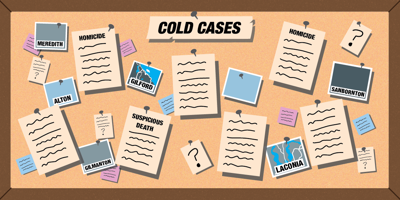
In Belknap County, the open cold cases date as far back as the suspicious death of Jerome O’Sullivan, on Feb. 21, 1971, in Gilmanton. The homicide of Francis Sidoti, on Nov. 21, 1977, in Sanbornton, is under investigation, as well.
Two cold cases are Laconia homicides, including the death of John Crawford, on Oct. 25, 1985, and Lisa Wright, on Dec. 6, 1991.
In Meredith, the unit is investigating the homicide of Angel Hazelton, a 21-month-old infant, on Aug. 15, 1989.
The most recent, coming up on its 16th anniversary, is the homicide of Roberta Miller, on Nov. 1, 2010, in Gilford.
The cold case unit
The NH Cold Case Unit is led by Chris Knowles, a senior assistant attorney general and chief of unit, and Todd Flanagan, deputy chief investigator in the state Attorney General’s Office.
In an interview, they talked about the work of the unit, which ramped up with additional funding last year.
Flanagan has been with the Attorney General’s Office for 16 years. Before that, he was with the Concord Police Department, and has nearly 40 years of experience.
Flanagan is specifically assigned the Hazelton case, and is a former resident of Meredith. He is also assigned to the Miller case, which gained attention last year on the 15th anniversary. Miller's family is offering a $56,000 reward for information leading to an arrest and prosecution.
Before Knowles joined the Attorney General’s Office, he was the district attorney in rural Alaska, covering anything from petty crimes to homicide.
Here in the Granite State, he said the practice is vertical prosecutions, where the first call goes to the Attorney General’s Office when a homicide occurs. He said they deploy two attorneys who are involved in the investigation from the start, and stay through the case.
“Hopefully, it doesn’t come to a cold case unit, but that is the practice New Hampshire has,” Knowles said. “I only mention that to say the cases we currently review are those that have been with our office since its inception.”
Knowles said he thinks there is misperception associated with the cold case unit, that the investigations are in some way closed.
“That is just not the reality of cold case work,” Knowles said. “They are all open.”
Knowles said the unit has “dedicated investigators” working with local police, federal partners, and nonprofit agencies.
Flanagan said last year, positive changes were made in calculation to open a cold case, including an updated metric described as the “decision matrix.” The unit reviews files and determines if there is new evidence with new technology and living witnesses. Each one gets a grade assigned to help prioritize.
Investigators can determine where money is spent and on what, depending on what comes up. This includes lab tests and searches, and Flanagan said they work on other aspects of cases in the background as they wait for lab test results, which can be time consuming.
The unit also works with cold case units in surrounding states which can assist in technology and resources. Summits with other units are also held to talk about cases directly and brainstorm.
“We go over real case examples, what has worked well, and how to learn from mistakes in the past,” Flanagan said.
Evidence gathering
“We have cases that go back 50-plus years, and some investigators are no longer with us, but we found they did a great job with what they were working with,” Knowles said.
Knowles was impressed with how they secured evidence long before the technology of today’s investigations.
“Now, it is our job to figure out what can be done,” Knowles said.
Flanagan said the process is still essentially the same today, with detectives gathering as much evidence as possible, leaving no stone unturned. The smallest detail might be the key to crack a case.
He referred to the Judith Lord case closed last year. The crime took place on May 20, 1975, when Lord was found strangled to death in her apartment, in Concord, with her 20-month-old son found unharmed in his crib one room over. The next-door neighbor, Ernest Theodore Gable, was once a prime suspect, but no arrest was made until November 2025. Previously, an FBI hair analysis excluded Gable from the suspect list, but new DNA testing threw that out, and investigators found Gable was, indeed, the killer.
There was no arrest or prosecution, because Gable was stabbed to death in Los Angeles in 1987, but Knowles said the important thing was they were able to bring some peace of mind to Lord's now-grown son. He said the father was a longtime suspect, and the boy lived for 50 years not knowing if his father had killed Lord.
“Todd was able to tell him,” Knowles said, and called this a landmark decision thanks to DNA.
Another case was 80-year-old Yvonne Fine, of Concord, who was raped and murdered in 1980. Knowles said there were allegations her son killed her, which was “obviously not true.” In 2000, using DNA testing, Joseph Whittey was convicted and sentenced to life in prison.
“Sometimes, you can make landmark decisions to pave the way for more cold cases,” Knowles said.
Flanagan said getting the conviction for a life sentence was huge.
“That got me hooked, when I got to see all the dynamics of a cold case all the way through,” Flanagan said.
In some cases, there is still evidence to sift through.
In May 2024, a Newport home was searched by police, to look for physical evidence in several cold cases. A command center was set up in front of the garage, and police went in and out, some putting items into containers, including one with a “biohazard” symbol.
Former Assistant Attorney General Scott Chase was at the scene, and said the search was in response to “unresolved homicide cases,” and involved the state Cold Case Unit.
In the Connecticut River Valley, there were seven unsolved murders between the 1970s and 1980s involving young women from New Hampshire and Vermont. One victim, who was pregnant, survived an attack where she was stabbed 27 times in 1988, and told news outlets that day she had been contacted by State Police about the search.
Knowles and Flanagan did not share to which cases the search was related. The investigation continues, and no charges have been filed associated with the search.
Impact of new media
Knowles said this investigative work is “constantly evolving,” especially with social media and podcasts. While the members of the unit can’t listen to every podcast possible, or just don’t know about all of them as they are ample, the team constantly scours the internet.
Podcasts, he said, are helpful, as they keep the victims’ faces and names alive in the community. He said people often think cases have been solved, or they just forget about them, if not reminded.
He said they even occasionally get tips from podcasters, but they always prefer a direct line of contact for those with possible information.
Knowles said while police departments know a lot, they don’t know it all. There are multiple avenues for people to submit tips, including anonymously, and the team always hopes people can find the strength to come forward with any information they might have. That could be just an offhand comment, or behavioral changes someone noticed, or something they think of that has connected dots.
“Even the smallest thing could result in closure, or at least moving the needle forward,” Knowles said.
Flanagan said they have located witnesses when murders have occurred based on Facebook posts, and he will be able to track them down and find information they may never have found otherwise. Sometimes there is banter in comments on a Facebook post, but when someone says they need to talk to police, “there are crickets.”
“Anonymous lines help,” Flanagan said.
Flanagan said there are situations where suspects have died, like Gable, but that is not low-hanging fruit. They still need to prove beyond a reasonable doubt, and then some, and to be confident enough to go to court.
If a suspect is getting along in their years, or health is declining, the case is often advanced to make it a priority to solve before the suspect dies.
Flanagan also said oftentimes, they deal with families of suspects, as well. Sometimes, suspects come from healthy families, but something led to a murder.
“For a long time, across the country with cases where suspects passed away, they sat on the cold case list,” Knowles said. “That’s not fair to the families. Suspects shouldn’t just stay on the list. If we can prove what happened, we owe it to the families to get that closure.”
A big year
Knowles came on as chief in April 2025, and thanks to a push by Attorney General John Formella and Gov. Kelly Ayotte (R-NH), they were able to land two full-time positions with the Department of Justice. This funded Flanagan’s position full-time, as well as another full-time investigator, Bruce Foremny. This means a lot, Knowles said, as there were budget cuts across the board.
“I think the things we’ve seen from the unit over the last year are due to them,” Knowles said.
He said their ample experience, as Foremny adds four decades himself, has been invaluable. Knowles said the key aspect is the passion they all have for their jobs, and everyone on the unit sees it as a privilege. However, it can get grim.
“We are looking at really dark things, the worst part of humanity in some cases,” Knowles said. “We are only able to do that with the team. It’s a such a phenomenal team of people.”
Flanagan said it is not lost on them they need results so funding continues. Since the money increased, six cases have been solved.
“We’ve seen quantifiable results,” Knowles said.
Patience is key, and Knowles said they are “so incredibly close on so many investigations.” Sometimes all it takes is one witness coming forward.
Knowles said the investigators are all determined, and they “are not going to stop.”
Flanagan referred to the Japanese proverb, “Nana korobi ya oki,” about falling seven times, but getting up eight.
“That’s what I feel like sometimes,” Flanagan said. “That eighth time getting up is when you sometimes bring it home.”
To report a tip about a cold case, call 603-271-2663 or email coldcaseunit@dos.nh.gov.


(0) comments
Welcome to the discussion.
Log In
Keep it Clean. Please avoid obscene, vulgar, lewd, racist or sexually-oriented language.
PLEASE TURN OFF YOUR CAPS LOCK.
Don't Threaten. Threats of harming another person will not be tolerated.
Be Truthful. Don't knowingly lie about anyone or anything.
Be Nice. No racism, sexism or any sort of -ism that is degrading to another person.
Be Proactive. Use the 'Report' link on each comment to let us know of abusive posts.
Share with Us. We'd love to hear eyewitness accounts, the history behind an article.