


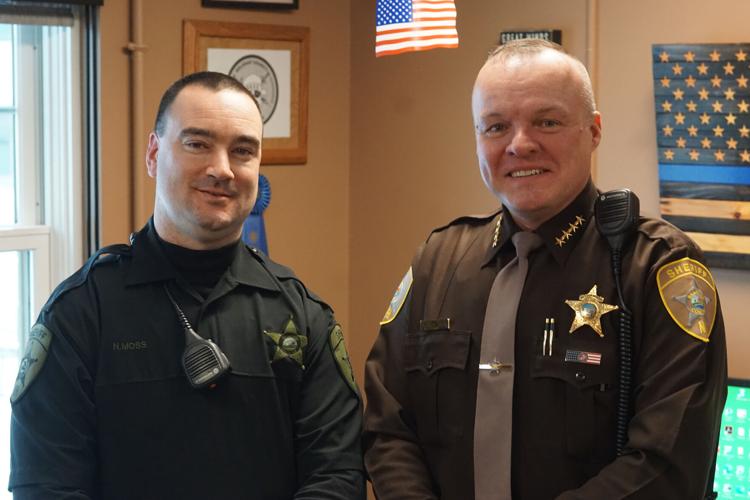
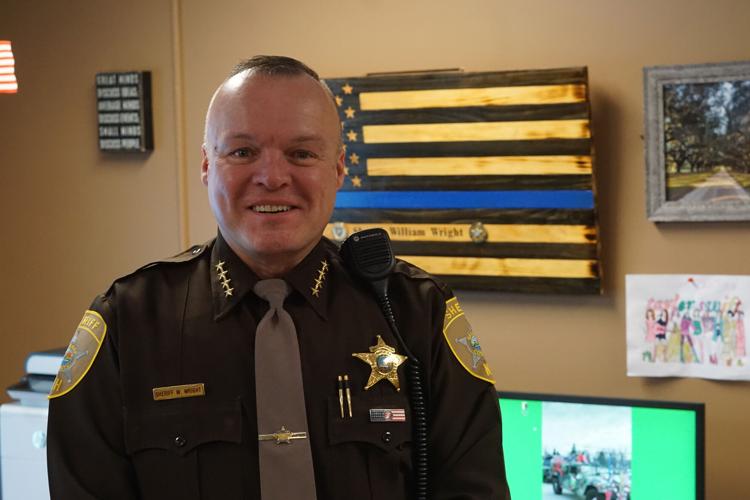
LACONIA — Belknap County Sheriff Bill Wright thinks it’s about time the county gets a working dog.
About a year ago, one of his deputies expressed interest in starting a K9 program at the county sheriff’s office. Wright instructed the deputy to come back with research into starting such a program so he could weigh the needs of the county.
He did, and thinks the idea could benefit Belknap and all of its municipalities if it came to fruition.
That deputy is Nathan Moss, and he’s been working for almost exactly two years for Belknap County. Before that, he worked for the state prison in Concord and hoped to become a dog handler there, but he didn’t have a bachelor’s degree. Here in Belknap County, there’s no paper ceiling, and he’s hoping to work with a dog if a program is established.
Wright said he learned of the Stanton K9 Foundation, which provides public bodies funds to start K9 programs. The Stanton grant is the same which funded Gilford’s K9 program last year. Through the program, the county could access $50,000 to fund a five-year program during which a dog would be trained in two disciplines, or $34,000 for a three-year program and a dog trained for one discipline.
“We could really use a K9 here at our level, because we’re county,” Wright said.
The county sheriff’s department, among other things, is responsible for hunting fugitives. Sometimes, fugitives can lead officers to dangerous or difficult-to-access locations, places where having a K9 at their disposal would help them achieve their mission.
“We have statewide jurisdiction,” Moss said Thursday. “Obviously, we can assist all the towns within our county.”
The sheriff’s department handles felony warrants, Superior Court indictments and other fugitive work, and ends up with the responsibility of going out to find those individuals. In cases where people are released from jail on bail and don’t show up to court, they often tend to hide, Wright explained.
The county can, at times, request the use of a K9 from another municipal police department or from New Hampshire State Police, but those dogs aren’t always available. K9s provided by State Police may be coming from long distances away.
By funding a K9 program at the county level, Wright said it could benefit the work of his deputies and serve the needs of all municipalities within Belknap.
“A K9 unit would definitely be a positive tool,” he said.
A working dog program at the county could serve two purposes through its training: patrol and tracking, and the identification of narcotics. If established, the sheriff would administer a competitive process within the department to select a handler. But Wright said the general consensus among his employees is Moss would be the guy to lead the program.
There’s overtime costs associated with starting a K9 unit. For example, Wright would need to allocate funding, $10,000 each year, to allow for a K9 handler to spend 3.5 hours each week to care for the animal; about 30 minutes each day. He could either ask for those funds in his budget, or reduce the given deputy’s hours on the street by 30 minutes. Wright said he’d prefer to include the cost in his budget, when the time is right, so as not to take a deputy off the streets more than is necessary.
“When you need it, you need it. And it’s a very small cost for what life safety’s all about,” he said.
Wright said he’s received “overwhelming” support from the county delegation, but was asked by county commissioners to hold off, preferring to take the idea up in the future. In the meantime, Wright wants permission from county commissioners to apply for the grant funding.
“I’m trying to be a good steward of taxpayer money,” he said. “I’m looking towards the future."
Wright and Moss see the prospects of starting a K9 program as a recruiting and retention incentive, too. A handler spends their life with the working dog, and often takes care of the K9 after it retires from service. It becomes akin to family, and that’s appealing to certain people.
“We haven’t forgotten the service part of our job,” Wright said in an interview. “We serve the public and we protect the public.”


(0) comments
Welcome to the discussion.
Log In
Keep it Clean. Please avoid obscene, vulgar, lewd, racist or sexually-oriented language.
PLEASE TURN OFF YOUR CAPS LOCK.
Don't Threaten. Threats of harming another person will not be tolerated.
Be Truthful. Don't knowingly lie about anyone or anything.
Be Nice. No racism, sexism or any sort of -ism that is degrading to another person.
Be Proactive. Use the 'Report' link on each comment to let us know of abusive posts.
Share with Us. We'd love to hear eyewitness accounts, the history behind an article.