


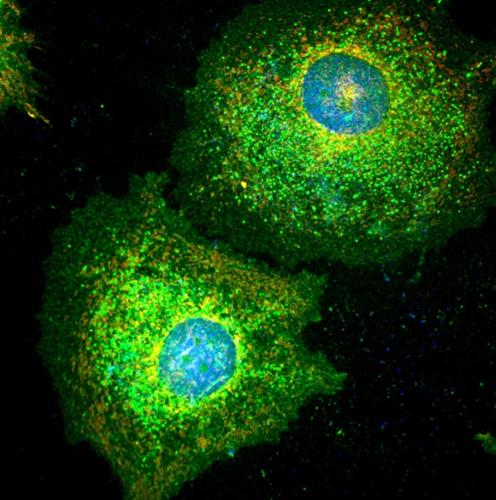



Senescent cancer cells stained for a Death Receptor protein that is highly upregulated in response to chemotherapeutic treatment. (Seamus Martin / TCD via SWNS)
By Stephen Beech
Cancer cells enter a “zombie-like state” to evade chemotherapy, reveals new research.
The key breakthrough by scientists at Trinity College Dublin could lead to improved treatment options for cancer patients.
The team discovered how cancer cells can evade the deadly effects of chemotherapy and enter the “zombie-like state” — called premature senescence — that can attract the wound healing properties of the immune system.
Although the human immune system protects us from infection, the researchers explained that it also plays a critical role in coordinating repair and replacement of damaged tissue.
The wound healing capabilities of the immune system stimulates cell division within damaged tissue to replace cells that have been lost through injury and brings extra nutrients and oxygen into the injured tissue by triggering the growth of new blood vessels.
The complex process ensures that new cells are only produced where and when they are needed.

(Photo by Andre via Pexels)
But the Trinity College team said cancers can “exploit” the wound healing process for their own ends by masquerading as damaged tissue and tricking the immune system into helping malignant cells to divide and acquire extra oxygen and nutrients rather than killing them.
Cancers have been described as “wounds that do not heal” for those reasons.
But how they switch on the wound healing capabilities of the immune system had been poorly understood until now.
The research team from the Smurfit Institute of Genetics at Trinity College Dublin found that molecules called Inhibitor of Apoptosis Proteins (IAPs) can enable tumors to escape the cell killing effects of commonly used chemotherapeutic drugs.
The team, led by Seamus Martin and Gokhan Gunay, discovered that IAPs functioned in that setting by neutralizing the cell-killing effects of molecules called “Death Receptors” that were switched on in response to DNA damage provoked by chemotherapy.


Rather than simply allowing tumors to escape the cell-killing effects of chemotherapeutic drugs, they found that IAPs enabled surviving tumor cells to enter “premature senescence” — helping tumors bounce back from chemotherapy.

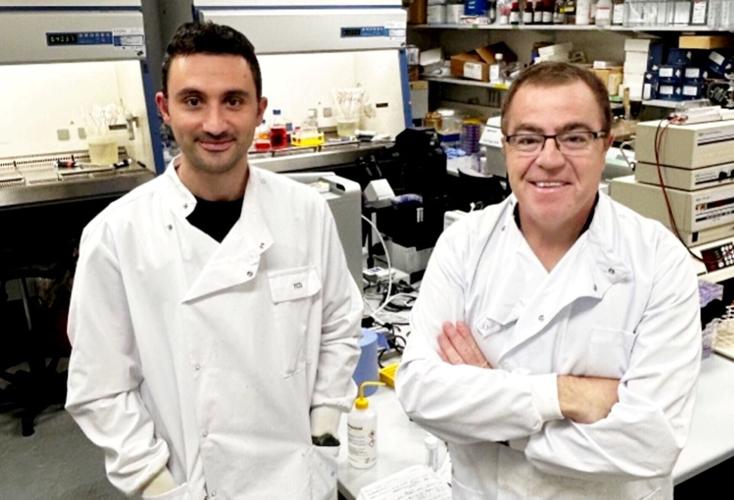
Dr. Gokhan Gunayh and Professor Seamus Martin in the lab in Trinity College Dublin. (Seamus Martin / TCD via SWNS)
Martin explained that senescent cells are non-dividing zombie-like cells that undergo dramatic changes within a few days of exposure to chemotherapy, including becoming almost 10 times bigger than a normal cell and ramping up genes associated with wound healing.
He said: “These changes endow them with a greatly increased ability to secrete inflammatory mediators, which attracts cells of the immune system.
“The accumulation of senescent cells in tissues as we age is also thought to contribute to the inflammatory processes associated with aging, as well as a decline in the normal function of many tissues.”
The team’s findings, published in the journal Science Advances, also showed that senescent cells formed in response to chemotherapy are highly dependent on IAPs for their continued survival.
Compounds which neutralized IAPs — called IAP antagonists — selectively eliminated senescent cells by reactivating the “Death Receptor” self-destruct program within these cells.

(Photo by Ivan S via Pexels)
The team says their findings could provide improved treatment options for patients living with cancer as neutralizing more tumors promises to improve quality of life and survival rates.
But scientists first need to understand how tumors function and where their weaknesses may lie.
Martins said the research isolates a new mechanism that explains how some tumors evade death and use the body’s immune system to aid their recovery, as well as pinpointing promising new drug treatments that killed them.
He added: “Discovering how tumors can evade the cell-killing effects of chemotherapy and enter senescence is an important and challenging problem.
“These new findings suggest ways in which we may be able to lower the defenses of tumors by neutralizing IAPs after the delivery of chemotherapeutic drugs, which should block their entry to senescence and kill more cells of the tumor.”


(0) comments
Welcome to the discussion.
Log In
Keep it Clean. Please avoid obscene, vulgar, lewd, racist or sexually-oriented language.
PLEASE TURN OFF YOUR CAPS LOCK.
Don't Threaten. Threats of harming another person will not be tolerated.
Be Truthful. Don't knowingly lie about anyone or anything.
Be Nice. No racism, sexism or any sort of -ism that is degrading to another person.
Be Proactive. Use the 'Report' link on each comment to let us know of abusive posts.
Share with Us. We'd love to hear eyewitness accounts, the history behind an article.