


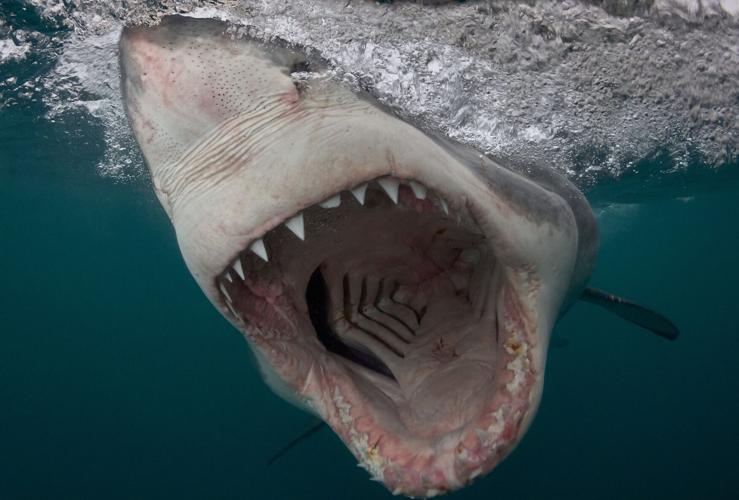
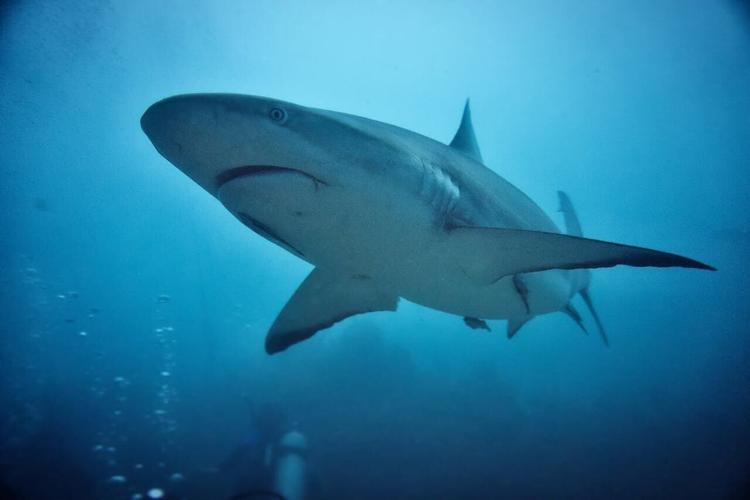

Great white shark charges in South Africa. (Chris Perkins via SWNS)
By Stephen Beech
Fatal shark attacks more than doubled in 2025, reveals a new report.
There was also a 38.3% increase in the number of people bitten by the apex ocean predators, compared to 2024.
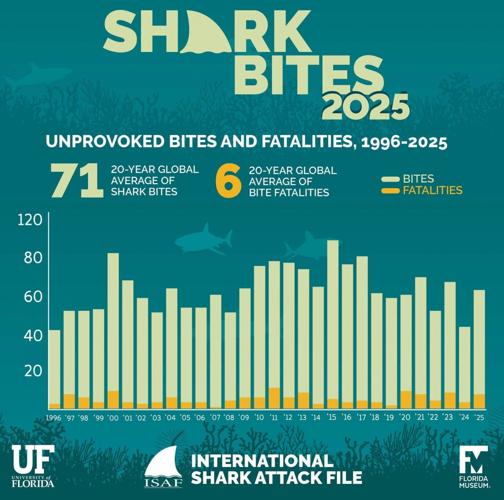
The International Shark Attack Files recorded a total of 65 unprovoked shark bites worldwide in 2025, nine of which proved fatal. Five of the fatalities were in waters off Australia.
The annual report showed a surge from just 47 unprovoked shark attacks on humans in 2024, four of which were fatal.
Experts say last year's overall number of attacks was slightly lower than the most recent 10-year average of 72, but the number of fatalities was 50% higher than the 10-year average of six.

Shark bites in 2025 and through time. (Florida Museum of Natural History via SWNS)
Last year also saw the first confirmed fatal attack on a human by a dusky shark, said Professor Gavin Naylor, director of the Florida Program for Shark Research at the Florida Museum of Natural History.
The museum’s International Shark Attack File was established in 1958 and includes records dating back to the 1500s.
The annual reports are primarily focused on "unprovoked bites" - defined as incidents in which a person does not initiate contact with a shark, intentionally or otherwise.
Activities that influence a shark’s behavior, such as spearfishing or releasing a shark from a hook or net, are not included in the report.
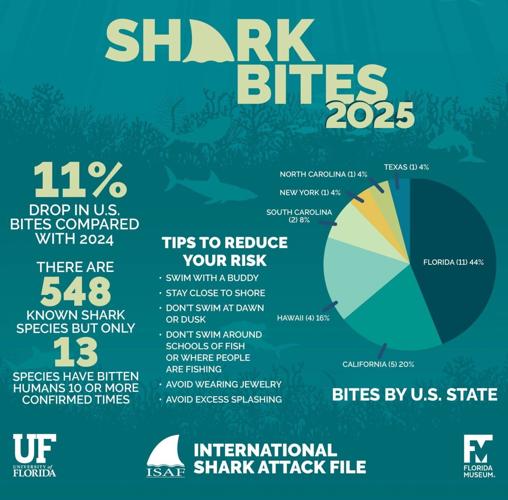
The number of unprovoked bites in the United States has decreased overall during the past five years, but it remains the region with the highest reported activity, accounting for 38% of last year's incidents worldwide.
Australia followed with 32% of the world’s unprovoked bites and 56% of shark-related fatalities.

(Photo by Glenda via Pexels)
Of the 25 shark bites reported in the US, there was one fatality when a 55-year-old triathlete was attacked by a great white shark after she entered Monterey Bay, California, with members of the open-ocean swimming club she co-founded.
Australia followed closely behind the United States, with 21 of last year’s global shark bites, notably higher than the most recent five-year annual average of 13 incidents for the region, five of which proved fatal.
Naylor said: “If these bites occurred anywhere other than Australia, they would probably have resulted in even more fatalities.
"Their beach safety is second to none.
"Within minutes of a bite, they’ve got helicopters airborne ready to respond."
An unprovoked shark attack in Canada was the country’s first since 2021.
The paddle boarder escaped uninjured when a great white took a bite out of his board.
Naylor said a recent recovery in the Northwest Atlantic great white shark population follows a steep decline that began in the 1960s.

(Florida Museum of Natural History via SWNS)


He said: "The species is still listed as endangered in the country, but it has increased in recent years."
Naylor said the first confirmed fatality involving a dusky shark happened when a free diver looking for crayfish was bitten off the coast of South Africa.
He said: "Their large size and tendency to swim in shallow coastal waters means it is possible that some unidentified bites can likely be attributed to this species."
International Shark Attack File manager Joe Miguez said: “The majority of the bites in the database involve unidentified species.
“In the moment of the attack, witnesses are often unable to identify the shark, and several species of closely related sharks are hard to distinguish from one another without a thorough analysis.”
The Bahamas had five unprovoked bites and New Zealand had three in 2025.

(Photo by Samson Bush via Pexels)
Five other countries reported single incidents, including Mozambique, where a diver was killed by a shark on surfacing .
Other countries which saw unprovoked bites in 2025 were Vanuatu, Maldives and the Marshall Islands.
Single bites also took place in the Spanish Canary Islands and Puerto Rico.
Last year 11 bites occurred off Florida, which consistently has more incidents than any other US state, although the 2025 figure was lower than Florida's most recent five-year annual average of 18.
Volusia County - often referred to as the shark bite capital of the world - accounted for more than half of Florida’s attacks.
But global shark numbers remain "far below" historical levels, according to the report, largely due to overfishing.
Naylor said: “Out of the 1,200 species, 30% of them are categorised as endangered.
“That’s a lot, especially because these animals have managed to persist for about 330 million years.

(Photo by ROMAN ODINTSOV via Pexels)
"They've been through the Permian Extinction and Cretaceous Extinction.
"Clearly, they’re resilient, yet here we are.
“Shark bites are the consequence of the biology of the animals, the climatic conditions and the number of people in the water, at the time of the incident.
“These global patterns change only slightly from one year to the other.
"But the regional incidents do oscillate a lot, and these local trends are interesting.”
But he pointed out that the chances of being bitten by a shark remain "extremely low" with drowning and being struck by lightning far more common.
Naylor added: "The International Shark Attack Files provide baseline data about shark attacks on people that are rigorously and scientifically investigated, evaluated and summarised on an annual basis.
"While a significant fraction of incidents likely go unreported, the temporal trends, and local and global patterns of incidents are used to evaluate the biology of the animals, their behavior and the risk they pose to humans."


(0) comments
Welcome to the discussion.
Log In
Keep it Clean. Please avoid obscene, vulgar, lewd, racist or sexually-oriented language.
PLEASE TURN OFF YOUR CAPS LOCK.
Don't Threaten. Threats of harming another person will not be tolerated.
Be Truthful. Don't knowingly lie about anyone or anything.
Be Nice. No racism, sexism or any sort of -ism that is degrading to another person.
Be Proactive. Use the 'Report' link on each comment to let us know of abusive posts.
Share with Us. We'd love to hear eyewitness accounts, the history behind an article.