



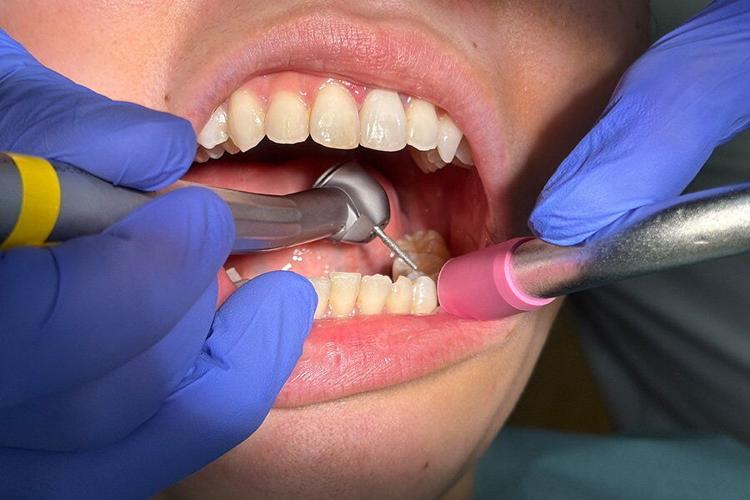



A dental drill being used in a patient's mouth. (Tomomi Yamada via SWNS)
By Stephen Beech
Dental drills are to be made quieter to reduce patients' anxiety.
Japanese scientists are studying the aeroacoustics of dental drills so they can pinpoint the anxiety-triggering sounds and design new, less loud instruments.
Fear of getting in the dentist's chair - known as odontophobia - prevents some people, particularly children, from getting regular check-ups and maintaining necessary dental hygiene.
One element of such anxiety comes from the sound of the dental drill, which makes a high-pitched whining noise.
As a dentist, Dr. Tomomi Yamada has witnessed discomfort and fear in patients first-hand.
Study leader Dr. Yamada said: “Originally, I was doing research on dental materials, but I realized that almost no one — not even dentists — was tackling this sound problem scientifically."

(Photo by Tima Miroshnichenko via Pexels)
Dr. Yamada, an Assistant Professor at the University of Osaka’s graduate school of dentistry, and her colleagues used Japan’s flagship supercomputer to conduct large-scale aeroacoustics simulations.
They analyzed the internal and external airflow of the dental drill, which is powered by compressed air and rotates at around 320,000 revolutions per minute.
From the simulations, they were able to visualize how air moves through and around the drill to create the noise.


Dr. Yamada said: “Our research showed that just making the drill quieter isn’t enough to make the sound less unpleasant.
“What really matters is improving its sound quality.”
The research team also tested the psychological effects of the dental drill, which can generate high-pitched sounds reaching nearly 20 kilohertz, with children and adults.
They found that younger listeners had different reactions to the drill, perceiving the sounds as louder and more unpleasant.
Dr. Yamada said: “This indicates that children’s fear of dental sounds is not merely psychological but also physiological in nature.

(Photo by Gustavo Fring via Pexels)
“Children truly hear these sounds differently, so their fear of dental treatment is a genuine sensory response, not just imagination.”
Dr. Yamada and her colleagues are working on optimizing the blade geometry and exhaust port of the drill to minimize the noise while maintaining the performance.
To get the dental industry to adopt the new technology, Dr. Yamada says achieving a balance between the device’s performance and safety is key as a quieter drill won’t necessarily get the job done.
She added: “Moving forward, we hope to work with dental manufacturers through industry–academia partnerships, progressing toward commercialization after completing the necessary regulatory and durability testing."
Dr. Yamada presented the findings at a joint meeting of the Acoustical Society of America and Acoustical Society of Japan in Honolulu, Hawaii.


(0) comments
Welcome to the discussion.
Log In
Keep it Clean. Please avoid obscene, vulgar, lewd, racist or sexually-oriented language.
PLEASE TURN OFF YOUR CAPS LOCK.
Don't Threaten. Threats of harming another person will not be tolerated.
Be Truthful. Don't knowingly lie about anyone or anything.
Be Nice. No racism, sexism or any sort of -ism that is degrading to another person.
Be Proactive. Use the 'Report' link on each comment to let us know of abusive posts.
Share with Us. We'd love to hear eyewitness accounts, the history behind an article.