


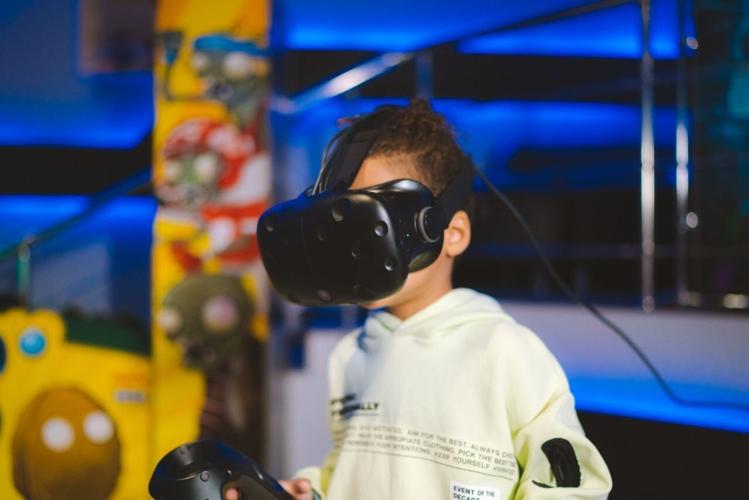
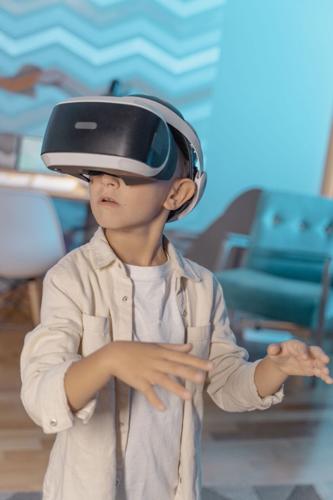


(Photo by Anastasia Shuraeva via Pexels)
By Stephen Beech
Virtual reality lowers anxiety in children awaiting surgery, reveals new research.
Youngsters who used a virtual reality (VR) headset before going under the knife showed reduced distress and fear — as well as lower heart rates and blood pressure.
Researchers in the United States used VR headsets to monitor anxiety levels among 80 children, ages 6 to 15, before an operation.
Pre-surgery anxiety affects up to three out of four youngsters in the build-up to an operation and is linked to difficult anesthesia induction, postoperative pain and prolonged recovery.
Pharmacological sedation is commonly used to help manage such anxiety, but carries risks.
Non-drug alternatives such as therapeutic play, music therapy and VR have shown promise but have not been widely tested until now.

A view inside the custom virtual reality environment used in the study: a calm room with a teddy bear, soft colors, and large windows looking out over the sea. (Walaa S. Abu Rukbah et al., Virg via SWNS)
For the new study, researchers created a custom VR experience, which used a Meta Quest headset and immersed users in either an interactive children’s room or a calming beach scene.
The experience was then provided, over the course of nine months, to 80 participants scheduled for elective surgery at an American children’s hospital.
Self-reported distress and fear, heart rate, and blood pressure were recorded before and immediately after each session, and children, parents and nurses were surveyed about their experience.
Average self-reported distress fell from 3.0 to 1.0 on a 0-10 scale, and fear from 1.0 to 0.0 on a 0-4 scale, with 46 of 80 children (57.5%) and 44 of 80 (55.0%) meeting a threshold for clinically meaningful improvement in each measure.
The findings, published in the journal PLOS Digital Health, also showed that heart rate fell by an average of 5.8 beats per minute and systolic blood pressure by 4.1 mmHg.
Most children, parents and nurses rated the experience positively.
The research team noted that with no control group, the changes in distress and fear can’t be attributed to VR alone and may partly reflect natural changes over time, particularly among children with the highest initial anxiety.


(Photo by Tima Miroshnichenko via Pexels)
However, they concluded that VR was “feasible and safe” to implement in real-world settings and was accompanied by “clinically meaningful” reductions in anxiety.
Study leader Dayanjan Wijesinghe, of Virginia Commonwealth University, said: “With continued research and thoughtful implementation, VR is a promising candidate for inclusion in compassionate, family-centered pediatric care, pending confirmatory controlled research — helping more children approach medical procedures with confidence and calm.”
First author Walaa Abu Rukbah said: “Sometimes, the best support we can offer a child before surgery isn’t a medicine at all.
“For me, one of the most meaningful parts of this study was seeing how positively children and families engaged with the VR experience.
“As a pharmacist, I value exploring safe, non-drug approaches that may help support children through the anxiety and uncertainty surrounding surgery.”
Wijesinghe added: “In a busy children’s surgical unit, a short virtual reality session proved easy for nurses to run, was safe, and was very popular.
“Nine in 10 children wanted to use it again, and nearly every parent would recommend it.

(Photo by MART PRODUCTION via Pexels)
“Children’s self-reported distress and fear were lower after the session than before it.
“Because this was a quality-improvement project without a comparison group, we cannot yet say how much of that improvement comes from virtual reality itself, and a controlled trial is the essential next step.”
He said: “We treated this as an improvement project rather than a one-off experiment.
“Over nine months we kept refining the program based on what children, parents and nurses told us.
“What struck me most was how readily the nursing staff took it on: every one of the 29 nurses involved said they would recommend it for other children.
“The children who were most anxious before the session showed the largest drops afterward.
“That is encouraging, but some of it probably reflects a statistical effect called regression to the mean, and only a controlled trial can separate the two.”


(0) comments
Welcome to the discussion.
Log In
Keep it Clean. Please avoid obscene, vulgar, lewd, racist or sexually-oriented language.
PLEASE TURN OFF YOUR CAPS LOCK.
Don't Threaten. Threats of harming another person will not be tolerated.
Be Truthful. Don't knowingly lie about anyone or anything.
Be Nice. No racism, sexism or any sort of -ism that is degrading to another person.
Be Proactive. Use the 'Report' link on each comment to let us know of abusive posts.
Share with Us. We'd love to hear eyewitness accounts, the history behind an article.