


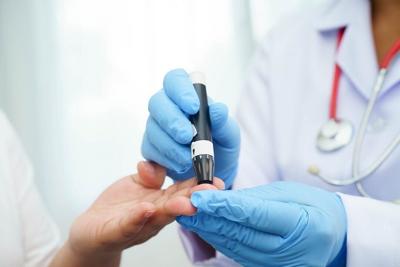

Early diabetes symptoms include strong thirst, frequent urination, hunger, weight loss without trying, fatigue and blurry vision, but many people notice none of them. November is American Diabetes Month, and World Diabetes Day falls on Saturday, Nov. 14, 2026. The International Diabetes Federation's theme for 2026 and 2027 is "Early Action on Diabetes."
About 40.1 million people in the U.S. (12%) had diabetes in 2023, and about 11 million adults with diabetes have not been diagnosed; another 115.2 million adults have prediabetes, according to the CDC. Thirst, frequent urination and tiredness together point to high blood sugar far more than any one of them alone, and only a blood test can confirm it. Here, Doctronic looks at 10 symptoms that may indicate someone has diabetes.
Key takeaways
- A pattern of symptoms matters more than any single sign, and only a blood test can confirm diabetes.
- Type 1 symptoms usually appear over days or weeks, while Type 2 develops slowly and may cause no symptoms.
- Prediabetes and gestational diabetes are usually found through blood testing, not symptoms.
- The ADA recommends testing all adults by age 35; an A1C of 6.5% or higher meets the threshold for diabetes.
- Very high blood sugar can cause emergencies (DKA and HHS) that need a 911 call.
Early Diabetes Symptoms, Decoded
The CDC lists these as common symptoms of diabetes. Each one traces back to sugar building up in the blood instead of reaching the cells that need it.
1. Increased thirst
When the kidneys flush extra sugar into the urine, water goes with it. The body loses fluid and responds with strong, frequent thirst.
2. Frequent urination
High blood sugar pulls more water through the kidneys, so people urinate more often, especially at night.
3. Hunger, even after eating
The blood holds plenty of sugar, but without enough working insulin, the cells can't use it. The body reads that as starvation and keeps sending hunger signals.
4. Weight loss without trying
When cells can't get glucose for energy, the body breaks down muscle and fat instead. Weight can drop even while someone eats normally or more than usual.
5. Fatigue
Cells short on fuel leave people tired even after a full night's sleep.
6. Blurry vision
Blurry vision happens when changing blood sugar moves fluid in and out of the eye's lens, changing its shape. It often comes and goes as glucose levels rise and fall.
7. Cuts and sores that heal slowly
Too much sugar in the blood can slow circulation and weaken the body's repair process, so small cuts and sores linger. The CDC includes slow-healing sores among Type 2 diabetes symptoms.
8. Frequent infections
Elevated glucose makes it harder for white blood cells to fight germs. Skin, gum, urinary and yeast infections can come back more often than usual.
9. Numbness or tingling in the hands or feet


Over time, excess glucose can damage nerve fibers, a condition called peripheral neuropathy. Many people first blame the feeling on sleeping positions or poor circulation.
10. Dark, velvety skin patches
Dark, velvety patches on the neck, armpits or groin, called acanthosis nigricans, are a sign of insulin resistance. The CDC lists them with Type 2 diabetes symptoms.
Type 1, Type 2, Prediabetes and Gestational Diabetes: How the Signs Differ
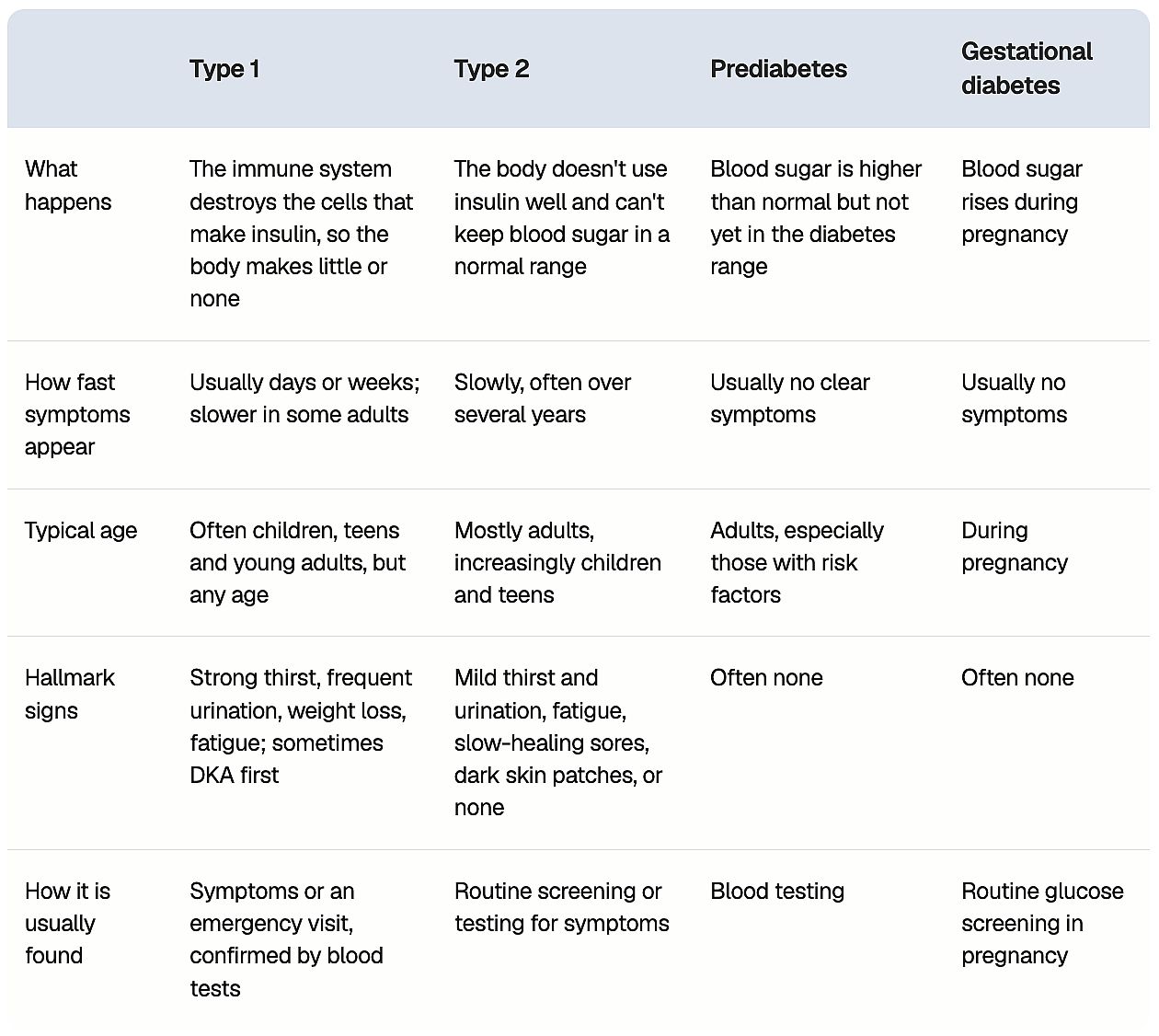
Type 1 symptoms usually develop quickly, over days or weeks; adults with Type 1 can have slower, Type 2-like symptoms, according to the National Institute of Diabetes and Digestive and Kidney Diseases (NIDDK). Sometimes the first sign of Type 1 is diabetic ketoacidosis (DKA), a dangerous buildup of acids in the blood.
Type 2 diabetes usually develops slowly, often over several years, and symptoms can be mild enough to miss. Once thought of as an adult disease, it is now increasingly seen in children and teens.
Prediabetes usually causes no clear symptoms and is found through blood testing. Gestational diabetes develops during pregnancy, usually in the second or third trimester, and is most often found through routine screening rather than symptoms.
Who Should Get Tested, and Which Tests Are Used
The CDC says the risk of Type 2 diabetes is higher for people who:
- Have prediabetes
- Are overweight or have obesity
- Are 45 or older
- Have a parent, brother or sister with Type 2 diabetes
- Are physically active less than three times a week
- Have had gestational diabetes or given birth to a baby who weighed over 9 pounds
- Are African American, Hispanic or Latino, American Indian or Alaska Native (some Pacific Islanders and Asian Americans are also at higher risk)
Family gatherings at Thanksgiving, on Nov. 26, are a good time to compare notes on relatives' health conditions, since a parent or sibling with Type 2 diabetes raises a person's own risk.
Two major guidelines differ slightly on when to start. The U.S. Preventive Services Task Force recommends screening adults ages 35 to 70 who are overweight or have obesity, and says testing every three years may be reasonable. The American Diabetes Association's Standards of Care in Diabetes 2026 recommends testing all adults starting no later than age 35. It advises testing earlier for adults with overweight or obesity plus at least one other risk factor.
The ADA uses these thresholds:
- A1C (average blood sugar over the past two to three months): below 5.7% is normal, 5.7% to 6.4% is prediabetes, and 6.5% or higher is diabetes.
- Fasting plasma glucose (after at least eight hours without food): below 100 mg/dL is normal, 100 to 125 mg/dL is prediabetes, and 126 mg/dL or higher is diabetes.
- Oral glucose tolerance test (OGTT), 2-hour result: below 140 mg/dL is normal, 140 to 199 mg/dL is prediabetes, and 200 mg/dL or higher is diabetes.
- Random plasma glucose: 200 mg/dL or higher, together with classic symptoms, points to diabetes.
When to See a Doctor or Get Help Now
Anyone who has several of the symptoms above, or several risk factors, should ask a primary care doctor about blood testing. Symptoms that come on quickly, especially in a child or young adult, need same-day attention.
Call 911 or go to the emergency room for these signs of diabetic ketoacidosis (DKA), according to the CDC:
- Blood sugar staying at 300 mg/dL or higher
- Fruity-smelling breath
- Vomiting that prevents keeping food or drinks down
- Trouble breathing
- Several symptoms of DKA at the same time
Hyperosmolar hyperglycemic state (HHS) is another emergency caused by very high blood sugar. Call 911 for signs such as these, listed by Cleveland Clinic:
- Extreme thirst
- Confusion
- Vision loss
- Weakness
- Blood sugar usually above 600 mg/dL
The Bottom Line
Diabetes often starts quietly, and a cluster of signs such as thirst, frequent urination, fatigue, blurry vision and slow-healing sores says more than any one symptom. Type 1 can appear within days or weeks. Type 2 and prediabetes may cause no symptoms for years, so the ADA recommends a blood test for all adults by age 35, and earlier for those with overweight or obesity plus at least one other risk factor. Anyone with blood sugar staying at 300 mg/dL or higher, fruity breath, vomiting that prevents keeping food or drinks down, trouble breathing or confusion should call 911.
This story was produced by Doctronic and reviewed and distributed by Stacker.


(0) comments
Welcome to the discussion.
Log In
Keep it Clean. Please avoid obscene, vulgar, lewd, racist or sexually-oriented language.
PLEASE TURN OFF YOUR CAPS LOCK.
Don't Threaten. Threats of harming another person will not be tolerated.
Be Truthful. Don't knowingly lie about anyone or anything.
Be Nice. No racism, sexism or any sort of -ism that is degrading to another person.
Be Proactive. Use the 'Report' link on each comment to let us know of abusive posts.
Share with Us. We'd love to hear eyewitness accounts, the history behind an article.