


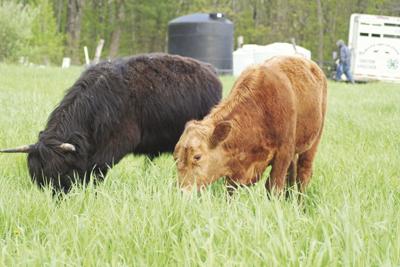
Miles Smith Farm Summer Camp is about to begin its 2019 season. This is not a typical summer camp. It opens in May and does not include swimming, archery or ghost stories. It's selective about its clientele, too. Requirements include cloven hooves, a tail, and a love of green grass. This is a grazing camp, where cows can eat their daily fill of abundant, luscious forage.
All winter, our cattle ate baleage — fermented hay that contains 50 percent more protein than non-fermented feed. They like the baleage, but they love the fresh green grass.
Grass starts out in early May as delicious tender shoots. Eating it at this stage would destroy the root system. (One inch of grass means there's one inch of roots). Letting the grass grow 6 inches high means the root system is also 6 inches deep. A sound root system is required to aerate the soil and, during a drought, to reach underground moisture. Earthworms love aerated soil; they can burrow in it and add their own nutrients to the dirt. Good roots make for good soil, and good soil captures carbon dioxide and keeps it out of the atmosphere.
If the grass is best at 6 to 8 inches, why not let it reach 12 or 14 inches? The taller, the better, right? Not quite. At 12 inches, it gets dry, brittle, and goes to seed. Unless they're starving, cattle will not eat the stuff. They will sleep in it and trample it, but won't munch on it.
Summer camp starts when the grass reaches 6 inches. We don't have enough grass to feed the herd on our 37-acre farm, so we rent pastures. St. Paul's School has leased us two fields, one near Audubon on Silk Farm Road and the other in the middle of the campus. The first day of camp will be at the Audubon pasture.
Before the campers arrive, husband Bruce removes trees that have fallen on the fence line, repairs damage from wildlife, and replaces broken fence posts. Since there is no water source at the Audubon pasture, a swimming pool company delivers 6,000 gallons to fill three tanks. Each cow drinks an amazing 20 gallons a day, so 35 cattle (we keep 15 of them at home) will consume this water in 10 days. Not to worry, though. The water isn't lost; 90 percent of it, greatly enhanced, is excreted back onto the ground and becomes the perfect fertilizer to improve soil and feed the grass.
We load selected cattle into the Cow Taxi, a 12-foot stock trailer, and transport them to camp. This will take several trips. Some of the cattle arriving in the pasture actually jump for joy. Eating and excreting sound like a poor selection of activities for a summer camp, but they are the cattle's two favorites! Way better than braiding lanyards and singing around the campfire.
Of course, our jobs as food-service managers aren't done. The 20-acre pasture is divided up so the cattle will efficiently graze it up, section by section. Opening up the next grassy paddock is like putting a fresh platter of cheeseburgers in front of hungry Boy Scouts. In addition to that kind of management, we have to keep the water tanks filled, while preparing the next pasture for use when this one is exhausted.
If you walk the paths around the Audubon pasture, you'll be treated to a scene of contentment. You may find yourself envying the happiest campers on God's green earth — where the siesta never ends, and the s'mores grow right out of the ground.
###
Carole Soule is co-owner of Miles Smith Farm (www.milessmithfarm.com), where she raises and sells pastured pork, lamb, eggs and grassfed beef. Contact her at cas@milessmithfarm.com.


(0) comments
Welcome to the discussion.
Log In
Keep it Clean. Please avoid obscene, vulgar, lewd, racist or sexually-oriented language.
PLEASE TURN OFF YOUR CAPS LOCK.
Don't Threaten. Threats of harming another person will not be tolerated.
Be Truthful. Don't knowingly lie about anyone or anything.
Be Nice. No racism, sexism or any sort of -ism that is degrading to another person.
Be Proactive. Use the 'Report' link on each comment to let us know of abusive posts.
Share with Us. We'd love to hear eyewitness accounts, the history behind an article.