




When we are looking for trails to get us to the uppermost heights of mountains we usually think of the mountain ranges of the Lakes Region: Belknap, Squam or Ossipee. Our thoughts also point northward to the White Mountains: Franconia Ridge, the Carters, the Presidential Range and many others. I suggest, if you’re looking for new mountain adventures, look westward. As Horace Greely stated, “Go west, young man, go west.” If you are standing on the summit of Mount Major, among the throngs of other hikers, turn your head westward and scan the horizon. You’ll see in the distance Mount Monadnock (3,165 ft.) peeking above the horizon. Mount Monadnock is part of the Wapack Mountain Range which includes several other lesser peaks: North Pack Monadnock, Pack Monadnock, and Temple Mountain. The Wapack Range, also known as the Pack Monadnock Range, runs 20 miles in South-Central New Hampshire.
Like many of you, I myself have neglected to twist my head around and look westward, as Greeley stated, and discover what is waiting for me: an historic mountain, a mountainous ridge and a network of well- maintained trails, some that date back to the early nineteenth century.
Mount Monadnock is the most dominant and well-known mountain of the Wapack Range. It’s acknowledged as the second most climbed mountain in the world, second only to the holy Mount Fugiyama in Japan, where over 300,000 people hike each year. The first recorded summit of Monadnock was by Samuel Willard in 1724. Willard was soon followed by others who laid out several other routes to the barren summit. Due to its spectacular views and its location to population centers in Massachusetts Monadnock became a popular destination for many trekkers, including Henry David Thoreau, Ralph Waldo Emerson, Benton Mackay, the visionary founder of the Appalachian Trail, and Arnold Guyot, the intrepid tramper and mapper of the Appalachian Mountains. A bog near the summit and a craggy viewpoint off the Cliff Walk Trail are named after Thoreau and another outlook is named after Emerson.
Since I have hiked several of the trails on Mount Monadnock I wanted to discover the Wapack Trail and climb Mounts North Pack Monanock (2,276 ft.) and Pack Monadnock (2,290 ft.). I rounded up a few good hiking friends, Dick, Susan, Beth and Steve and we drove, in separate cars (to stay safe) to the northern terminus of the Wapack Trail on Mountain Road in Greenfield, NH.
The 21.5 mile long trail ends on Mount Watatic in Ashburnton, Mass. The entire length of the trail can be hiked in one long day, or divided into two days, camping overnight at the Windblown Cross-Country Ski Area. Besides passing over several mountains, none taller than 2,300 feet, it passes along stone walls, through blueberry fields, alongside ponds and wetlands, cellar holes and across ledges with outstanding views. It connects with the Mid-State Trail in Massachusetts if you desire a longer multiday hike. The Friends of Wapack is the primary organization responsible for maintaining the trail and other feeder trails. If you would like information about the organization go to https://wapack.org/.
When we arrived at the trailhead on Mountain Road it was lined with about two dozen vehicles. We gathered our gear, water and food and began our climb on Ted’s Trail. This is one the most popular trails to the summit of North Pack, so you may want to arrive early to avoid the crowds. Within a few minutes of being on the trail I quickly understood why this trail is so popular.
We began by hiking on fairly level ground passing through a cathedral of pine and hardwood. We found a beautiful cluster of pink lady slippers that looked as if a florist had planted them for a trail beautification project. The lady slipper, which has a very intricate reproduction cycle, is in bloom now throughout the area. It is a large, showy wildflower resembling a slipper and belonging to the orchid family. Red efts were crawling across the trail. These little fellows are sometimes confused with salamanders, but have their own identity. They live in moist plant growth and are one of the indicators of a healthy ecosystem and a thriving forest
We then entered the Wapack National Wildlife Refuge, the first national wildlife refuge in New Hampshire, established in 1972. The trail winds through the refuge for three miles of the 1,672 acre preserve. The refuge is known as a popular destination for observing kettles of hawks as they prepared for their migration south in the fall. It also provides critical nesting habitat for numerous songbirds such as the American tree sparrow, Swainson’s thrush, magnolia warbler, crossbills, pine grosbeaks and white-throated sparrows. Dick and I had a chance to observe a beautifully colored rufous-sided towhee as it hopped from tree branch to tree branch, singing to its mate, “Drink-your-tea” and calling “chewink-towhee.”
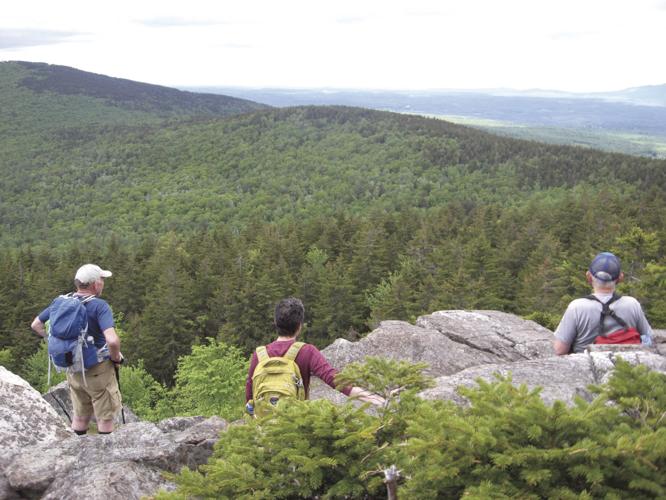
After leaving the forest floor we began climbing, following a brook that featured cascades and rock formations that offered a few scrambles. Within two miles we began to encounter ledges and cliffs that with fine views to the north and east. Beth decided to take to her own hike, following the cliff trail with plans to meet us at the summit. After spending a considerable amount of time admiring the views and lounging on the ledges we began our final leg to the summit.
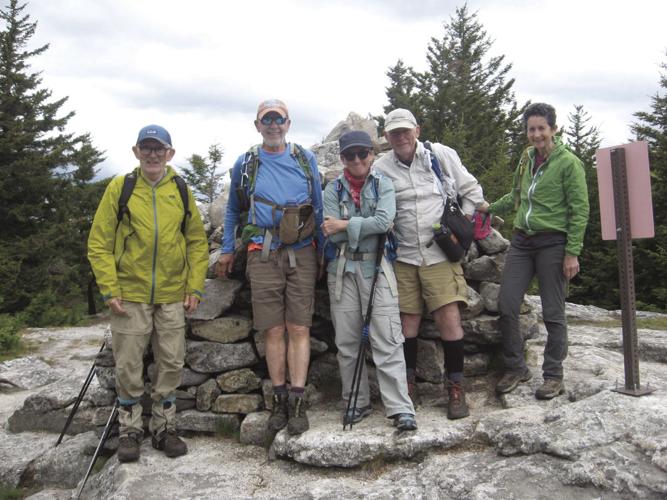
Arriving at the summit we found Beth waiting for us, sitting next to a gigantic cairn. As we downed our lunch we made plans for the hike out: Steve and I would continue on the Wapack Trail, ending at Miller State Park. Dick and Susan would descend North Pack by way Carolyn’s Trail, and Beth would continue her redline journey by hiking several of the connecting trails.
Steve and I tramped along, heading south on the Wapack trail, passing through reforested meadows and stone walls where sheep once roamed and ruled the agricultural economy of New Hampshire and Vermont until the wool market collapsed in the mid-1800s. Ancient hemlock and huge white pines dominated the landscape as we made our way, climbing steadily until we reached the summit of North Pack Monadnock. We transitioned from the silence and solitude of the forest to the shouts and joyful voices of children climbing on rocks and running around the picnic sites of Miller State park.
The summit of the mountain can be reached by an auto road that starts at the base of the mountain in Miller State Park. The park is the oldest state park in New Hampshire. The 1.3 mile paved road to the summit is open in the summer and on spring and fall weekends. The park is named for James Miller, (April 25, 1776 – July 7, 1851) a Peterborough native who was a brigadier general in the United States Army during the War of 1812 and became the first Governor of Arkansas Territory. He retired to his farm in Temple, NH where he died of a stroke after a long and successful political career.
The hike off the mountain was fraught with ledges and a steep decline ending at the entrance of the state park, where Beth met us and drove back to the north end of the trail, where we began our trek. Shortly after I began my drive home, I ran into quite a sight: The home of the Yankee Siege Trebuchet. The Yankee Siege is a 40,000 pound working catapult. It stands 100 feet tall and is designed to work exactly as the medieval catapults did in smashing through castle fortifications. The catapult is able to throw 250 pound objects over several hundred yards. The farmer who built the catapult used the replicated war machine to hurl pumpkins over long distances. The site has been constructed to resemble a medieval castle, complete with walls, turrets and even a moat. The Trebuchet has not been use in several years and stands like a giant hulk waiting for the next war to begin.
The Wapack Mountain Range is waiting for you to explore and find the delights of hiking with your family on picturesque and historic mountain trails. Find out why so many hard-core as well as novice trekkers are drawn to the Wapacks every year.
•••
For more information or questions contact Gordon at forestpd@metrocast.net. You can also purchase his book, Paths Less Travelled, and discover other family oriented hikes in the Lakes Region and beyond. Signed copies of the book can be purchased at Innisfree Book Store in Meredith.
(0) comments
Welcome to the discussion.
Log In
Keep it Clean. Please avoid obscene, vulgar, lewd, racist or sexually-oriented language.
PLEASE TURN OFF YOUR CAPS LOCK.
Don't Threaten. Threats of harming another person will not be tolerated.
Be Truthful. Don't knowingly lie about anyone or anything.
Be Nice. No racism, sexism or any sort of -ism that is degrading to another person.
Be Proactive. Use the 'Report' link on each comment to let us know of abusive posts.
Share with Us. We'd love to hear eyewitness accounts, the history behind an article.