


It was a gorgeous spring day: bright blue skies, temperatures in the 50s, daffodils beginning their upward surge through the garden soil, robins chirping in the apple tree and pussy willows opening their fur coats. These are the wonderful signs of spring, the coming of summer and the end of winter. This is usually a time to rejoice and revel in the greening grass and the budding maples, but we are in the grasp of something that has dampened this time of year and put an end to celebrations. The Corvid-19 virus outbreak is ravaging the world, the largest and most deadly epidemic since the 1918-20 Spanish Flu, when 500 million people were infected with the H1N1 virus, resulting in 50 million deaths.
Now, 100 years later we are confronted with another viral outbreak infecting thousands of people around the world, inflicting all races, classes and ages of people, resulting in anxiety, fear, frustration, closure of business and an upsurge in unemployment. We are shuttered behind the walls of our homes, hopefully practicing the discipline of social distancing. Many of us have lost our regular social contact and activities, those activities that are rewarding and that bring us joy and happiness.
However, the out-of-doors can provide an outlet for our pent-up frustrations: gardening, hiking, walking, biking can be done safely and securely if we take the correct measures to minimize our risk of becoming infected with Covid-19:
• Limit your hikes to solo outings or at the most only one or two others that you know.
• Avoid crowds on the trails, trailheads, and on the way to the trailhead. If the trailhead is full, that means the trails are going to be crowded. Go to another trailhead and another trail - there are plenty to choose from in our area. Try a bushwhack!
• Keep at least a 6 foot separation to other hikers.
• Don’t touch things at the trailheads such as benches, signs and water fountains.
• Wash your hands before you leave and when you return. Avoid touching your face.
• Wipe down surfaces with disinfectant wipes.
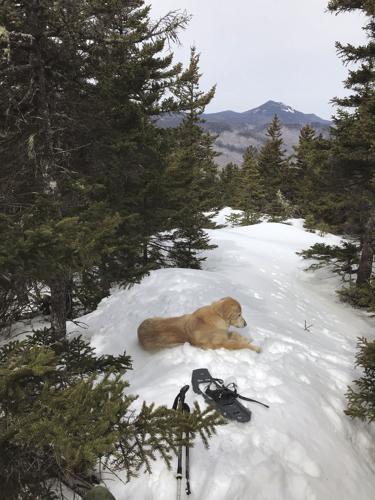
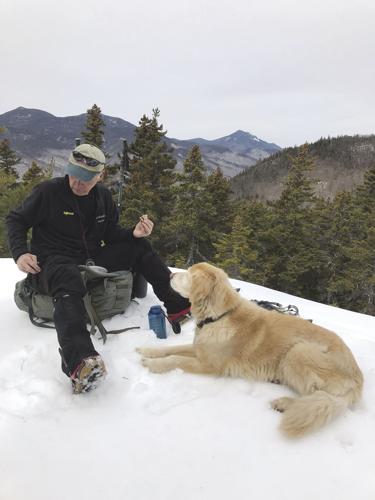
It was with these recommendations on this beautiful spring day that Reuben and I met Fran for another wilderness hike, a bushwhack to Hope Mountain (2,505 ft.) and Hope Mountain, Southeast Peak (2,180 ft.). Our destination, Mount Hope and its little sister to the south, seemed like a fitting choice, a climb symbolizing our hope that the virus will soon lose strength and disappear. We know this won’t happen soon (the Spanish flu lasted two years) but we can hope.
Driving into Crawford Notch we passed the shuttered AMC Highland Center. To our amazement the parking lot and both sides of Rt. 302 were crammed with cars. People were standing in groups, jabbering, shaking hands, and gleefully getting ready to hike the two or three trails from this end of the Notch. It appeared that no one was heeding the advice of health professionals, the CDC, our state government and even the Appalachian Mountain Club. This warning is posted on AMC website:
“In continued and evolving support of the national effort to control the spread of COVID-19, AMC encourages limiting outdoors engagement during this time to brief, local outings and backyard adventures, always keeping in compliance with state and Federal stay-at-home guidance. Popular outdoor locations and facilities have recently been overrun with visitors, defeating the purpose of international social distancing protocols meant to minimize coronavirus-related health risks.”
We sped through the crowded highway on our way to the Davis Path, which islocated at the southern end of Crawford Notch. When we arrived at the trail head parking lot we breathed a sigh of relief, no cars. I wondered, “Why were there so many people at the Highland Center, when there are dozens of other trails in the Notch?” We flung our packs over our shoulders and began the trek to “the Hopes.” The hike began with a short ramble along the Davis Path, then we ducked into the woods to begin our whack. It was a pleasant trek in open woods free of snow, but the spring-like conditions soon faded as we continued our climb to the summit. How quickly I forgot that this time of the year is the shoulder season, when conditions are mixed between winter and summer. The mountainsides facing south and west were free of snow due to the angle of the sun warming the ground. While snow to depths of 2-3 feet still lingered on the north east side of the mountain and in shaded cols and ravines. We needed to continue switching footwear, from Microspikes to snowshoes.
This is also the time of year when trails, rock covered slopes and summits can be ice covered and dangerous without crampons or mountaineering snowshoes and the risk of slipping and sliding is a distinct possibility. Recently, a 35 year old hiker was descending Mount Washington along the Cog Railroad tracks. Near Jacobs Ladder, a very steep section of the rail line, she slipped and fell, sliding down the steep slope hitting several rocks, resulting in serious injuries. Lt. Mark Ober of the NH Fish and Game, who led the rescue stated, “It was those rocks that ultimately saved her from plunging into the ravine, a fall that would have likely proved fatal.” Due to the steep and icy conditions rescuers had to call on the Cog Railway to bring a train to the location where she lay and bring her off the mountain to a waiting ambulance at the. Base Station.
Two questions that come immediately to mind: Why was she descending Mount Washington using the Cog Railroad tracks when there are two trails that she could have taken, the Jewell and the Ammonoosuc, and was she wearing crampons? The report does not answer these two questions, but this accident can serve as a reminder that spring hiking conditions pose unique challenges and risks that we sometimes we don’t calculate when spring is jumping out all around us.
After our summit of Mount Hope we continued heading south to Mount Hope, South Peak. This little known mountain at an elevation of only 2,180 ft. provided stunning views of Mounts Willey, Nancy, Bemis, Anderson, Carrigain and Vose Spur. Spending time on this barren-rock summit brought to mind how peaceful and contemplative a secluded mountain top can be, removed from the troubling times we live in, when despair and fear seem to be everywhere.
Following this time to reflect, have lunch and take photos, we left the mountain top and began our descent to the Saco River Valley. Our hike down involved an assortment of conditions: bare ground, ice covered rocks, and a foot of snow. This meant changing from trail crampons to bare boots and snow shoes several times. This was a typical spring hike. Therefore, when you hit the trail be prepared for a variety of trail conditions that can take a pleasurable experience and turn it into a disaster.
With a few thoughtful considerations, getting into the out-of-doors can provide respite and relief from our shuttered-in life style and continual fears about a Covid-19 infection. If you would like to learn where off-the radar trails are, where you’ll be away from the crowds that gather at the more popular trailheads, I recommend purchasing Paths Less Travelled, authored by this writer. The book contains vivid narratives of 58 treks to peaks, ponds, abandoned villages and waterfalls, where there are no crowds to spoil the vista and the adventure. It can be ordered on-line from Amazon, Barnes and Nobel and the Publisher Dorrance Publishing, Pittsburg, PA.
•••
For comments or questions contact Gordon at forestpd@metrocast.net


(0) comments
Welcome to the discussion.
Log In
Keep it Clean. Please avoid obscene, vulgar, lewd, racist or sexually-oriented language.
PLEASE TURN OFF YOUR CAPS LOCK.
Don't Threaten. Threats of harming another person will not be tolerated.
Be Truthful. Don't knowingly lie about anyone or anything.
Be Nice. No racism, sexism or any sort of -ism that is degrading to another person.
Be Proactive. Use the 'Report' link on each comment to let us know of abusive posts.
Share with Us. We'd love to hear eyewitness accounts, the history behind an article.