


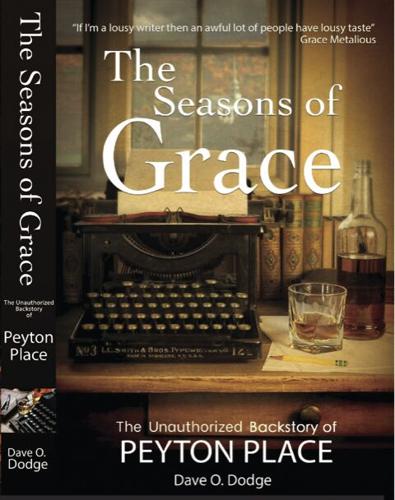
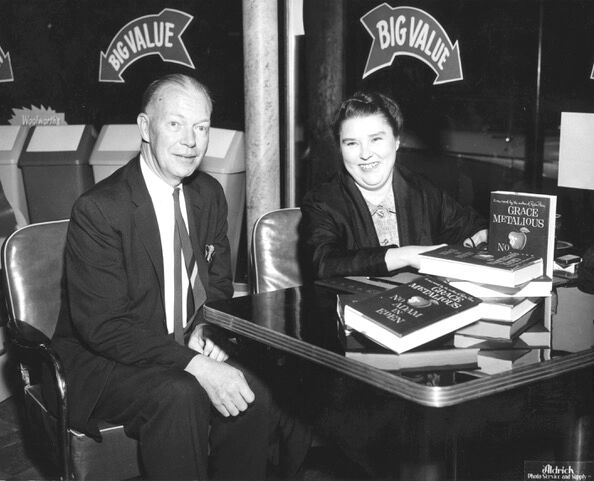

The seasons of New Hampshire are important to writer Dave O. Dodge. The seasons also were important to former Gilmanton writer, Grace Metalious. Both crafted stories around the weather, and their descriptions of the seasons are so accurate one can imagine a blue-sky, foliage-bright autumn day in the first page of Metalious' book, “Peyton Place” or a menacing winter’s snowstorm in Dodge's recently-published fictional book, “The Seasons of Grace The Unauthorized Backstory of Peyton Place.” Dodge's book begins and nears its end with an old-fashioned blizzard and his descriptions of battling cold and snow echo the difficulties in Metalious' life.
Although Dodge, a travel writer and novelist who also works in marketing, now runs Ochenta y Dos, an urban bed and breakfast and spa in Merida, Yucatan, Mexico, he understands New England weather, having grown up in West Franklin, New Hampshire. Like many people, Dodge knew of writer Grace Metalious and her contributions to the literary world. He recalls, “I didn’t know much about Grace when I was a kid. I do remember Sunday afternoon drives with my parents when they rode around trying to find the sheep pen from ‘Peyton Place’.” (The pen was a shocking part of the book, and led to a view of “Peyton Place” as a salacious story, and its author as someone who pushed the boundaries of polite society.)
Dave was too young to watch “Peyton Place,” the television show. It wasn’t until years later when he came across a book about Grace titled “The Girl from Peyton Place” by George Metalious and June O’Shea that Dave realized what an interesting woman Grace had been in her short life, 1924 to 1964. He said her impact on culture and the literary world was extreme. When he read “Inside Peyton Place” by Emily Toth, he learned even more about Grace.
Dodge began to wonder if he could write a historical fiction book based on Grace, and her interesting but sometimes difficult life. From the start of Dodge's book, he tells the reader “The Seasons of Grace” is a work of fiction, and not a biography.
Dodge reflects, “I believe Grace wanted to show she was a writer. She was a young housewife and mother, and she never had the opportunity to go to college. But she wrote over 350 short stories.”
Metalious was from Manchester, New Hampshire, and young when she married George Metalious. The couple moved to the Laconia area and were struggling financially. George worked as an educator and the couple had a total of three children.
Why did Metalious write “Peyton Place”? Dodge surmises, “She needed the money. They were living in a little house in the area, which I describe in my book.” It was the 1950s, and she had finished the book after writing for months. The book’s description must have been accurate, because a woman who read “The Seasons of Grace” told Dodge that as a little girl, she played with the Metalious children and recalled the house and seeing Metalious writing the book.
“Peyton Place” was expected to sell a modest amount, but became a best-seller. Dodge says it totaled a large amount, including a television show and movie. He imagines in his book, the experience of locals who were invited by 20th Century Fox to take a bus to the movie’s premiere. Ironically, the bus ride took place during a snowstorm, the weather again reflecting the difficulties Metalious experienced during her lifetime.
“When ‘Return to Peyton Place’ came out,” Dodge explained, “Grace insisted the movie’s world premiere be held locally at the Colonial Theatre in Laconia.”
In Dodge’s novel, many scenes are set in the area; older readers may recall O’Shea’s Department Store in downtown Laconia. Metalious shopped there, once her financial situation improved.
With wealth from her wildly popular book, and trips to New York City and Hollywood, the pressure was on to produce more books. Perhaps the pressure contributed to Metalious' drinking problem.
Metalious had many fans, but others were shocked at “Peyton Place” and its story of secrets hidden in a beautiful New England village. Housewives just did not speak of – or write about – such things in the 1950s, but she dared to do so.
Dodge has turned that time into a fictional book, surmising scenes with empathetic dialogue, and the insight to see Metalious as a courageous and highly-talented writer. In the four books she penned: “Peyton Place,” “Return to Peyton Place,” “The Tight White Collar” and “No Adam in Eden,” the titles hint at stories about the realities of life. While he may not have known Metalious personally, Dodge knows many details about the author. One detail, for example, is Metalious named the small house where she resided in the area, “It’ll Do,” a tongue-in-cheek reference to its modest style.
As “The Seasons of Grace” concludes, we read of Metalious' tragic death during a snowstorm, and later her funeral. Perhaps she sensed she would be an outsider in death, as she had been in life. Thus, her final resting place at the Smith Meeting House Cemetery in Gilmanton is located away from others buried there.
Dave has visited her gravesite, and mentions the season he paid his final respects to Grace: On a warm day, when a hopeful sun shone on the beautiful New England village.
(Readers may purchase “The Seasons of Grace” by Dave O. Dodge, online at Amazon or GoodReads; the book will soon be available at Barnes and Noble. Dodge is currently working on a historical fiction book about New Hampshire resident Betty Hill, who skyrocketed to fame with her story of UFOs.)


(0) comments
Welcome to the discussion.
Log In
Keep it Clean. Please avoid obscene, vulgar, lewd, racist or sexually-oriented language.
PLEASE TURN OFF YOUR CAPS LOCK.
Don't Threaten. Threats of harming another person will not be tolerated.
Be Truthful. Don't knowingly lie about anyone or anything.
Be Nice. No racism, sexism or any sort of -ism that is degrading to another person.
Be Proactive. Use the 'Report' link on each comment to let us know of abusive posts.
Share with Us. We'd love to hear eyewitness accounts, the history behind an article.