


There were many moments of distress for Mirno Pasquali as he managed a refugee camp in Tikrit, such as when 300 families showed up out of the blue, in immediate need of the most basic necessities. Those moments can be followed by some of the most encouraging, as when nearby residents pooled their resources to to fill a truck with 500 falafel sandwiches to donate to their new neighbors.
Those were among the memories that Pasquali brought back to Laconia last month when he returned home after more than a year in his most recent gig, and five years into a career of humanitarian work.
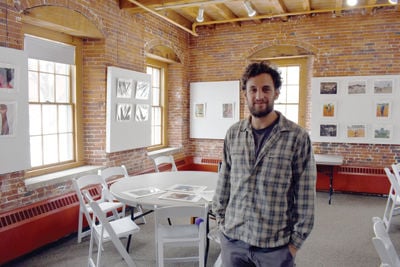
Pasquali will be giving a talk about his humanitarian work, which includes stints in Jordan and Tanzania, as well as Iraq, at the Belknap Mill tonight, March 1, beginning at 6 p.m.
Pasquali took an indirect route to his humanitarian career, though the idea of helping others was never foreign to him. His parents met while serving in the Peace Corps, so his upbringing was infused with stories and artifacts of their time abroad.
“That was kind of intrinsic in our household,” he said.
He got another view into humanitarian crises when refugees from Serbia and Croatia were settled in Laconia and suddenly had some new classmates. With encouragement from his parents, he befriended them.
“We couldn’t really talk, but we could go out and play soccer,” he said. By the time he graduated from Laconia High School (Class of ’07), Pasquali had grown close with some of the families, enough so that he traveled with them back to their old hometown during a gap year he took after high school.
He also traveled to New Zealand during his year off. His traveling, he expected, would help shape him in the same way that it did Jack Kerouac in On the Road, a coming-of-age novel. In retrospect, he finds that the time he spent working at a Laconia restaurant, for near minimum wage, to pay for his adventures, was more influential to the person he is today.
“I think that gave me a different perspective of the real world,” he said.
After his gap year, he enrolled at Allegheny College in Meadville, Pennsylvania, where he studied environmental science and political science. While there, he became enamored of biogas digesters – simple systems that convert organic waste, such as food scraps or manure, into liquid fertilizer and clean methane gas, which can be used for cooking, heating or electricity generation. As a senior project, he traveled back to Bosnia to promote the concept, and after graduation he landed an internship with an organization that distributes the systems in India.
While Pasquali was knowledgeable in the design and build phase of biogas systems, the work in India was different. There, the systems were in place, but local people weren’t always using them properly.
“They weren’t working. Why weren’t they working? To me, it was a social question.”
To answer the question, Pasquali had to build relationships with the local people, learn about their values and concerns. Building those relationships, he found, was more rewarding than building biogas digesters.
Leveraging that experience, Pasquali accepted a position doing community mobilization in Jordan, at a camp run by the United Nations High Council on Refugees. His role was to develop councils among the residents of the camp, and to work with them to identify and address issues among the residents, and to learn how services could be better delivered.
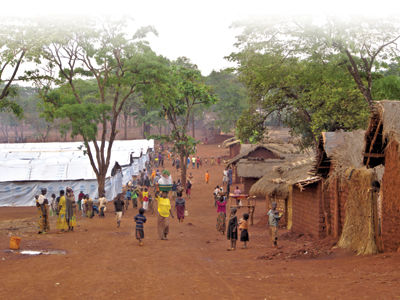
He worked in Jordan for a year ending in February 2015. His next assignment, which lasted from July 2015, to May 2016, took him to Tanzania, where refugees fleeing violent political clashes and economic instability fled to a camp operated by Doctors Without Borders.
In Tanzania, Pasquali worked as a logistician, helping to construct a hospital to care for the many children that arrived at the camp dangerously malnourished, and to build clinics to treat people who had contracted malaria.
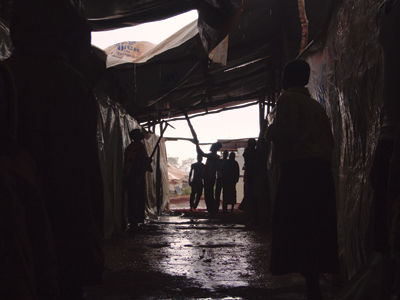
There, he learned how politics could affect the fate of those living in refugee camps. The camp in Jordan, with its close proximity to sophisticated urban centers, and its location in a world closely covered by international media, enjoyed substantial funding from the United Nations. When compared to the camp in Tanzania, which was also funded by the U.N., Jordan looked like a five-star resort. After the facilities were built, Pasquali spent his time photographing the living conditions of the refugees – many were living in improvised shelters made of tattered tarps – and sending reports to the U.N. requesting more funding.
In his most recent job, which lasted from October 2016, until last month, Pasquali managed a refugee camp just outside of Tikrit, Iraq, operated by the Danish Refugee Council.
In Tikrit, the camp’s population grew to as many as 15,000 when Pasquali was there. But the camp also provided services to the more than 100,000 people described as “internally displaced,” who fled fighting between Iraqi security forces and ISIS.
His time in Iraq was his first experience working in a conflict zone, and what he saw there was, at times, moving. He had 13 people working with him on his team, all of them Iraqis and all of their families had suffered, in some way, from the emergence of ISIS. Many of the people who showed up at the camp had been ISIS supporters or sympathizers, yet Pasquali watched as his colleagues treated each of them not as enemies but as humans who were in desperate need. He thought of one colleague in particular, whose father had been murdered.
“That is incredible to me. That is the most optimistic and encouraging facet. This guy has had a family member killed by ISIS, and he is willing to uphold humanitarian principles and provide water and blankets for that family.”
At times, the needs could be nearly overwhelming. On any given day, they could have hundreds of families appear without warning, each with needs that require immediate attention. He also saw gestures of generosity, such as the truck full of sandwiches, or other goods. Many, who were able to stay in their own homes, opened their doors to strangers who needed a place to live.
One day, in Tikrit, he was approached by a man who said he had a truck full of items he wanted to distribute, and asked for Pasquali’s help so that it would be an orderly and equitable distribution. The items? Cigarettes.
Tobacco use is discouraged by the U.N., and a formal distribution would certainly have been criticised further up the bureaucratic chain. But, in ISIS-controlled territories, smoking is outlawed, and he couldn’t think of a more therapeutic thing for people escaping the brutal and oppressive Islamic State than to allow them such an indulgence. When a septuagenarian woman offered him one of hers, Pasquali sat on the curb next to her and shared a smoke.
By February of this year, Pasquali was emotionally exhausted, so he left Iraq behind and returned home to recover.
That’s the pattern for international humanitarian workers, he said. Several months, up to a year, of intense work, then a retreat home for weeks or months, until the next opportunity arises.
“It’s very jarring. You develop these really strong emotional relationships with your team members, very quickly. Then you leave. That’s an exhaustive process over time.”
He’ll need several weeks until he feels ready to jump back in, he said. His next station will likely be in Bangladesh, helping care for the Rohingya Muslims who are fleeing persecution in Myanmar.
Pasquali didn’t know how to get into the humanitarian work. It’s a line of work that found him, instead. He started building devices that extracted methane from manure, and now manages refugees camps.
“I always wanted to work overseas, I always wanted to work in emergency settings. I didn’t have a plan to get into it, I just stumbled into it.”


(0) comments
Welcome to the discussion.
Log In
Keep it Clean. Please avoid obscene, vulgar, lewd, racist or sexually-oriented language.
PLEASE TURN OFF YOUR CAPS LOCK.
Don't Threaten. Threats of harming another person will not be tolerated.
Be Truthful. Don't knowingly lie about anyone or anything.
Be Nice. No racism, sexism or any sort of -ism that is degrading to another person.
Be Proactive. Use the 'Report' link on each comment to let us know of abusive posts.
Share with Us. We'd love to hear eyewitness accounts, the history behind an article.