


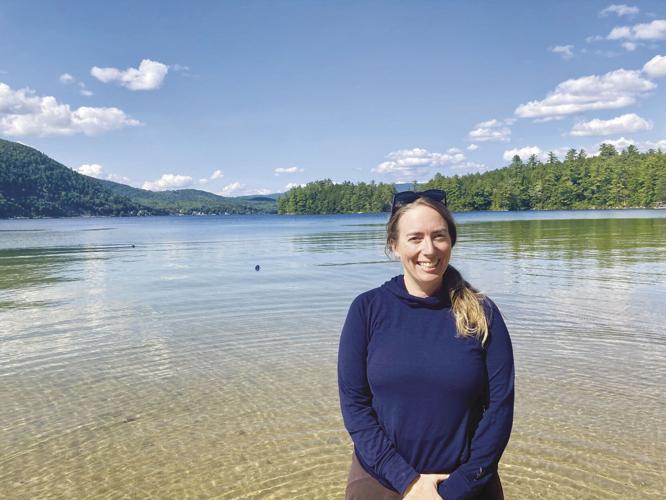

BRISTOL – When a group of active citizens are concerned about something, they take action to reach a goal. So it was with lake lovers in the Newfound/Bristol area when they formed the non-profit Newfound Lake Region Association in 1971. The goal of the Association founders was to protect Newfound Lake and its watershed.
Over the ensuing years that mission has taken many forms, from educational workshops for adults and children, tours of Newfound Lake each summer on the EcoTour pontoon boat, water quality monitoring, invasive species prevention, stormwater management and land conservation.
The programs work with seasonal Weed Watchers monitoring the shores of Newfound Lake for the presence of native and invasive aquatic plants. Newfound Lake Hosts provide complimentary boat and trailer inspections on Newfound public boat launches to check for fragments of flora and fauna, as well as educate boaters about invasive species and promote proper clean, drain, and dry practices. Since 2002, Lake Hosts have prevented 28 fragments of invasive plants — including milfoil — from being launched into Newfound Lake.
A variety of programs take place each year at Grey Rocks Conservation Area on North Shore Road in Hebron. Hiking trails and programs at Grey Rocks are on or near the shores of Newfound Lake and it is on this land that a new project is underway by the NLRA. Grey Rocks was given to the NLRA in 2011.
Now, the organization is thinking of its future.
The Grey Rocks Conservation Center is a $2.2 million project that will bring a hub for watershed science, a community gathering place and educational center, as well as office space for the NLRA staff.
NLRA Executive Director Rebecca Hanson said, “This project has been a long time coming. Our Grey Rocks property in Hebron is the logical place to create a new center, being next to Newfound Lake. It will bring us closer to more people and importantly, it will be the launching platform for the next half century of work.”
“We asked ourselves ‘where are we going and what do we hope to do in the future and how do we get there?’ To answer those questions, we recognized that a physical space was a necessity.”
At this time, NLRA is winding down its fundraising effort for the project and there has been big support from private donations and businesses. The fundraising leg of the project took 14 months, and Hanson said they are still welcoming contributions.
Currently NLRA operates from offices in downtown Bristol, but the Conservation Center, designed to be 3,400 square feet, will bring much more to the operations of the organization.
“There will be education and exhibit areas, space for events, offices, and a laboratory. We broke ground this fall, and the construction has begun,” Hanson said.
Design and build of the Conservation Center is by Sippican Partners Construction of Ashland. The Center is slated to be finished in the spring of 2025.
“We expect to see regular use with connection to the watershed, school field trips, increased volunteer participation, and the great room as a place for educational events and meetings,” Hanson said.
These many changes and efforts have a simple reason, and that is Newfound Lake. Known as among the cleanest lakes in the United States, Newfound has good water quality.
“We track water quality and Newfound Lake’s water is excellent; it also has no blooms of cyanobacteria,” Hanson said.
Watershed management is key to the protection of Newfound Lake. NLRA works with watershed towns in a number of ways such as making private property owners and others aware of ways to protect the lake.
NLRA has between 900 and 1,000 members, all taking an interest in the water quality and protection of Newfound Lake.
Hanson said, “There is a big interest in protecting the lake. People have pride in the lake, and they want to keep it healthy and clean. In the past couple of years water quality has become a bigger and more obvious issue.”
Hanson has been with the NLRA nearly five years and grew up in Holderness. She got an undergraduate degree at UNH and a master’s in environmental science at Plymouth State University. Before working at NLRA, she was the director of conservation for the Squam Lakes Association.
“Our board of directors oversees everything, and I am the operational arm of the organization,” she said. “We have four year-round staff and seasonal staff as well.”
For more information, visit newfoundlake.org.


(0) comments
Welcome to the discussion.
Log In
Keep it Clean. Please avoid obscene, vulgar, lewd, racist or sexually-oriented language.
PLEASE TURN OFF YOUR CAPS LOCK.
Don't Threaten. Threats of harming another person will not be tolerated.
Be Truthful. Don't knowingly lie about anyone or anything.
Be Nice. No racism, sexism or any sort of -ism that is degrading to another person.
Be Proactive. Use the 'Report' link on each comment to let us know of abusive posts.
Share with Us. We'd love to hear eyewitness accounts, the history behind an article.