



The Rev. Martin Luther King Jr. was born on Jan. 15, 1929, and assassinated on April 4, 1968, the day of my mother’s birthday. Speaking as much to me as to herself, she would always remember it, saying in her gentle voice, “This is the day Dr. King was assassinated.”
This year, 2023, would have been Dr. King’s 95th birthday. What would he think if he were alive?
A question that we cannot answer, of course. In fact, we cannot even speculate as so much has changed. However, we can look back through the archives and read about a news conference he held on April 25, 1967, at Ebenezer Baptist Church, speaking about the 1968 presidential race between Richard Nixon and Hubert Humphrey.
He commented on Atlanta television Station WSB-TV: “I do not want to give the impression I feel a Negro is not capable of being president. There are many Negroes who are capable this day and were capable yesterday and the day before and many days in the past. But because of prejudices and narrow-mindedness, Negroes have been held out of the political arena and certainly held out of the presidency. But I do think that the day will come in the not-too-distinct future when the Negro vote itself will be powerful enough to be a coalition with liberals and the white community and thereby elect a Negro president of the United States.”
It was 45 years later the Barack Obama was elected the 44th president of the United States, serving from 2009 to 2017. At the time of his election, many of us thought people might come together. There was a short time when many of us believed that there might be shift in the attitudes of people. Why did we need to think about race as a color?
There are three men who have had a dream that we could come together as one people:
Nelson Mandela, the South African anti-apartheid activist who served as the first Black president of South Africa from 1994 to 1999; the Rev. Desmond Tutu, the South African Anglican bishop remembered and honored for his work as an anti-apartheid and human rights activist who received the Nobel Peace prize and was instrumental in ending apartheid in South Africa; and Dr. Martin Luther King, the most prominent leader in the Civil Rights Movement from 1955 until his assassination in 1968. It was their collective dream that one day people would come together, not in a “negative peace which is the absence of tension, to a positive peace which is the presence of justice” (“Letter from a Birmingham Jail,” Dr. Martin Luther King, 16 April 1963).
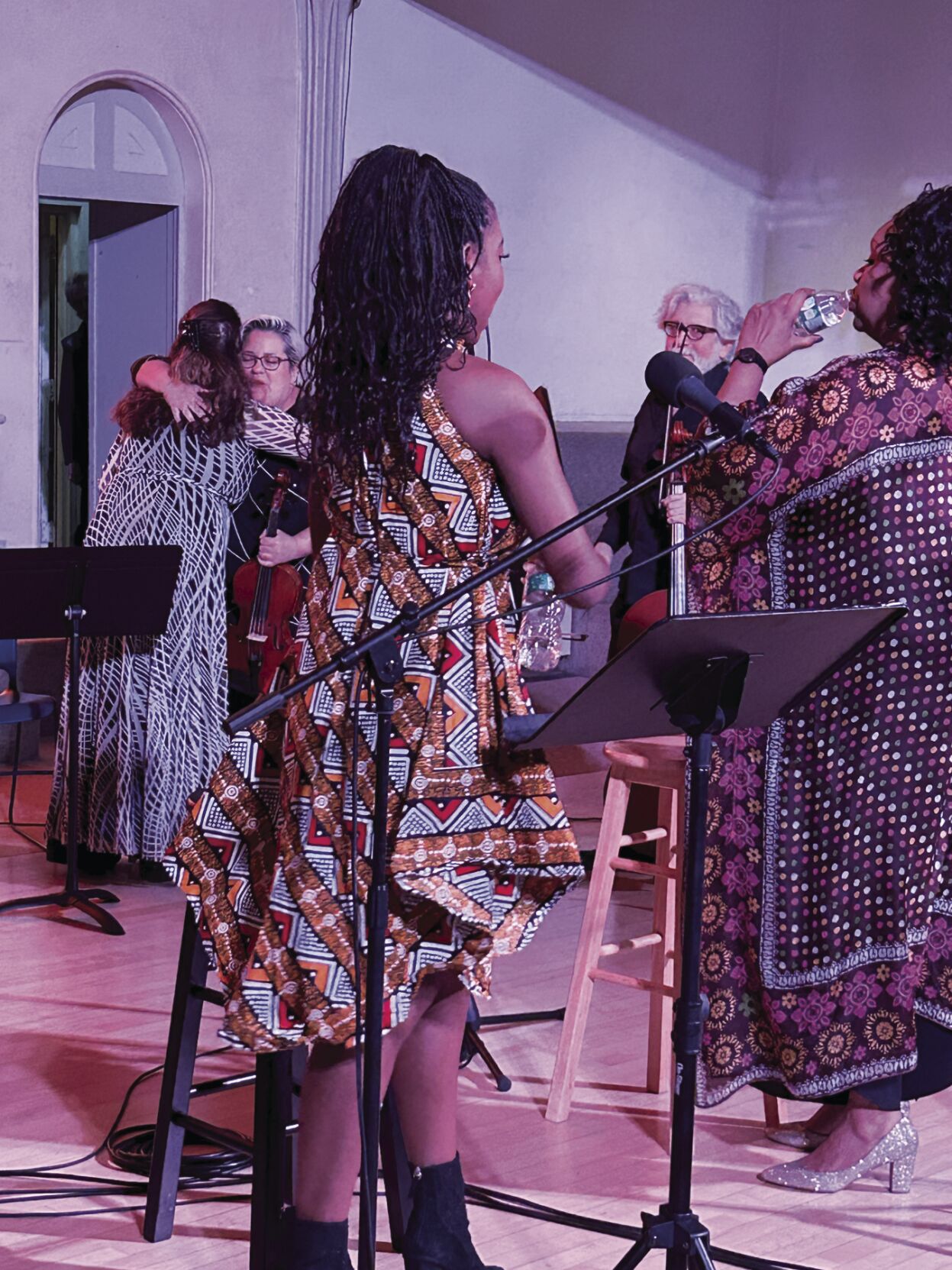
On Monday I attended a concert at St. Mark’s Church in the Bowery in the East Village. The evening, titled “Maya Songs,” a musical tribute to Maya Angelou’s poetry, was dedicated to Dr. King. The program was directed by Jacob Ming-Trent ("The Merry Wives"), and featured Aisha de Haas ("Caroline, or Change") and Meecah ("Hamilton") singing. Ray Leslee ("Avenue X") set Angelou's poetry to music. The singing and the poetry were glorious.
I also watched a documentary about the planning of the historic March on Washington, held on Aug. 28, 1963, where Dr. King delivered his well-known “I Have a Dream” speech. Apparently, it was the gospel singer Mahalia Jackson who was center stage with Dr. King who played a direct role in turning that speech into one of the most memorable and meaningful in American history. As Dr. King was speaking from behind the podium on the steps of the Lincoln Memorial she was heard to say, “Tell them about the dream, Martin.” In the documentary, just at that moment you can notice Dr. King shifting from his prepared notes to improvise the entire next section — the historic section that begins:
“And so even though we face the difficulties of today and tomorrow, I still have a dream. It is a dream deeply rooted in the American dream ...”
I, too, have a dream. I wonder?
•••
Elizabeth Howard is the host of the Short Fuse Podcast, found on Apple Podcasts, Spotify or through the Arts Fuse. She is a journalist, columnist, and communications consultant. Ned O’Gorman: A Glance Back, a book she edited, was published in May 2016. She is the author of A Day with Bonefish Joe (David R. Godine, 2015). Her articles have appeared in publications in the United States and internationally. You can send her a note at: eh@elizabethhoward.com.


(0) comments
Welcome to the discussion.
Log In
Keep it Clean. Please avoid obscene, vulgar, lewd, racist or sexually-oriented language.
PLEASE TURN OFF YOUR CAPS LOCK.
Don't Threaten. Threats of harming another person will not be tolerated.
Be Truthful. Don't knowingly lie about anyone or anything.
Be Nice. No racism, sexism or any sort of -ism that is degrading to another person.
Be Proactive. Use the 'Report' link on each comment to let us know of abusive posts.
Share with Us. We'd love to hear eyewitness accounts, the history behind an article.