


LACONIA — There are companies that have been able to adapt to these pandemic times in order to survive, and then there’s Orion Entrance Control, which was able to produce an item that the market didn’t even know it would be clamoring for.
Orion, a manufacturer of high-tech turnstiles based in the O’Shea Industrial Park, has taken what would have been a year of declining sales into one of significant growth, thanks to a stand-alone product that can read the temperature of a person standing in front of it, then give that person a green light to proceed, or tell them that their temperature is too high.
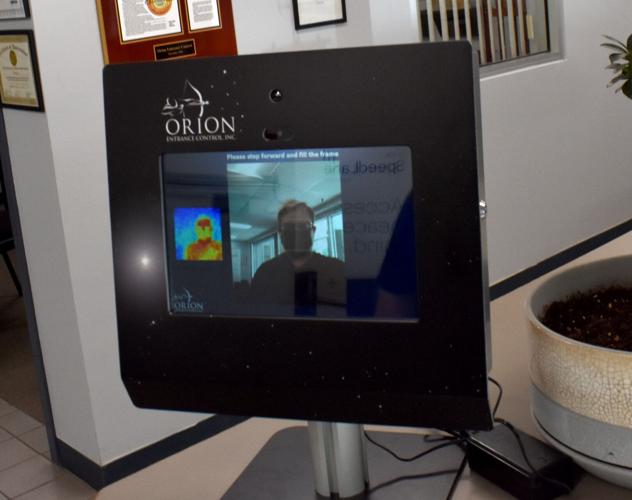
The kiosk, which Orion calls the “Orion Pre-Entry Temperature Reader” or “OPTR-K,” uses an infrared scanner to measure the skin temperature of more than 30 points on a person’s face, then averages the temperatures and compares the result to a predefined parameter, and displays the result to both the person attempting to gain entry and to another screen observed by someone managing entry into the building.
The kiosk replaces a task – taking temperature checks – that is currently being performed manually at health care facilities, offices, and, increasingly, educational places. That not only takes up an employee’s time, but also put that worker in close contact with someone who could be infectious.
“When COVID first hit, the market was flooded with products from China,” said Steve Caroselli, Orion’s founder and president. Some of those products were less expensive than the OPTR-K, but, Caroselli said, they haven’t proven satisfactory in the long run. Orion’s calling card has always been the quality that comes from American-sourced components, and the flexibility and customizability that can be provided by a small manufacturer.
Orion sold its first temperature-reading kiosk to a gym in Laconia a little more than a month ago, then shipped two to California, and has since taken orders for 49 more. Customers include health care and education facilities, as well as corporate headquarters and courthouses.
At $3,900 per unit, the OPTR-K is an attractive option to anyone who is currently paying an employee to take temperatures at the door. Caroselli said the product has enabled his company to rebound in a year that wasn’t looking too good a few months ago, when corporate clients stopped ordering turnstile systems because their buildings were temporarily shuttered.
“It’s a big need, we needed to do something to stay busy, it has worked out really well,” Caroselli said.
Another product Orion is developing might prove similarly successful, especially as society learns to live with contagion. Orion is partnering with another company, which develops low-cost radar systems to produce what Caroselli called the “Constellation Line” of products. These feature a radar device which can be placed behind a ceiling tile and can monitor how many people are in a room, and whether they are appropriately spaced apart. They can also detect heart rate, breathing rate and coughing, which could provide early indications of disease.
Caroselli said he thinks the coronavirus pandemic will have an effect on business practices and the way we think about public spaces – and that effect will last even after a vaccine is widely available for COVID-19.
“I think this is a 3-5 year problem,” he said. Orion’s new products, he said, allow for his clients to continue to progress and grow, even in a time of pandemic.
“We want people to get back to work and feel safe,” he said. “How do we make people feel comfortable being back out in the world? We feel temperature checks are a big part of that.”


(0) comments
Welcome to the discussion.
Log In
Keep it Clean. Please avoid obscene, vulgar, lewd, racist or sexually-oriented language.
PLEASE TURN OFF YOUR CAPS LOCK.
Don't Threaten. Threats of harming another person will not be tolerated.
Be Truthful. Don't knowingly lie about anyone or anything.
Be Nice. No racism, sexism or any sort of -ism that is degrading to another person.
Be Proactive. Use the 'Report' link on each comment to let us know of abusive posts.
Share with Us. We'd love to hear eyewitness accounts, the history behind an article.