



Have you ever dived off your dock and experienced a sudden drop in water temperature as you plunged down? And then as you came back up to the surface, the temperature was more comfortable? What you were experiencing is thermal stratification. This is when the lake “divides” into different layers of density due to differing temperatures. Water density is dependent on its temperature — the warmer the water, the less dense it becomes. Thus, these lake layers change with the seasons and fall turnover is approaching.
The turning over of the lake is an important process that allows for aquatic organisms and the lake ecosystem to thrive. Lake turnover is responsible for replenishing dissolved oxygen levels in the deepest parts of the lake. So, let’s dive in and explore the changes in stratification that Lake Winnipesaukee experiences during the year.
Let’s start with what goes on in Lake Winnipesaukee during the summer. In summertime, the lake is stratified into three different layers. At the beginning of summer, the shallowest of these layers is the warm surface layer known as the epilimnion. The epilimnion has the highest dissolved oxygen concentration since it interacts the most with wind and solar radiation. Dissolved oxygen concentrations don’t play a direct role in driving lake stratification, but are important for aquatic organisms that require oxygen to survive. The deepest layer at the bottom of the lake is called the hypolimnion. The hypolimnion typically remains around 4°C throughout the year, and rarely receives any direct solar energy. It is isolated from the air that interacts with the surface of the lake; thus, it contains the lowest amount of dissolved oxygen.
In between the warm epilimnion and the cold hypolimnion is the transition zone, the metalimnion. The metalimnion is a layer where the cool waters of the hypolimnion gradually warm until they mix into the epilimnion. Within the metalimnion, the zone of greatest temperature, and also density, difference is called the thermocline. Throughout the summer season, wind and wave actions drive the warm water in the epilimnion deeper, gradually bringing hypolimnetic water through the metalimnion. As the summer progresses, the epilimnion layer increases in depth — in some areas of the lake as much as 27 feet. Eventually, the epilimnion warms to the point where there is a large density difference between the epilimnion and the hypolimnion. At this stage, wind and wave action is no longer able to help drive the incorporation of hypolimnetic water into the metalimnion.
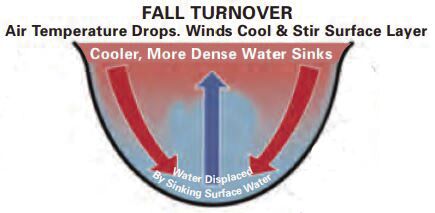
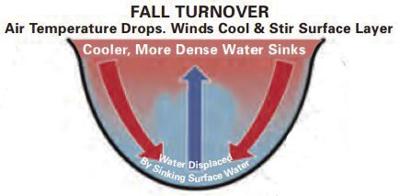
As the summer winds down and cooler fall temperatures arrive, Lake Winnipesaukee’s surface waters will cool and sink, mixing the epilimnion down towards the hypolimnion. The now cooler epilimnion displaces the relatively warmer hypolimnion, essentially turning over the layers. As this happens, the temperatures, and densities, of the epilimnion and hypolimnion become similar, allowing for winds and waves to once again mix the water between these layers. Eventually, the lake becomes isothermal, and the entire lake is the same temperature, allowing for further mixing of the water column.
Lake turnover is a phenomenon in which the entire water column is mixed up. This occurs twice a year in Lake Winnipesaukee, once in the spring, and again in the fall, and is critical to the ecosystem in freshwater lakes. When Winnipesaukee is isothermal, it doesn’t require as much wind action to mix water deeper into the lake. Wind moves the highly oxygenated surface waters towards the lake bottom. This is important for aquatic life, because once the lake freezes over in the winter, oxygen inputs are limited. Therefore, the majority of oxygen in the lake before the freeze must last until the ice melts in the spring, when the lake turns over again.
So, as the season of change approaches, just think that Lake Winnipesaukee is also taking this time to turn over a new leaf as the year begins to wind down.
•••
Jacquelyn Bellefontaine is the conservation outreach manager for the Lake Winnipesaukee Association. She manages communications and outreach initiatives. Jackie can be reached at jbellefontaine@winnipesaukee.org.
The Lake Winnipesaukee Association is a nonprofit dedicated to protecting the water quality and natural resources of the lake and its watershed. To learn more, visit winnipesaukee.org.


(0) comments
Welcome to the discussion.
Log In
Keep it Clean. Please avoid obscene, vulgar, lewd, racist or sexually-oriented language.
PLEASE TURN OFF YOUR CAPS LOCK.
Don't Threaten. Threats of harming another person will not be tolerated.
Be Truthful. Don't knowingly lie about anyone or anything.
Be Nice. No racism, sexism or any sort of -ism that is degrading to another person.
Be Proactive. Use the 'Report' link on each comment to let us know of abusive posts.
Share with Us. We'd love to hear eyewitness accounts, the history behind an article.