


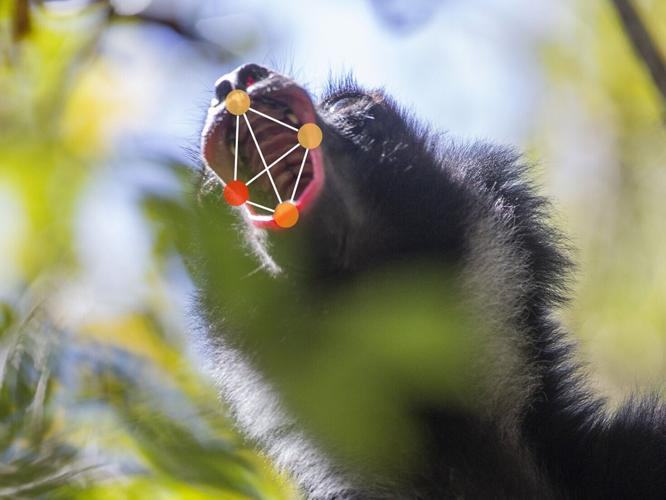
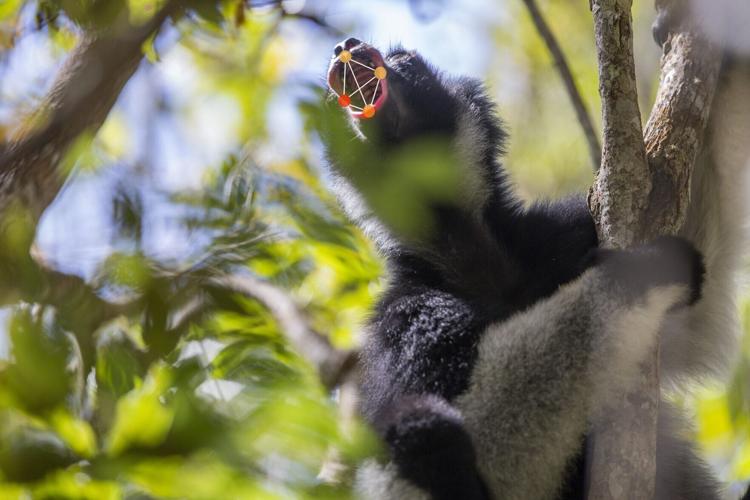
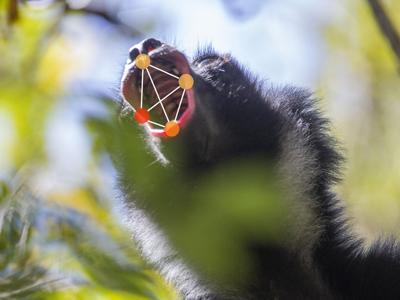

How the points of the mouth are tracked during singing. (Filippo Carugati via SWNS)
By Stephen Beech
The world's only singing lemur uses an opera singer's trick to belt out forest songs.
Researchers found that the wet-nosed primate opens its mouth wider on higher notes — just like a trained soprano.
They discovered that the indri, the world's only known singing lemur, appears to use a strikingly similar vocal technique to leading opera stars to hit the highest notes.
The new study, published in the journal PLOS Computational Biology, shows the first direct evidence that wild indris coordinate their mouth opening with the frequency of their songs.
Found only in the rainforests of Madagascar, indris produce complex, haunting songs that carry across vast distances.
Singing strengthening bonds within their social group and warns neighboring groups to keep their distance, say scientists.
Human singers are trained to widen their mouths as pitch rises, aligning the resonant frequencies of the vocal tract with the harmonics of the voice and amplifying the sound.


The new study suggests that the process, known as formant tuning, may serve a similar purpose for the indri.
For an animal communicating through thick forest, scientists say it could make the difference between a song that carries and one that doesn't.
Study corresponding author Chiara De Gregorio, honorary research fellow at the University of Warwick, said: "Every time the pitch of an indri's song rose, we could see its mouth opening wider, frame by frame.
"It's the kind of fine-tuned coordination between voice and body that we usually associate with trained human singers, not with a lemur singing from the forest canopy."
The research team analyzed 83 video recordings of 19 wild indris, combining field audio with markerless motion-tracking technology.

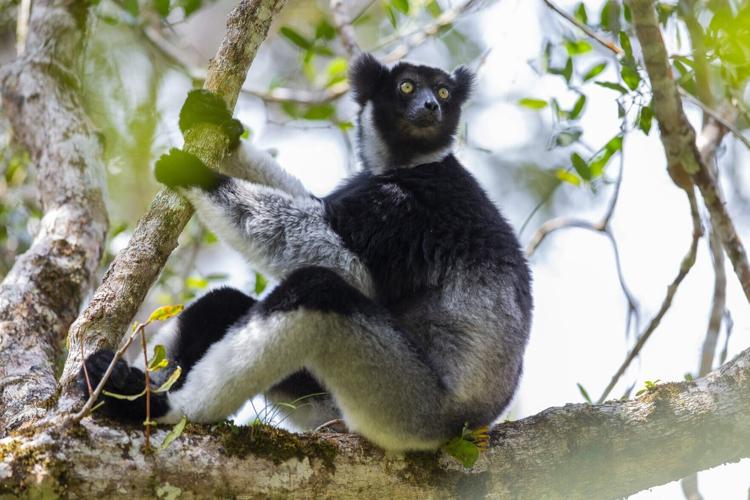
An Indri in the Maromizaha forest. (Filippo Carugati via SWNS)
They tracked upper and lower lip position frame by frame, comparing changes in mouth opening with changes in vocal frequency.
Their findings showed that the indris opened their mouths wider to project higher-pitched vocalization through the forest.
Study first author Filippo Carugati said: "Applying markerless pose estimation to footage recorded in the wild allowed us to look not just at the sounds indris make, but at the physical movements behind them."
Carugati, from the University of Turin in Italy, added: "It let us study how the face and mouth move while an animal is singing, almost frame by frame, and connect those movements directly to changes in pitch.
"That's something you simply can't capture by listening to the audio alone."
He said humans and indris last shared a common ancestor around 74 million years ago, meaning similarities in vocal production between the two species are likely the result of "convergent evolution" — the same solution arrived at independently across deep evolutionary time.


(0) comments
Welcome to the discussion.
Log In
Keep it Clean. Please avoid obscene, vulgar, lewd, racist or sexually-oriented language.
PLEASE TURN OFF YOUR CAPS LOCK.
Don't Threaten. Threats of harming another person will not be tolerated.
Be Truthful. Don't knowingly lie about anyone or anything.
Be Nice. No racism, sexism or any sort of -ism that is degrading to another person.
Be Proactive. Use the 'Report' link on each comment to let us know of abusive posts.
Share with Us. We'd love to hear eyewitness accounts, the history behind an article.