


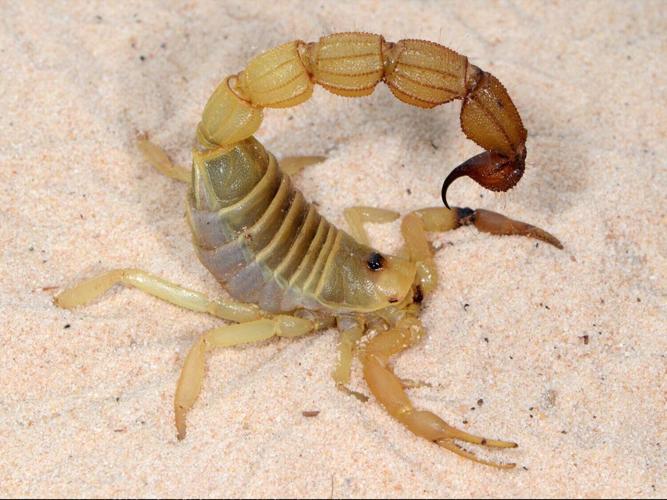
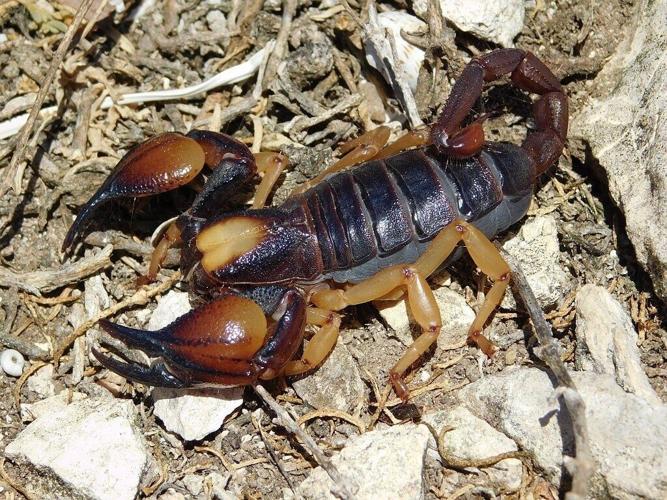
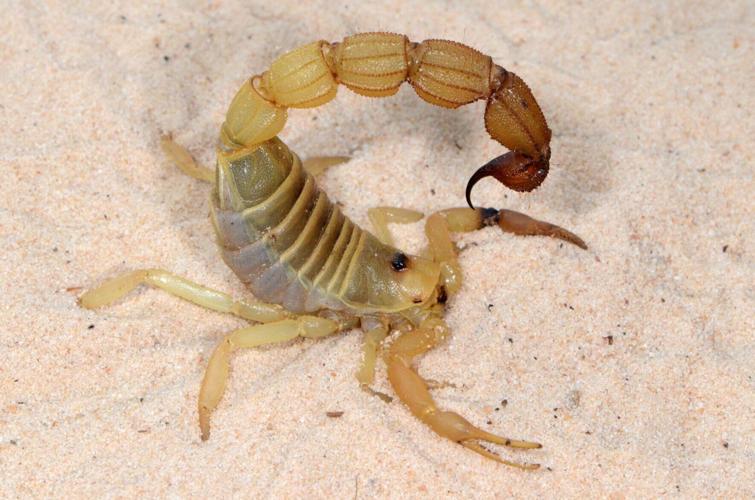
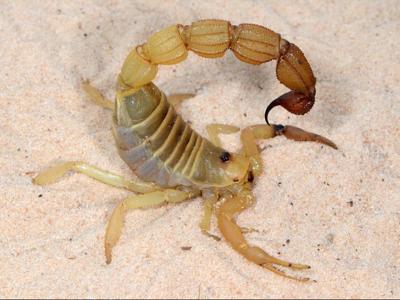

Peninsular Burrowing Scorpion (Opistophthalmus latro). (Paul Bester via SWNS)
By Stephen Beech
Scorpions' fearsome sting and pincers are fortified with metal, reveals new research.
Scientists have uncovered the distribution and scale of metal enrichment among the deadly arthropods' weapons for the first time.
Scorpions wield some of the natural world's most formidable built-in weapons, from crushing pincers to venomous stingers.
It was previously known that the scorpion's sting and pincers contain trace metals that strengthen them.
But only a tiny fraction of the 3,000 scorpion species had ever been examined for the trait.
The new American study, published in the Journal of the Royal Society Interface, dramatically expands that understanding.
Researchers from the Smithsonian's National Museum of Natural History and the Smithsonian's Museum Conservation Institute analyzed 18 scorpion species.
They discovered "striking" patterns in the concentration and distribution of metals.

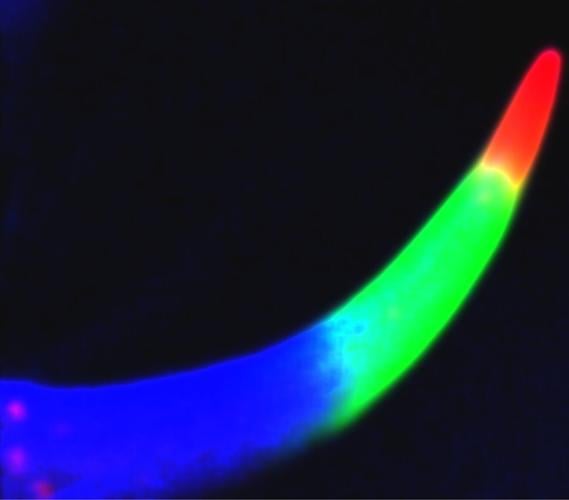
Micro X-ray fluorescence microscopy of the metals present the stinger of a scorpion. (E.P. Vicenzi/Smithsonian Museum Conservation Institute and NIST via SWNS)
Sam Campbell, from the National Museum of Natural History in Washington DC, said: "Scorpions are incredible hunters, and while we knew that metals strengthen the weapons in some species' arsenals, we don't know if all scorpions' weapons contain metal, and if so, whether this metal enrichment relates to how they hunt.
"We decided to use microanalytical techniques to unravel where and how these metals are distributed in the scorpions' weapons to offer a clue as to how and why metal enrichment has been carried through the scorpion family tree."
He explained that scorpions use their pincers and stingers to defend themselves from predators and to subdue their prey.
But, across species, the reliance on each weapon varies widely.
Some scorpions sting only when prey is difficult to subdue, while others use their stinger more aggressively.
Some wield oversized, powerful pincers but relatively small stingers, while others show the reverse.
The research team suspected that the behavioral differences might correspond to how metals are distributed across each weapon.


Using high-resolution electron microscopy and X-ray analysis, scientists at the Museum Conservation Institute identified clear and highly localized patterns of metal enrichment in the scorpion's weapons.
In the stinger, they found that zinc is concentrated at the very tip of the needle-like structure.

Rough thicktail scorpion (Parabuthus raudus). (Paul Bester via SWNS)
Just below that point, manganese becomes the dominant metal, creating a sharp and visually distinct boundary between the two layers.
A similarly specific pattern emerged in the pincers.
In the movable outer segment, known as the tarsus, researchers detected either zinc alone or a combination of zinc and iron.
The metals appeared only along the cutting edge of the pincer, reinforcing the parts that endure the most stress during prey capture.
Study co-author Edward Vicenzi, of the Museum Conservation Institute, said: "The National Museum of Natural History's large scorpion collection allowed us to analyze metal enrichment in a wide range of scorpion species, more than have ever been studied before using these techniques.
"The microscopic-scale methods we used allowed us to identify individual transition metals in extremely high detail, showing us how nature skillfully engineered these metals in the scorpion's weapons."
The research team expected species with stronger crushing pincers to contain higher levels of zinc, but they found the opposite.
Zinc appeared more often in species with longer, slender pincers - structures typically associated with less crushing power and a greater reliance on stinging.

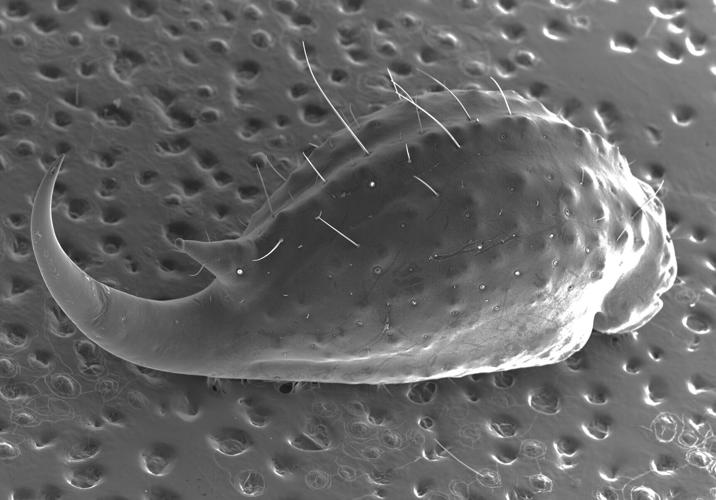
SE micrograph of the entire telson (stinger) of the Tanzanian red bark scorpion (Babycurus Jacksoni). Image includes the telson vesicle, in which the two venom producing glands can be found. Muscles surrounding the glands will contract internally, pushing venom up through conduits to the tip of the telson (termed the aculeus). This species also features a subaculear tubercle (small protrusion above the stinger) with an unknown function. (Sam Campbell / University of Queensland via SWNS)
Campbell, a doctoral candidate, said: "This points to a role for zinc beyond hardness, perhaps playing a bigger role in durability.
"After all, long claws need to grasp prey and prevent it from escaping before being injected by venom.
"This is an interesting finding because it suggests an evolutionary relationship between how a weapon is used and the specific properties of the metal that reinforces it."
This research paves the way for investigating a host of unique scorpion adaptations. By standardizing how scientists measure enrichment, further research could examine metal enrichment in other arthropods, including spiders, wasps, ants and bees, answering questions about how organisms have adapted in response to predators and the need to hunt.
Study senior author Hannah Wood said: "By combining the National Museum of Natural History's deep knowledge of scorpion taxonomy, morphology and behavior, and the Museum Conservation Institute's expertise in microanalysis, we were able to efficiently and drastically expand our understanding of the evolution of metal enrichment in scorpions."
Wood, a research entomologist and curator of arachnids at the National Museum of Natural History, added: "Not only does our work illustrate the material properties of scorpion's weapons, but it establishes a new approach towards analysing the role of metal enrichment across the tree of life."


(0) comments
Welcome to the discussion.
Log In
Keep it Clean. Please avoid obscene, vulgar, lewd, racist or sexually-oriented language.
PLEASE TURN OFF YOUR CAPS LOCK.
Don't Threaten. Threats of harming another person will not be tolerated.
Be Truthful. Don't knowingly lie about anyone or anything.
Be Nice. No racism, sexism or any sort of -ism that is degrading to another person.
Be Proactive. Use the 'Report' link on each comment to let us know of abusive posts.
Share with Us. We'd love to hear eyewitness accounts, the history behind an article.