


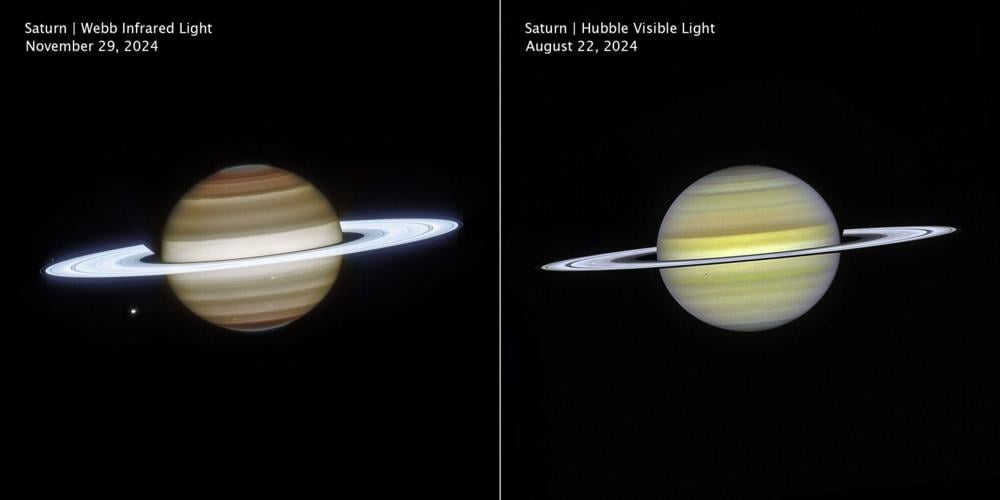

Complementary views of Saturn from NASA’s James Webb Space Telescope and Hubble Space Telescope show a dynamic planet with atmospheric features, orbiting moons, and bright rings. (NASA / ESA / CSA / STScI et al. via SWNS)
By Dean Murray
Space scientists have revealed the most detailed portrait of Saturn ever.
NASA’s James Webb Space Telescope and Hubble Space Telescope have teamed up to capture new views of the planet, revealing it in strikingly different ways.
The space agency said by blending complementary infrared and visibleâlight views, the two space observatories have provided researchers with a richer, more layered understanding of the gas giant’s atmosphere.

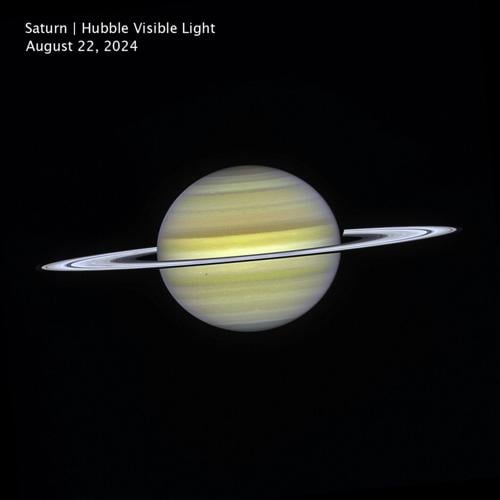
Captured Aug. 22, 2024 by NASA’s Hubble Space Telescope, this visible-light view of Saturn reveals the planet’s softly banded atmosphere and iconic rings. Several moons are also visible, labeled Janus, Mimas, and Epimetheus. (NASA / ESA / CSA / STScI et al. via SWNS)


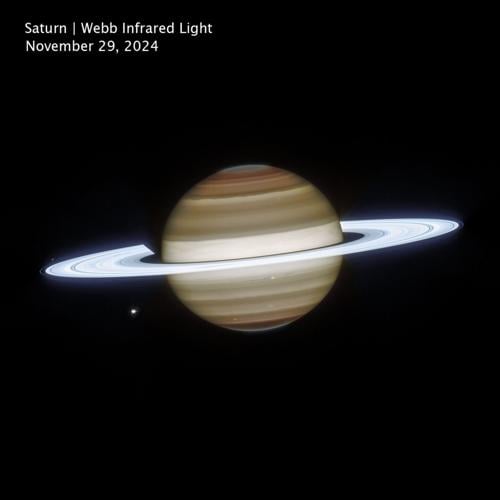
Hubble captured subtle colour variations across Saturn’s cloud bands, while Webb was able to sense clouds and atmospheric chemicals at different depths, from deep cloud layers to the upper atmosphere.
Together they allow scientists to examine Saturn’s atmosphere as a threeâdimensional system, expanding on earlier data collected by NASA’s Cassini orbiter between 1997 and 2017.

Captured Nov. 29, 2024 by NASA’s James Webb Space Telescope, this infrared view of Saturn shows its glowing icy rings and layered atmosphere. Several moons are visible, including Janus, Dione, and Enceladus. (NASA / ESA / CSA / STScI et al. via SWNS)
NASA said: "Hubble’s observations of Saturn for decades have built a record of its evolving atmosphere. Programs like OPAL, with its annual monitoring, are allowing scientists to track storms, banding patterns, and seasonal shifts over time.
"Webb now adds powerful infrared capabilities to this ongoing record, extending what researchers can measure about Saturn’s atmospheric structure and dynamic processes."





(0) comments
Welcome to the discussion.
Log In
Keep it Clean. Please avoid obscene, vulgar, lewd, racist or sexually-oriented language.
PLEASE TURN OFF YOUR CAPS LOCK.
Don't Threaten. Threats of harming another person will not be tolerated.
Be Truthful. Don't knowingly lie about anyone or anything.
Be Nice. No racism, sexism or any sort of -ism that is degrading to another person.
Be Proactive. Use the 'Report' link on each comment to let us know of abusive posts.
Share with Us. We'd love to hear eyewitness accounts, the history behind an article.